The hum of a refrigerator is a comforting sound. It signals stability. It says that the power is on, the food is cold, and the world is functioning exactly as it should. In Tehran, that hum is the baseline of existence for millions of people tucked into concrete apartment blocks that climb the Alborz mountains.
On this particular night, the hum was the only thing Farrah heard before the first boom.
It wasn’t the sharp crack of a firework. It was a low, vibrational thud that traveled through the soles of her feet before it reached her ears. It was the sound of a heavy door slamming shut in a room deep underground. Then came the second. Then the third.
Farrah didn't run for the basement. She went to the window.
This is the human instinct we rarely talk about in the West when we see headlines about "precision strikes" or "strategic escalations." We talk about the hardware. We discuss the F-35s, the long-range ballistic missiles, and the effectiveness of the S-300 surface-to-air defense systems. We map out the geography of Parchin or the outskirts of Karaj. But on the ground, the reality isn't a map. It is a sensory overload.
The Geography of Anxiety
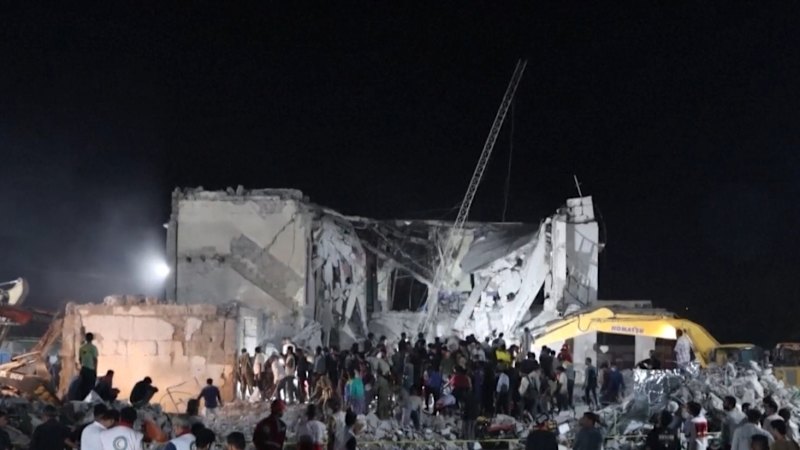
Tehran is a city of shadows and steep hills. When the Israeli Air Force launched its multi-wave assault, targeting military sites across several provinces, they weren't just hitting coordinates. They were piercing the veil of a fragile normalcy.
For months, the residents of the Iranian capital had been living in a state of suspended animation. They watched the news from Gaza. They tracked the skirmishes in Lebanon. They calculated the distance between a "shadow war" and a "hot war." On this night, the distance evaporated.
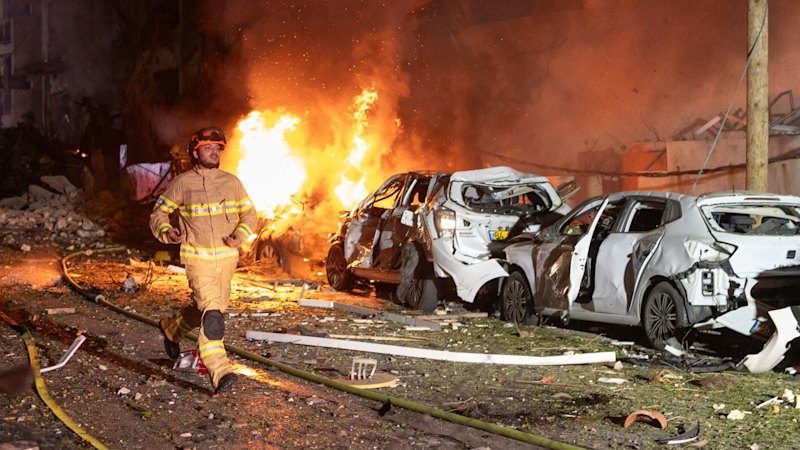
The strikes were targeted. The Israeli military was surgical, focusing on missile manufacturing facilities and air defense arrays. They wanted to decapitate the capability, not the population. But "surgical" is a cold word. It doesn't account for the way the air pressure changes when a warhead finds its mark. It doesn't describe the smell of ozone and burnt rubber that drifts over the highway.
Consider a hypothetical shopkeeper named Reza. He isn't a strategist. He doesn't have a seat at the Supreme National Security Council. He sells tea and dried mulberries. To Reza, the geopolitical "tit-for-tat" between Jerusalem and Tehran isn't a game of chess. It’s a series of questions he can’t answer.
Will the currency collapse by morning? Will the internet be cut? Should I fill the car with petrol now, or wait until the queues stretch for three kilometers?
The "invisible stakes" of these strikes aren't just the destroyed launchers or the crippled radar sites. The real casualty is the psychic floor of a nation. When the sky turns amber from the glow of interceptors, the collective heart rate of ten million people spikes simultaneously. That is a physiological fact.
The Calculus of Silence
Following the initial explosions, a strange silence usually descends. It is the silence of a city holding its breath.
The official reports began to trickle out through state media. They were predictably understated. "Limited damage," they said. "Intercepted threats," they claimed. But the digital world tells a different story. Telegram channels light up with grainy footage shot from balconies. You see the streaks of light—the frantic, searching fingers of anti-aircraft fire—clutching at an invisible enemy in the dark.
The technical reality of the engagement is staggering. We are talking about waves of aircraft traveling over a thousand miles, navigating through the airspace of multiple sovereign nations, and delivering payloads with a margin of error measured in centimeters.
To achieve this, the Israeli jets had to first blind the "eyes" of the Iranian defense. This means hitting the early-warning radars in provinces like Ilam and Khuzestan. It is a methodical stripping of a nation's armor. Imagine someone walking into your home and systematically unscrewing every lightbulb while you stand in the center of the room, unable to see their face. That is the strategic intent.
But why now?
The timing isn't accidental. It follows a massive Iranian ballistic missile barrage weeks prior. This is the new language of the Middle East. It is a dialogue written in fire. Each side is trying to establish a "deterrence," but deterrence is a ghost. The more you chase it with explosives, the further it retreats.
The Human Cost of High-Altitude Strategy
We often hear the phrase "collateral damage" used to describe civilian casualties. On this night, the reported civilian toll was low, a testament to the specificity of the targets. But there is a different kind of collateral damage that doesn't show up on a casualty list.
It is the trauma of the "near miss."
Imagine living two miles from an industrial park that secretly houses a solid-fuel mixing plant for missiles. You don't know it's there. You just know it as the "factory district." Then, at 2:00 AM, that district becomes the focal point of a regional conflict. Your windows rattle in their frames. Your children wake up screaming, not because they are hurt, but because the world has suddenly become loud and unpredictable.
This is the psychological tax of modern warfare. It creates a generation of people who flinch at the sound of a thunderclap.
The complexity of the situation is often buried under slogans. One side claims they are "defending their existence." The other claims they are "resisting imperialism." In the middle sits the actual human being, trying to figure out if they should go to work on Sunday.
The truth is that both sides are trapped in a mathematical loop.
$$D = P \times V$$
If Deterrence ($D$) is the goal, it is calculated by the Power of the strike ($P$) multiplied by the Visibility of the consequences ($V$). If the strike is too small, it isn't a deterrent. If it’s too large, it triggers an all-out war that neither side can truly afford. This night was a masterclass in that precise, terrifying math.
The Morning After
When the sun finally rose over the Alborz mountains, the city looked exactly the same. The taxis were honking. The scent of fresh sangak bread wafted from the bakeries. The mountains were still capped with the first dusting of autumn snow.
But the atmosphere had shifted.
The strikes changed the "red lines." For decades, attacking the Iranian capital was unthinkable. It was the ultimate escalation. Now, it has happened. The "unthinkable" has become a data point. It has been normalized.
This is how regions slide into the abyss—not with one giant leap, but with a series of small, calculated steps that eventually make the impossible feel inevitable.
Farrah, the woman at the window, didn't see the jets. She only saw the flashes. By morning, she was back in her kitchen. The refrigerator was still humming. She made tea. She watched the steam rise from the cup.
She looked at her hands and noticed they were shaking, just a little.
It wasn't because of the bombs. The bombs were over. It was the realization that the hum of the refrigerator was no longer a guarantee of anything. It was just a sound. The stability was an illusion, a thin coat of paint over a house that was caught in a storm.
The world will move on to the next headline. The analysts will argue about the "degradation of Iranian manufacturing capabilities." The politicians will issue statements of "deep concern" or "unwavering support."
But in Tehran, people are looking at the sky differently now. They are looking for the amber glow. They are listening for the slamming door. They are waiting for the math to fail, and for the hum of the city to be replaced by the roar of the inevitable.
The sun shines on the mountains, but the shadows in the valley have grown much longer.