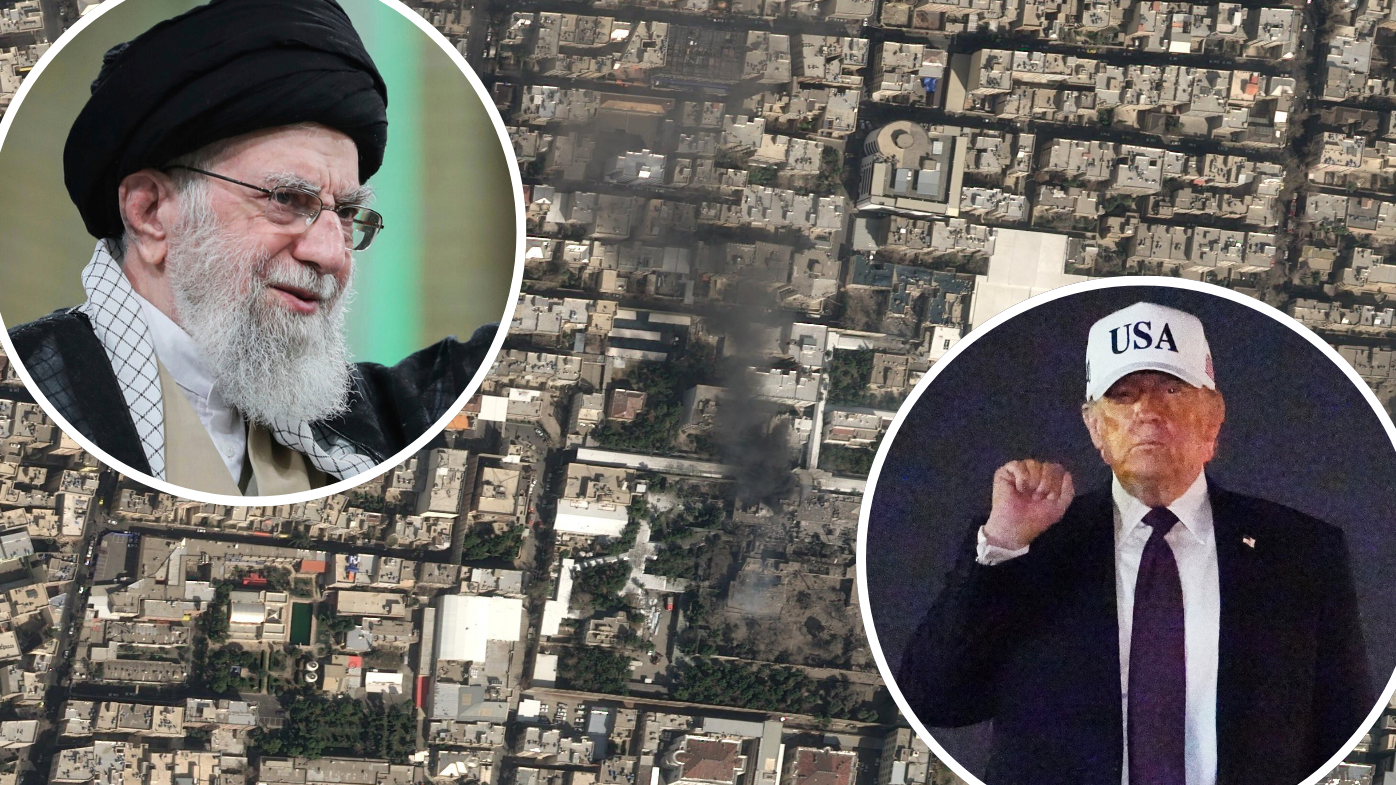
The windowpanes in Tehran do not just rattle when the missiles strike; they hum. It is a low, vibrational frequency that begins in the marrow of your bones before it ever reaches your ears. For the millions of people living beneath that sky, the geopolitical maneuvers of Washington and Jerusalem are not headlines or "strategic recalibrations." They are the sound of a tea glass sliding across a wooden table. They are the sight of a child looking up, wondering if the stars have finally decided to fall.
When the news broke that the United States and Israel had launched coordinated strikes against Iranian military infrastructure, the world's financial markets blinked. Analysts in air-conditioned studios in London and D.C. began moving digital pins across digital maps. But the map is not the territory. The territory is a mother in Isfahan clutching a transistor radio. The territory is a young soldier at a radar station who knows, with a terrifying clarity, that he is currently a data point in a targeting computer halfway across the globe.
The Mechanics of an Escalation
To understand the weight of these attacks, we have to look past the smoke. This wasn't a random outburst. It was a choreographed sequence of violence, a "kinetic dialogue" between nations that have forgotten how to speak any other language.
The strikes targeted specific nodes: drone manufacturing plants, missile silos, and command centers. On paper, it looks surgical. In reality, every "precision strike" sends ripples through the civilian psyche. Consider a hypothetical shopkeeper named Arash. He doesn't own a centrifuge. He doesn't command a militia. Yet, when the $F-35s$—the apex predators of the modern sky—slip past the aging S-300 air defense systems, Arash's entire world shrinks to the size of his basement.
The S-300 is a formidable piece of Soviet-era engineering, but against the sheer electronic warfare capability of a joint US-Israeli operation, it is like trying to catch a ghost with a butterfly net. The technical disparity is staggering. While Iran has invested decades into its "forward defense" via regional proxies, its domestic air space remains vulnerable to the invisible. Stealth isn't just a design feature; it’s a psychological weapon. It tells the target: We are already here, and you didn't even hear us arrive.
The Invisible Stakes
Why now? The answer lies in the shifting sands of regional patience. For years, the "shadow war" stayed in the shadows. Cyberattacks on water systems, the mysterious assassination of scientists, the "unexplained" fires at port facilities. These were the whispers.
But the whispers have become screams.
The United States finds itself in a precarious balancing act. It wants to deter Iranian regional influence without being sucked into another "forever war" that would drain its treasury and its soul. Israel, meanwhile, views the situation through an existential lens. When you live in a country where you can drive from one end to the other in a few hours, a nuclear-capable neighbor isn't a political disagreement. It is a timer.
The logic of the strike was simple: degrade the ability to project power. By hitting the drone factories, the coalition isn't just protecting its own interests; it is cutting off the supply lines that feed conflicts from the Levant to the borders of Europe. Every drone destroyed on a cooling tarmac in Iran is one less drone that can be used to swarm a naval vessel or strike a power grid elsewhere.
The Human Cost of Strategy
We often talk about "deterrence" as if it’s a physical wall. It isn't. Deterrence is a feeling. It is the hope that the other side is more afraid of the consequences than they are hungry for the objective.
But what happens when the fear evaporates?
Inside Iran, the reaction to these strikes is a volatile mix of nationalist fervor and quiet, desperate exhaustion. There is a specific kind of fatigue that comes from living in a state of "perpetual almost-war." The currency devalues. Bread prices climb. The internet flickers out as the government tightens its grip on information. For the average Iranian, the geopolitical chess match feels less like a grand strategy and more like a ceiling that is slowly lowering.
The tragedy of the modern Middle East is that the people with the most to lose are the ones with the least say in the matter. The decision to launch a wave of Tomahawk missiles is made in a room with a mahogany table. The decision to retaliate with a swarm of "suicide" drones is made in a room with a prayer rug. Neither room has a window that looks out onto the streets where people are just trying to get their kids to school.
The Logic of the Unthinkable
There is a mathematical grimness to this. If Iran retaliates, the U.S. and Israel have already signaled they will climb the next rung of the "escalation ladder."
The ladder looks like this:
- Limited Sabotage: Cyberattacks and "accidents."
- Targeted Attrition: Killing key personnel or destroying specific shipments.
- Infrastructure Strikes: Hitting the buildings where the weapons are made.
- Regime Threatening Strikes: Hitting the command-and-control centers of the government itself.
We are currently standing on the third rung. The wood is creaking.
The danger of this specific moment is the "intelligence gap." Each side assumes they know exactly how much pain the other can tolerate before they fold. But history is a graveyard of leaders who miscalculated their enemy's breaking point. When the U.S. provides the intelligence and the mid-air refueling, and Israel provides the pilots and the local tactical data, the message is clear: the alliance is seamless.
But a seamless alliance doesn't guarantee a predictable outcome.
The Ghost in the Machine
We must also talk about the technology that makes this possible, because the technology dictates the morality. We have entered the era of the "unmanned" war. From the perspective of a drone operator in a container in Nevada, or a technician in an underground bunker in Tel Aviv, the war is a series of thermal signatures. A "hot" engine block is a target. A "cold" human body is an abstraction.
This detachment is what allows the escalation to continue. If every strike required a thousand boots on the ground, the political cost would be too high. But when the war is fought with bytes and thermobaric payloads, it becomes easier to justify "just one more strike."
The cost, however, is merely deferred. It is paid in the long-term radicalization of those who watch the sky with hatred. It is paid in the crumbling of international norms. It is paid in the cold reality that we are teaching a new generation that the only way to be heard is to build a louder bomb.
The Fragile Silence
After the sirens stop, there is a silence that is louder than the explosions. It is the silence of a neighborhood waiting to see if there will be a second wave. It is the silence of a diplomat looking at a red phone, wondering if anyone is left on the other end who still believes in the power of a pen.
The U.S.-Israel strikes on Iran weren't just about destroying concrete and steel. They were a test of the world's pulse. They were a gamble that the status quo can be maintained through a show of overwhelming force.
As the sun rises over the Zagros Mountains, the smoke clears, but the air remains heavy. The factories can be rebuilt. The missiles can be replaced. But the sense of safety—that fragile, invisible thread that holds a society together—has been frayed once again.
We watch the news and see the infrared footage of things blowing up. We see the spokespeople in their sharp suits giving their calibrated statements. But if you look closely at the edges of the frame, you see the real story. It’s in the eyes of the people who know that tonight, they will go to bed, and tomorrow, they will wake up in a world that is slightly more broken than the one they left.
The sky in the Middle East is beautiful, vast, and ancient. It has seen empires rise and fall into the dust. It has seen the birth of mathematics and the invention of the wheel. It is a tragedy that today, for so many, the only reason to look up is to see if death is coming on silver wings.