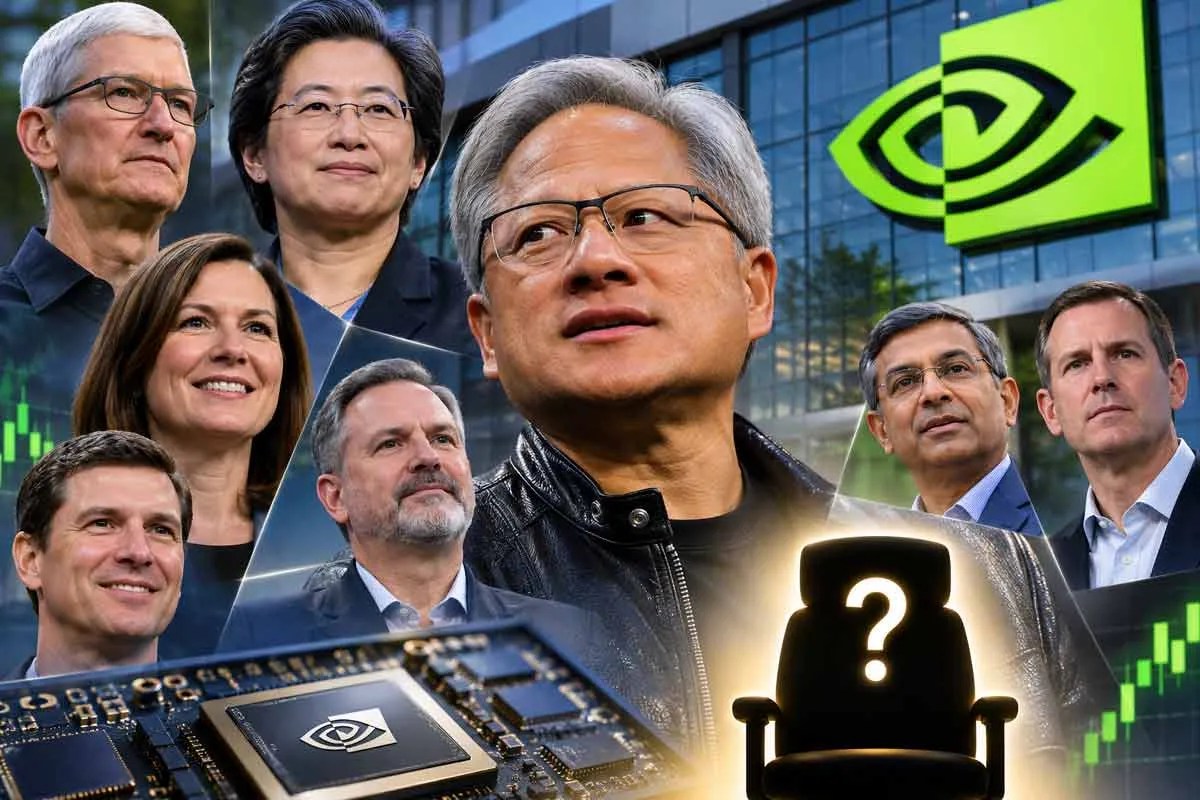
Asking who will replace Jensen Huang after he steps down from Nvidia is the wrong question. Worse, listing names like Tim Cook or Lisa Su turns a hard industrial engineering problem into a celebrity fantasy draft.
It makes for easy clicks. Headlines love a horse race. People love imagining a superstar executive swooping into a trillion-dollar empire, slapping on a leather jacket, and keeping the money printer humming.
That consensus is lazy. It treats Nvidia like a standard corporate relay race where a polished baton pass solves everything. It ignores how Nvidia actually became dominant, why founder-led hardware and software empires rarely survive ordinary CEOs, and what happens inside a company when its chief architect disappears.
I have watched boards bring in marquee executives to "stabilize" complex organizations. I have seen companies blow millions on executive search firms and transition packages only to watch internal engineering velocity stall because the new boss treated a living system like a spreadsheet. Hiring a famous name does not buy you instinct. It buys you press releases.
To understand what a post-Jensen Huang era actually means, you have to strip away the fan fiction about Tim Cook and Lisa Su and look at the real mechanics holding Nvidia together.
Why Tim Cook and Lisa Su Are Fantasy Picks
Put Tim Cook or Lisa Su on a list of big names in tech and readers nod along. Both are accomplished leaders. Neither makes much sense as a successor to Jensen Huang.
Start with Tim Cook. Cook is one of the finest operations and supply-chain minds in modern business history. Apple's ability to coordinate massive global manufacturing, manage component allocation, and execute logistics at scale is legendary. Yet Apple's operating model rests on tight vertical control over consumer hardware, industrial design, and a tightly curated consumer ecosystem. Nvidia sits in a very different position. It sells merchant silicon, networking gear, and software platforms into data centers run by cloud giants that are simultaneously its biggest customers and its most aggressive custom-chip competitors. Supply-chain mastery keeps margins healthy. It does not automatically set the architectural direction for accelerated computing five years out.
Now look at Lisa Su. Su's turnaround at AMD is one of the most impressive execution stories in semiconductors. She took a company that looked cornered, backed the Zen architecture, pushed chiplet designs forward, and rebuilt credibility with hyperscalers and enterprise buyers alike. Her semiconductor credentials are real. Still, leading a rival chipmaker is not a plug-and-play audition to run Nvidia. AMD has historically fought as a challenger pushing open standards and competing across CPUs, GPUs, and data center accelerators. Nvidia built its moat by treating the entire stack—silicon, interconnects, system topology, and CUDA software—as a single co-designed machine. Pulling an executive from a direct competitor also brings immediate questions about cultural fit, organizational loyalties, and whether a rival builder wants to inherit someone else's architecture rather than forge their own.
There is a simpler reason both names miss the mark. Neither one is sitting in line waiting for a call to play second fiddle to a founder's shadow. Speculating about them is entertainment, not succession analysis.
The Founder-Architect Trap
Most coverage treats Jensen Huang as a charismatic frontman who happens to know chip design. That gets the order of operations backward.
Huang is the system architect. A founder-CEO who has shaped a company for decades does not just make high-level capital allocation calls. They carry an integrated mental model of the hardware roadmap, developer tooling, customer bottlenecks, and long-term bets that would look reckless on a quarterly board deck.
When a founder-architect steps aside, the hardest thing to replace is not public charisma. It is institutional memory—the accumulated judgment about which technical bets failed in the lab, which customer complaints signal a real shift versus noise, and where to push engineering resources before the market asks for it.
In semiconductor and infrastructure companies, technical debt and architectural drift compound quietly. If a successor optimizes too hard for short-term predictability, they risk slowing down the exact risk-taking that built the lead. If they try to out-vision the founder on day one, they can fracture teams that trusted the founder's instincts.
Consider a thought experiment. Imagine a scenario where an incoming CEO arrives at a dominant chip company and immediately freezes experimental software initiatives to focus on core hardware gross margins. On paper, that looks disciplined. In practice, if software ecosystems and developer tooling are what lock customers into the platform over multiple product cycles, starving those layers can quietly erode the moat while current-generation sales still look strong.
That is the trap. By the time a succession mistake shows up in quarterly revenue, the underlying engineering choices were made quarters or years earlier.
What "People Also Ask" Gets Wrong About Succession
Whenever a giant company faces leadership questions, search queries pile up around familiar anxieties. Most of them start from a flawed premise.
"Will Nvidia collapse without Jensen Huang?"
Collapse is dramatic and unlikely in the short term. Data center infrastructure runs on multi-year capital expenditure cycles, deep software integration, and massive installed bases. Customers do not rip out entire clusters overnight because a CEO changes titles.
The real risk is subtler than collapse. It is incumbent complacency—gradually shifting from an aggressive, full-stack builder into a defensive cash-cow operator while rivals chip away at specific layers like networking, inference efficiency, or custom ASICs. Empires rarely implode in a single quarter. They lose edge one cautious roadmap decision at a time.
"Should Nvidia hire an outsider or promote from within?"
This binary frames the choice around familiarity versus fresh eyes. Both sides have obvious flaws.
An outside superstar often brings polished governance and Wall Street fluency, yet lacks deep context on internal engineering politics and long-horizon technical trade-offs. An internal lifer knows the plumbing inside out, yet may be too invested in existing product lines to cannibalize them when the market shifts.
The better question is not insider versus outsider. It is whether the leadership structure separates technical direction, commercial execution, and operational discipline clearly enough that no single blind spot takes over the company.
"Does a new CEO automatically mean slower innovation?"
Not automatically, though it often changes how innovation happens. Founders can afford to look stubborn because they own the narrative and the long view. A non-founder CEO faces sharper scrutiny from boards and institutional investors whenever margins dip or R&D spikes without immediate payoff.
If the board demands immediate financial reassurance at the expense of multi-year platform bets, innovation slows down—even if the new CEO talks a big game on earnings calls.
The Real Threat Is Not the Next CEO. It Is Losing Stack Coherence.
Here is the contrarian truth nobody in a horse-race article wants to admit: Nvidia's biggest vulnerability is not who sits in the corner office after Jensen Huang. It is losing full-stack coherence.
Nvidia's advantage has never been just raw transistor count or a single accelerator chip. It has been the tight coupling between GPUs, high-speed interconnects, rack-scale systems, and software frameworks that make complex workloads run cleanly at scale. Rival chips can beat a specific metric on paper. Matching an integrated hardware-and-software ecosystem across thousands of nodes is much harder.
Every major customer—hyperscalers, sovereign cloud projects, enterprise buyers—is trying to reduce single-vendor dependence. They are designing custom silicon, pushing open software alternatives, and negotiating harder on cost and supply.
If a post-Huang leadership team lets the company drift into acting like a conventional component vendor—selling chips while treating software, networking, and system architecture as separate silos—the moat narrows fast. Once a platform becomes "just another set of parts," price pressure and commoditization follow.
I have seen market leaders lose their edge this exact way. They did not get beaten by a genius rival overnight. They got beaten because they forgot what made their product an ecosystem instead of a catalog.
What Smart Operators Should Actually Watch
If you track Nvidia, semiconductors, or enterprise tech strategy, stop refreshing rumor lists of famous CEOs. Watch signals that actually predict durability after a founder transition.
- Watch who controls the roadmap, not just who gives the keynote. Pay attention to the senior engineering and architecture leaders running silicon, systems, and software. If key technical builders exit around a leadership transition, that matters far more than a splashy external hire.
- Track software and developer gravity. Hardware cycles come and go. Developer ecosystems, compilers, libraries, and deployment tools create switching costs. Watch whether platform software stays central or gets treated as a cost center.
- Look at capital allocation during uncomfortable quarters. Anyone can look visionary when demand outstrips supply and margins are fat. The real test of a successor comes when growth normalizes, customers push back on pricing, and tough trade-offs between R&D and buybacks surface.
- Separate succession theater from governance reality. Boards often stage smooth transitions to calm markets. Real readiness shows up in how early a successor is given genuine operational authority and how openly the board debates long-term risks rather than rubber-stamping past playbooks.
The Downside of Being Contrarian Here
Betting against a charismatic founder stepping down—or arguing that famous executives are overhyped in succession debates—carries its own blind spots.
A strong non-founder CEO can sometimes bring sharper organizational discipline, cleaner delegation, and steadier execution to a sprawling company that grew too fast around one person's bandwidth. Founders sometimes hold onto pet projects too long or create bottlenecks because every major call funnels through one brain. A disciplined successor can clear those bottlenecks and scale processes without breaking the core engine.
There is also a timing risk in being early on institutional drift. A company with dominant market share and deep customer lock-in can coast on prior investments for years before the market punishes slower innovation. Calling "erosion" too early looks foolish while stock charts and revenue lines are still climbing.
Still, ignoring structural risks just because current numbers look strong is how smart analysts get blindsided.
Actionable Moves for Builders, Buyers, and Investors
If you are building inside a tech company, buying infrastructure, or allocating capital, do not waste energy guessing celebrity successors. Act on what actually moves leverage.
- If you run a company, build a decision system—not a cult of personality. Document how technical bets get evaluated, push real ownership down to strong lieutenants, and stop relying on one executive's heroics to save sloppy execution.
- If you buy compute or infrastructure, avoid single-vendor lock-in blind spots. Even when one platform leads today, architect workloads with portability and multi-vendor reality in mind so leadership changes or pricing shifts at a supplier do not hold your roadmap hostage.
- If you invest, underwrite the system, not the slogan. Look past name recognition on executive announcements. Examine R&D intensity, ecosystem stickiness, customer concentration, and whether the company still takes bold technical risks when it does not strictly have to.
Names like Tim Cook and Lisa Su make great headlines. Architecture, execution, and stack coherence decide who actually wins.