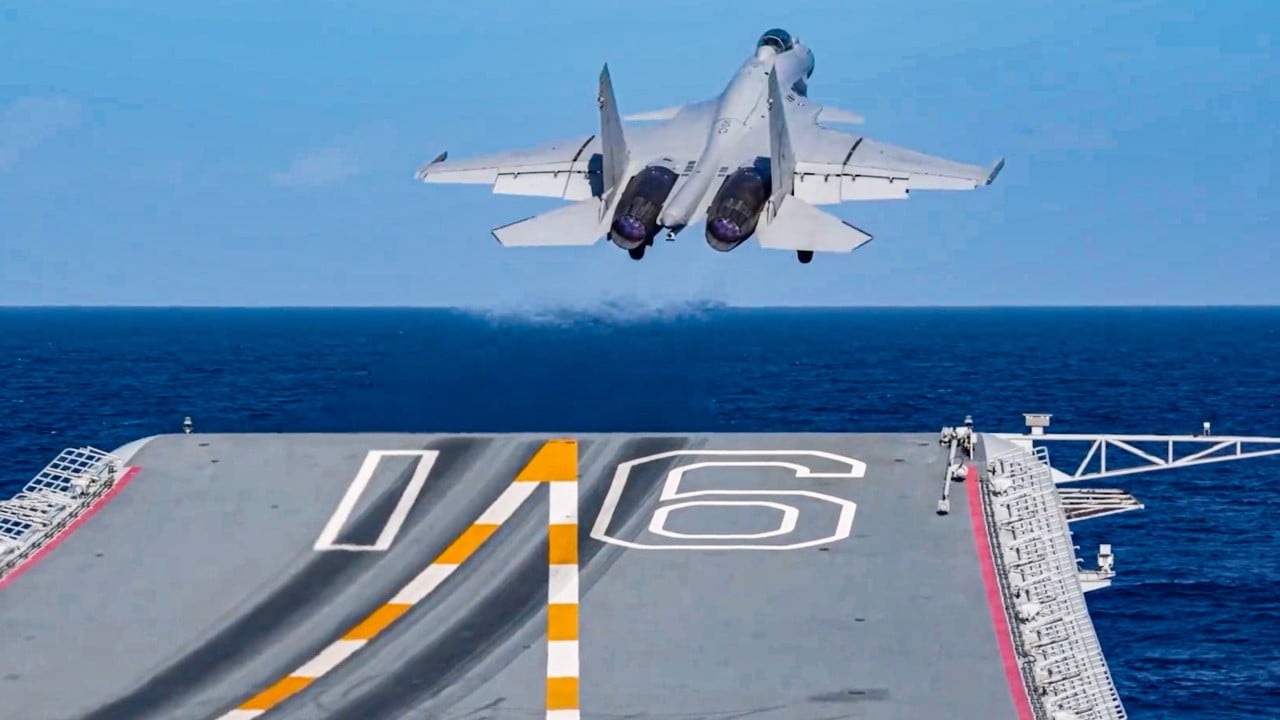
The conclusion of the 40-day deployment of the People’s Liberation Army Navy (PLAN) aircraft carrier Liaoning task group in June 2026 establishes a measurable shift in China’s blue-water operational baseline. Analysts routinely mischaracterize these far-seas training iterations as simple political signaling or basic crew training. Breaking down the parameters of this deployment reveals a systematic stress test of complex naval integrations designed to offset structural hardware limitations and expand the PLAN combat envelope beyond the First Island Chain.
The strategic value of this deployment lies not in the mere presence of a hull in the Western Pacific, but in specific operational variables: cross-class task group synchronization, structural modifications to the carrier air wing, and the extension of combat radii via land-based logistical dependencies.
The Combined Task Force Framework: Carrier and Amphibious Integration
The most significant tactical evolution during the 40-day cruise was the joint exercise conducted between the Liaoning carrier group and a Type 075 amphibious assault ship group, specifically featuring the landing helicopter dock (LHD) Anhui. This combination alters the traditional deployment framework of both asset classes.
[Type 001 Carrier Group] <---> [System-of-Systems Link] <---> [Type 075 LHD Group]
        |                                                             |
   (Air Superiority/EW)                                        (Helo/Amphibious Lift)
        \                                                             /
         \---> [Unified Far-Seas Expeditionary Combat Space] <-------/
Integrating a Short Take-Off Barrier-Arrested Recovery (STOBAR) aircraft carrier with an LHD addresses specific localized vulnerabilities for both groups.
Escort Optimization and Commanded Force Architecture
Operating a dual-component task force requires an extensive defensive screen. The integration combined the carrier's traditional escorts—principally Type 055 guided-missile destroyers and Type 052D destroyers—with the auxiliary defenses of the amphibious group. This structure yields distinct operational efficiencies:
- Sensor Layering: Type 055 destroyers act as the primary air defense commanders for the entire combined formation, utilizing their dual-band active electronically scanned array (AESA) radar suites to manage airspace for both the carrier-based fighters and the amphibious group's rotary assets.
- Ammunition Conservation: By pairing the air superiority capabilities of the carrier’s fighter wing with the localized anti-air missile capacity of the escorts, the task group can optimize its vertical launching system (VLS) loadout, balancing long-range land-attack cruise missiles, anti-ship ballistic missiles, and fleet air defense interceptors.
Expeditionary Strike Capacity
The combination of the Liaoning and the Anhui creates an organic expeditionary strike group capable of simultaneous sea control and power projection. While the carrier establishes localized air superiority and electronic suppression, the Type 075 provides air assault, amphibious landing, and close-in rotary-wing support. This configuration is optimized for scenarios east of Taiwan or within the Philippine Sea, where land-based air cover from the Chinese mainland is operating at its maximum range limit.
Air Wing Modernization: Quantifying the J-15B and J-15D Integration
The deployment validated the operational transition of the Liaoning’s air wing from baseline legacy platforms to advanced 4.5-generation variants: the J-15B air superiority fighter and the J-15D electronic attack aircraft.
The STOBAR Performance Deficit
The Type 001 Liaoning utilizes a ski-jump ramp rather than a catapult system. This design imposes a strict weight penalty on departing aircraft. The physics of ski-jump operations dictate that an aircraft's maximum takeoff weight (MTOW) is directly constrained by the ambient wind-over-deck speed and the thrust-to-weight ratio of the airframe.
$$MTOW = f(Thrust, Speed_{wind}, Angle_{ramp})$$
For the baseline J-15, this meant trading fuel volume for weapon payload, severely shortening its operational combat radius when fully armed.
The J-15B Mitigation Factor
The J-15B addresses this structural bottleneck through structural reinforcement and updated propulsion systems. Featuring WS-10 series engines with higher thrust output compared to legacy Russian AL-31F engines, the J-15B optimizes its takeoff performance from the ski-jump.
The integration of an advanced AESA radar allows the J-15B to utilize long-range active radar homing air-to-air missiles, such as the PL-15. This transforms the carrier's primary asset from a point-defense fighter into an offensive interceptor capable of engaging targets at distances exceeding 200 kilometers, countering Western airborne early warning and maritime patrol aircraft before they can track the task group.
J-15D Electronic Suppression Vectors
Operating alongside the J-15B, the twin-seat J-15D electronic attack variant provides the task group with organic, carrier-borne tactical jamming capabilities. The J-15D features wingtip electronic warfare pods and a fuselage modified to carry heavy electronic suppression equipment, mirroring the role of the U.S. Navy's EA-18G Growler.
In far-seas operations, the J-15D provides a protective umbrella by blinding adversary surface combatant radars, disrupting airborne early warning links, and spoofing incoming anti-ship missile seekers. This reduces the task group’s reliance on land-based electronic warfare platforms and allows the fleet to maintain a lower electromagnetic signature until engagement is initiated.
Land-Based Interoperability: The Aerial Refueling Force Multiplier
A critical aspect of the June 2026 exercises was the coordinated training between carrier-borne fighters and land-based aerial refueling tankers. This interoperability reveals how the PLAN intends to circumvent the inherent endurance limits of its current carrier fleet.
[Mainland Air Bases] ---> [H-6N / YY-20 Tankers]
                                    |
                            (Mid-Air Refuel)
                                    v
[Liaoning Task Group] ---> [J-15B Strike Sorties] ---> [Extended Combat Envelope]
The Range Extension Equation
Because the Liaoning cannot launch heavy land-based or organic carrier-borne turboprop tankers like the U.S. Navy’s planned MQ-25 or standard buddy-refueling configurations without severe payload penalties, it must look to land-based support. The integration of YY-20 and H-6N tankers operating from mainland bases or features in the South China Sea allows J-15B fighters to launch from the ski-jump with a maximum weapons payload and a reduced internal fuel load.
Once airborne, these fighters rendezvous with land-based tankers beyond the First Island Chain, topping off their fuel tanks before proceeding to their operational patrol stations.
| Metric | Baseline STOBAR Operation | Integrated Tanker Operation |
|---|---|---|
| Takeoff Payload Configuration | Low Fuel / High Ordnance or High Fuel / Low Ordnance | Reduced Fuel / Maximum Ordnance |
| Effective Combat Radius | Restricted (~400–600 km) | Extended (~1,100–1,500 km) |
| On-Station Loiter Time | Minimal (<30 minutes) | Substantial (>90 minutes) |
| Dependence Vector | Self-Contained Fleet Asset | Hybrid Sea-Land System-of-Systems |
Operational Vulnerabilities of the Hybrid Refueling Model
This hybrid model introduces a critical single point of failure. The land-based tankers themselves are large, non-stealthy, slow-moving targets that must fly deep into contested airspace to service the carrier air wing. If an adversary successfully intercepts the YY-20 or H-6N assets, the carrier’s airborne fighters lose their return fuel margin, rendering them unable to recover back to the Liaoning or reach alternate land bases. The PLAN is betting that its long-range air defense destroyers and land-based DF-21D and DF-26 anti-ship ballistic missile screens can push adversary capital ships and interceptors far enough away to secure these refueling corridors.
System-of-Systems Reconnaissance and Early Warning Architectures
During the deployment, state media highlighted the implementation of a comprehensive aerial and maritime early warning and reconnaissance system. This addresses a historical blind spot in Chinese naval planning: situational awareness at extended ranges.
The Radar Horizon Bottleneck
A surface ship’s organic radar is limited by the curvature of the earth, restricting its direct detection line-of-sight against low-flying anti-ship cruise missiles to approximately 30 to 40 kilometers. To defend a carrier task group, early warning assets must be elevated to expand the detection horizon.
The Liaoning lacks a fixed-wing airborne early warning (AEW) aircraft like the E-2C/D Hawkeye due to its lack of a catapult launch system. It relies instead on Z-18Y early warning helicopters. These rotary platforms suffer from distinct ceilings and endurance limitations:
- Altitude Constraints: Lower operational ceiling limits the maximum radar line-of-sight compared to fixed-wing aircraft.
- Time on Station: Limited fuel capacity cuts patrolling intervals, requiring a high rotation rate of airframes to maintain continuous coverage.
Distributing the Sensing Layer
To overcome the limitations of the Z-18Y, the PLAN utilized this deployment to test a distributed reconnaissance network. This system integrates multiple data streams via high-frequency, directional tactical data links:
- Space-Based Surveillance: Synthetic aperture radar (SAR) and electro-optical satellites detect and track large adversary surface combatants, feeding initial targeting vectors down to the fleet.
- Land-Based Shore Drones: High-altitude, long-endurance (HALE) unmanned aerial vehicles, such as the WZ-7 and WZ-8, fly missions over the Western Pacific to track adversary fleet movements and provide real-time targeting updates to the Liaoning group.
- Passive Cooperative Engagement: The Type 055 destroyers use their massive radar arrays in passive modes, picking up adversary emissions without exposing their own positions, while sharing a unified tracking picture across the entire task group.
This system-of-systems architecture reduces the probability of a surprise low-altitude cruise missile strike, providing the task group with the reaction time necessary to deploy hard-kill interceptors or execute wide-band electronic spoofing measures.
The Strategic Play: Operational Constraints and the Transition to Fujian
The 40-day deployment of the Liaoning task group must not be viewed as the apex of Chinese naval power, but rather as an bridge to its next generation of force projection. The operational data gathered, tactics refined, and integration frameworks tested during this cruise are directly transferable to the Type 003 carrier, Fujian, which features electromagnetic catapults (EMALS).
The true output of the Liaoning's far-seas iterations is the cultivation of an experienced, carrier-qualified officer corps and the validation of joint-force doctrines. The limitations observed during this deployment—the refueling vulnerabilities, the STOBAR payload penalties, and the reliance on rotary-wing early warning—define the exact operational requirements that the Fujian's catapult-launched air wing, featuring the KJ-600 AEW aircraft and J-35 stealth fighters, is designed to resolve. The PLAN is using its older, modified platforms to master the complex organizational logic of carrier operations today, ensuring that when its supercarrier fleet comes fully online, the institutional framework required to deploy them effectively is already institutionalized.


