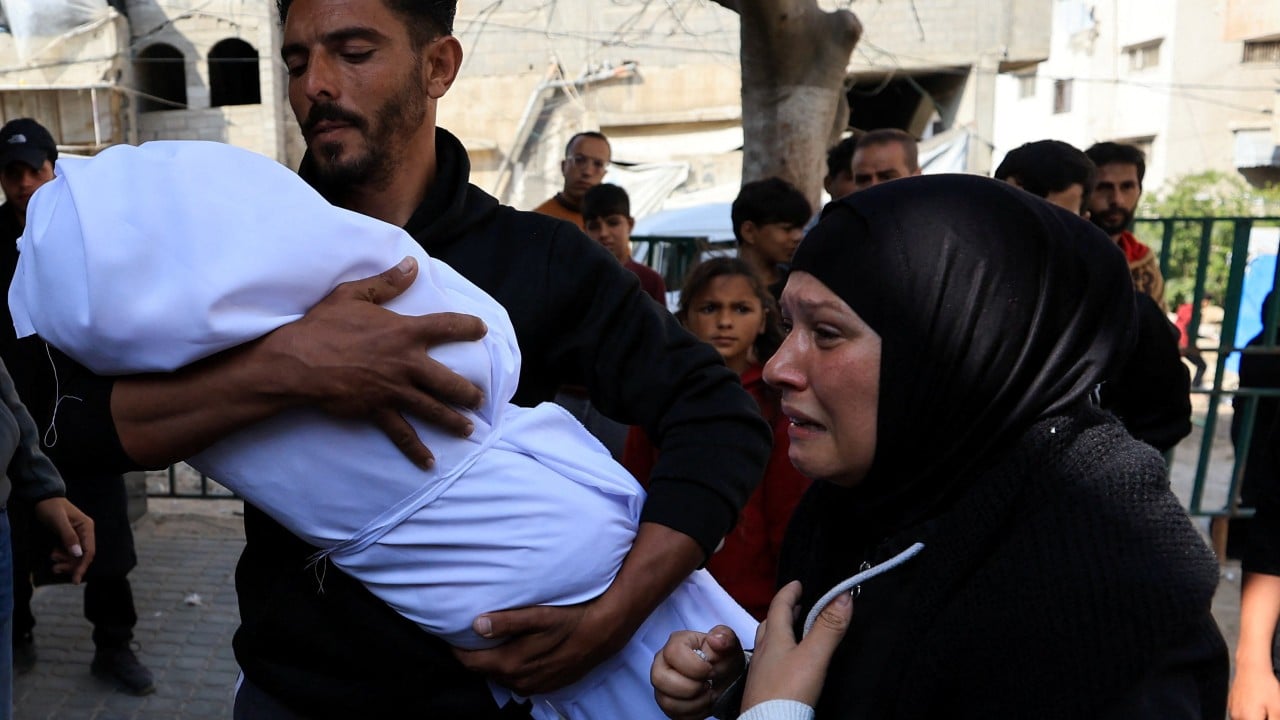
The physical reality of modern asymmetric warfare in high-density urban environments creates a mathematical inevitability of non-combatant casualties that traditional reporting often obscures through emotional narrative. When military operations are conducted within an area possessing a population density exceeding 20,000 people per square kilometer, the margin for error in kinetic targeting effectively collapses. The deaths of a pregnant woman and her children during recent strikes in Gaza are not isolated tragedies but represent the structural outcome of a conflict defined by overlapping civilian and military infrastructure.
The Spatial Constraint Framework
Urban warfare in the Gaza Strip operates under a set of spatial constraints that dictate the lethality of every engagement. These constraints can be categorized into three primary vectors:
- Subterranean Integration: The presence of extensive tunnel networks beneath residential zones creates a vertical stack of military objectives. A strike intended to neutralize a deep-earth asset necessarily compromises the structural integrity of the surface-level housing.
- Blast Radius Overlap: In refugee camps and densely packed neighborhoods, the effective blast radius of standard precision-guided munitions often exceeds the footprint of the intended target building. Shrapnel and pressure waves propagate through narrow alleyways, turning architectural features into secondary projectiles.
- The Proximity Paradox: High-value targets often reside in multi-story residential blocks. The decision to strike involves a calculation where the military utility of neutralizing a target is weighed against the certainty of "collateral damage"—a sanitized term for the biological reality of civilian presence.
The death of a pregnant woman in this context illustrates the failure of "precision" as a safety metric. Precision refers only to the accuracy of the munition hitting its coordinate; it does not account for the biological and social density surrounding that coordinate.
Mechanics of Asymmetric Attrition
The conflict persists through a cycle of asymmetric attrition where the metrics of success for each side are diametrically opposed. For the Israeli Defense Forces (IDF), the objective is the degradation of the adversary's command structure and hardware. For Hamas and associated groups, the objective is the maintenance of operational presence and the leverage of international perception.
This creates a Targeting Friction where the intelligence required to confirm a target is often decoupled from the real-time movement of non-combatants within the target zone. Intelligence cycles (Find, Fix, Track, Target, Engage, Assess) often fail at the "Track" stage in Gaza because the environment is too fluid. A residential building identified as a command node at 10:00 AM may be re-occupied by a family seeking shelter by 10:30 AM.
The Demographic Impact of Kinetic Overreach
Quantifying the impact of these strikes requires looking past the immediate body count to the demographic "echoes" created by the loss of specific cohorts. The death of a pregnant woman represents a dual-loss event: the loss of a primary caregiver and the loss of future population potential.
The structural damage to the Gaza healthcare system complicates these events. When strikes occur, the medical infrastructure is usually operating at a 300% capacity deficit. The inability to provide emergency obstetric care or neonatal support in the aftermath of a blast ensures that injuries which would be survivable in a stable environment become fatal. This is the Systemic Lethality Multiplier. The bomb does not need to kill the individual instantly; it only needs to destroy the path to the hospital or the hospital’s ability to function.
Logistical Failures in Civilian Protection
International humanitarian law requires "effective advance warning" of attacks that may affect the civilian population. However, the operational reality of "roof-knocking" or phone alerts is plagued by three distinct failure points:
- Information Asymmetry: Civilians often lack the means to receive digital warnings due to power outages or telecommunications blackouts.
- The Exit Bottleneck: In high-density blocks, the time required to evacuate elderly, children, and pregnant women exceeds the warning window provided (often 5 to 15 minutes).
- The Safe Zone Fallacy: As the conflict progresses, the definition of a "safe zone" becomes purely theoretical. When displaced populations are funneled into smaller and smaller sectors, the density increases, which in turn increases the casualty rate of any subsequent strike in that "safe" area.
The Economic and Psychological Debt
The burial of family members in Gaza is not merely a ritual of grief but an indicator of the total collapse of civil order. Every burial in a non-traditional cemetery or a mass grave signifies the exhaustion of the city's logistical capacity.
The psychological debt incurred by the surviving children creates a feedback loop of radicalization. This is the Long-Term Strategic Deficit. While a strike may achieve a short-term tactical goal (killing a commander), it simultaneously generates a new cohort of individuals with zero stake in a peaceful settlement. The removal of the maternal unit from a family structure in a patriarchal, traditional society like Gaza's often leads to the total atomization of the surviving children, making them more susceptible to recruitment by armed factions.
Intelligence Gaps and the "Fog of Urban War"
The reliance on signals intelligence (SIGINT) and human intelligence (HUMINT) in Gaza is flawed by the sheer volume of noise. In a high-stress environment, intelligence sources are often compromised or motivated by local feuds. If a strike is based on faulty intelligence regarding the presence of a military asset, the resulting civilian deaths are not just "unfortunate"—they represent a total failure of the strategic objective.
The IDF’s use of AI-driven targeting systems, such as those reported to be used in recent years, introduces a new variable: Algorithmic Distance. By automating target identification, the human element of "proportionality" is shifted further up the chain of command, potentially desensitizing operators to the ground-level reality of a pregnant woman living in the apartment below a suspected insurgent.
The Geopolitical Calculation of Loss
The deaths of non-combatants serve as the primary currency in the international diplomatic arena. For the Palestinian leadership, these casualties provide the moral leverage necessary to bypass traditional military weakness. For the Israeli government, the mounting civilian toll creates a "clock" of international pressure that limits the duration of their operations.
The strategic play for any actor observing this conflict is to recognize that the urban density of Gaza has turned the traditional laws of war into a series of impossible choices. There is no version of high-intensity conflict in Gaza that does not result in the deaths of children and pregnant women. The geography forbids it.
The immediate strategic necessity is the decoupling of humanitarian corridors from active combat zones through a "Zero-Conflict Sectoring" approach. This requires an external, neutral logistical force to manage "Green Zones" that are physically separated from military-integrated infrastructure. Without this spatial separation, the kinetic attrition of the civilian population will continue as a mathematical certainty, regardless of the precision of the munitions employed. The conflict has reached a stage where tactical successes are being entirely negated by the strategic cost of civilian loss, creating a permanent state of diminishing returns for the occupying force and a permanent state of trauma for the occupied.