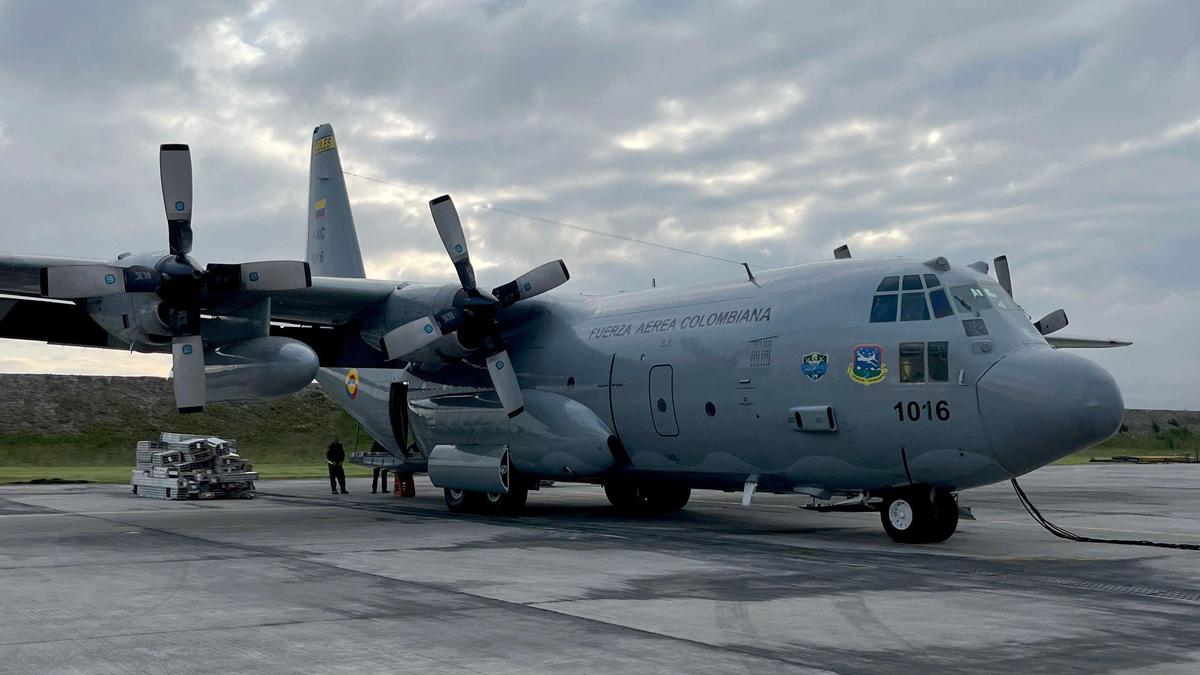
The crash of a Colombian military transport aircraft carrying 125 personnel establishes a critical case study in aviation risk management, specifically regarding the intersection of high-occupancy tactical flights and topographical constraints. Initial reports confirming 48 rescues indicate a high-impact but partially survivable event, suggesting a controlled flight into terrain (CFIT) or a mechanical degradation that allowed for a forced landing attempt rather than a catastrophic mid-air disintegration. Understanding this event requires a departure from emotional reporting and an entry into the physics of structural integrity, the logistics of mass casualty extraction, and the specific failure points of military logistics in mountainous corridors.
The Kinematics of Survivability in High-Occupancy Crashes
In aviation accidents involving high passenger counts, survivability is rarely a matter of luck. It is a function of the Energy Management Equation. When an aircraft impacts the ground, the kinetic energy ($E_k = \frac{1}{2}mv^2$) must be dissipated. If the fuselage remains intact, it acts as a decelerator, protecting the occupants. The fact that 48 individuals survived suggests the aircraft did not enter a vertical dive, which would have resulted in an instantaneous energy transfer exceeding human physiological limits.
Survival in this context is dictated by three technical variables:
- Impact Angle: A shallow angle allows the aircraft to slide, lengthening the duration of deceleration and lowering the G-forces exerted on the human spine.
- Terrain Composition: Soft soil or dense canopy can act as an ablative buffer, absorbing energy that would otherwise be transferred to the airframe.
- Post-Impact Fire Suppression: The primary killer in survivable impacts is not the trauma, but the inhalation of toxic fumes from burning jet fuel (Jet A-1) and hydraulic fluids.
The rescue of 48 people implies that the "creatable space" within the fuselage—the volume of the cabin that remains uncrushed—was maintained in at least 40% of the aircraft's longitudinal axis. This points toward a tail-first or flat-belly impact profile rather than a nose-down high-velocity strike.
The Topographical Bottleneck: Andean Flight Dynamics
Colombia’s geography presents some of the most hostile flight environments in the world. The Andean cordilleras create "micro-climates" where pressure altitudes shift rapidly, affecting engine performance and lift. Military transport aircraft, often operating near their Maximum Takeoff Weight (MTOW) when carrying 125 personnel, have narrow margins for error in these conditions.
Density Altitude and Engine Performance
As altitude increases or temperature rises, air becomes less dense. This reduces the mass of air flowing over the wings (decreasing lift) and the mass of air entering the engines (decreasing thrust). A military transport plane fully loaded with 125 people is likely operating at the edge of its performance envelope. If such an aircraft encounters a "downdraft" or "mountain wave"—a common phenomenon in the Colombian highlands—the engines may lack the instantaneous thrust required to "climb out" of the sinking air mass.
The Turn Radius Trap
In mountainous terrain, pilots often find themselves in "blind" valleys. If the aircraft’s climb rate is lower than the slope of the terrain, the only option is a 180-degree turn. However, the radius of a turn increases with the square of the speed ($R = \frac{v^2}{g \tan \theta}$). In a heavy transport, this radius might exceed the width of the valley, leading to a "controlled flight into terrain" where the pilot is flying a perfectly functional aircraft but has run out of navigable airspace.
Mechanical Failure vs. Pilot Oversight
While structural or engine failure is always a candidate in military aviation due to high cycle counts and rugged operating environments, the presence of 125 people suggests a logistics mission that may have bypassed standard safety buffers. We must categorize the potential failure points into a Tiered Fault Hierarchy:
- Primary Tier (Mechanical): Uncontained engine failure, loss of hydraulic pressure to control surfaces, or catastrophic structural fatigue. In older transport models, metal fatigue in the wing spar or tail section is a known systemic risk.
- Secondary Tier (Environmental): Sudden onset of "clear air turbulence" or severe icing at high altitudes, which can stall the wings before the pilot can react.
- Tertiary Tier (Operational): Overloading or improper Weight and Balance (W&B) configuration. If the center of gravity (CG) shifts too far aft during flight—perhaps due to passengers moving or cargo shifting—the aircraft becomes pitch-unstable and can enter an unrecoverable stall.
The rescue of 48 survivors suggests the pilots maintained some degree of authority over the aircraft until the moment of impact. A total mechanical failure, such as the loss of both engines or the entire tail assembly, typically results in a zero-percent survival rate.
The Logistics of the Golden Hour
In mass-casualty aviation events, the "Golden Hour" refers to the sixty-minute window following the trauma where medical intervention is most likely to prevent death. The Colombian military’s ability to rescue 48 people indicates a rapid activation of the Search and Rescue (SAR) Chain.
The efficiency of this chain depends on:
- ELT Accuracy: The Emergency Locator Transmitter must survive the impact to broadcast the precise coordinates via satellite (Cospas-Sarsat system).
- Asset Proximity: The availability of winch-capable helicopters is the bottleneck. In dense Colombian jungles or steep mountains, landing a rescue craft is often impossible; survivors must be hoisted individually, a process that takes 5-10 minutes per person.
- Triage Prioritization: With 125 potential victims and only 48 initial rescues, the medical teams are forced to apply "black tag" logic—focusing resources on those with the highest probability of survival while bypassing those with non-survivable injuries.
The delta between the 125 aboard and the 48 rescued leaves 77 individuals unaccounted for or deceased. This 61% fatality rate is consistent with a "high-energy survivable" crash, where the front of the aircraft (the cockpit and forward cabin) typically absorbs the brunt of the kinetic energy, often resulting in higher mortality for the crew and forward passengers, while those in the aft sections have higher survival rates.
Structural Vulnerabilities in Military Transports
Military transport aircraft are designed for durability, not necessarily for passenger comfort or impact cushioning. Unlike commercial airliners, which have "crush zones" beneath the passenger floor, many military cargo planes have reinforced floors to support heavy vehicles. This rigidity is a double-edged sword:
- The Strength Benefit: It prevents the aircraft from snapping in half during a hard landing.
- The Deceleration Penalty: Because the floor does not deform, the energy of the impact is transferred directly into the seats and the occupants' skeletal structures, leading to internal organ damage and spinal fractures even if the cabin remains intact.
Furthermore, military seating is often "sideways" (paratrooper style) or consists of nylon webbing. These seats provide significantly less neck and torso support than forward-facing, high-back commercial seats. In a sudden deceleration, the lateral forces on a passenger in a webbing seat are catastrophic, which may account for why only a fraction of the 125 aboard survived the initial impact.
Systemic Implications for Latin American Military Aviation
This incident exposes a recurring vulnerability in regional military operations: the reliance on aging fleets for high-capacity personnel movements. The maintenance of high-cycle airframes requires a rigorous non-destructive testing (NDT) regimen to detect microscopic cracks in the aluminum skin.
A "maintenance-induced" failure is a significant possibility. If a pressurized cabin suffers a "rapid decompression" due to a failure in a door seal or a fatigue crack, the pilots may lose consciousness or control before they can descend to breathable air. However, the survival of 48 people contradicts a high-altitude decompression event, which would likely lead to a high-speed, unsurvivable impact.
The focus must now shift to the Flight Data Recorder (FDR) and Cockpit Voice Recorder (CVR). These "black boxes" will reveal the critical five-minute window before the impact. Specifically, investigators will look for:
- V-speed deviations: Did the aircraft lose airspeed unexpectedly?
- Engine EGT (Exhaust Gas Temperature): Did the engines flame out or overheat?
- Control Input Corridors: Were the pilots fighting a "trim runaway" or a "heavy" wing?
Strategic Response Requirements
The immediate priority for the Colombian Ministry of Defense is not just recovery, but a comprehensive "fleet grounding" or safety stand-down for similar airframes. The loss of 77 personnel in a single event represents a significant degradation of human capital and tactical capability.
Future missions of this scale must be decomposed into smaller, multi-aircraft sorties to distribute risk. Carrying 125 personnel on a single airframe in high-risk terrain creates a "single point of failure" that is unacceptable under modern risk-mitigation frameworks.
The investigation must move beyond "pilot error" as a convenient catch-all. It must analyze the organizational fatigue of the unit, the meteorological intelligence provided to the crew, and the structural integrity of an airframe tasked with operating at its absolute limit. The survivors provide the data; the wreckage provides the evidence; the flight path provides the motive. Only by synthesizing these three can the systemic flaw be isolated and corrected.