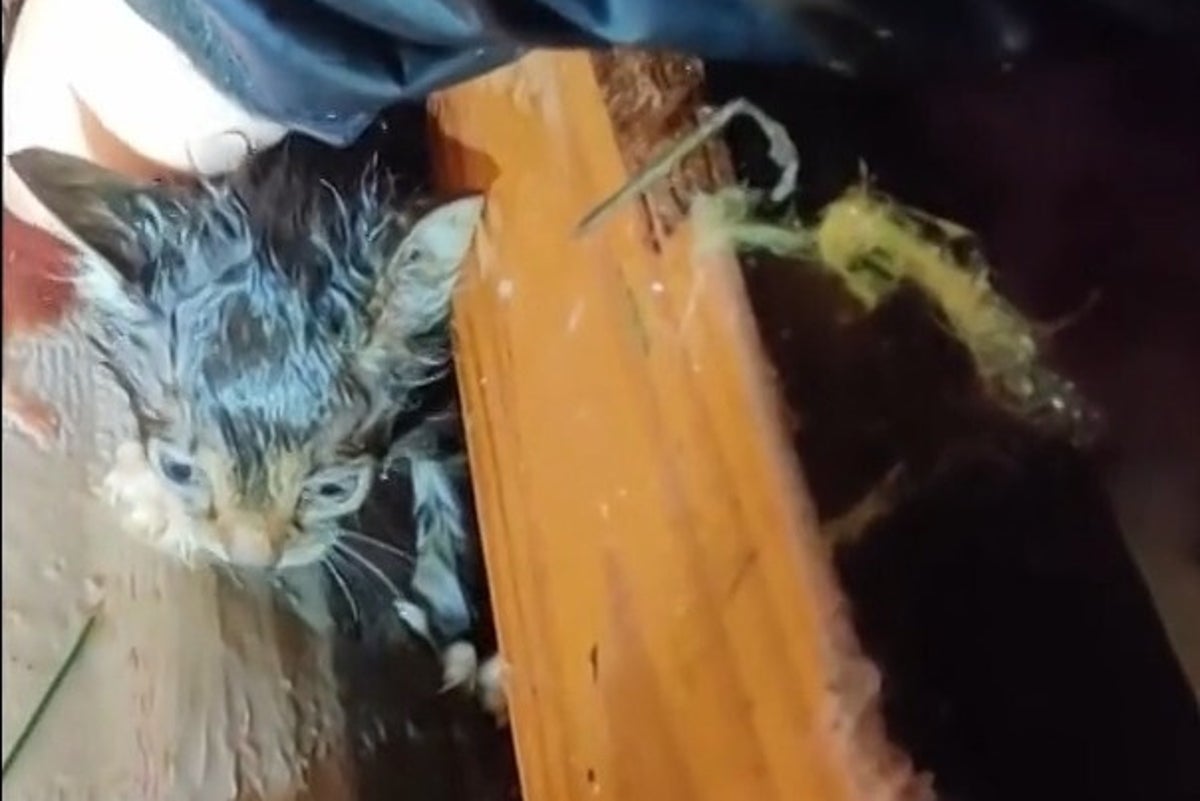
The survival of biological assets following a tornadic event is not a matter of chance but a function of structural failure patterns and the immediate deployment of thermal and acoustic search protocols. While media narratives focus on the emotional relief of animal rescue, the mechanical reality involves a race against the "Golden Hour" of trauma—a period where the probability of survival for trapped organisms drops precipitously due to dehydration, internal hemorrhaging, or environmental exposure. In the Mississippi trailer park incident, the successful recovery of a kitten from debris represents a case study in the intersection of independent storm chasing logistics and impromptu urban search and rescue (USAR) tactics.
The Structural Vulnerability of Manufactured Housing
The primary variable in the destruction of the Mississippi site is the inherent design limitation of manufactured homes. Unlike site-built structures anchored to deep foundations, trailers often rely on steel chassis and tie-down systems that fail under the extreme uplift and lateral pressures of an EF-2 or higher tornado.
- Fragmentation Density: When a trailer undergoes catastrophic failure, it produces a high density of lightweight, sharp-edged debris (aluminum siding, plywood, insulation). This creates a "micro-void" environment.
- The Void Space Theory: In traditional masonry, voids are created by leaning walls (lean-to voids) or pancaked floors. In a trailer park, voids are smaller and more erratic, formed by the crumpling of thin-gauge metal around dense objects like appliances or furniture.
- Thermal Retention: These small voids can trap heat, which is a double-edged sword. It prevents immediate hypothermia but accelerates dehydration in small mammals with high metabolic rates.
The rescuer’s success depended on identifying a specific micro-void within a pile of non-structural debris. This requires a systematic deconstruction of the rubble pile rather than indiscriminate clearing, which can cause "secondary collapses"—shifting the debris and crushing any survivors trapped beneath.
The Storm Chaser as an Ad Hoc First Responder
The presence of storm chasers on-site immediately after a strike creates a unique logistical bridge. While municipal emergency services (EMS) often face delays due to blocked arterial roads and downed power lines, storm chasers are already positioned within the "hot zone." Their role shifts from data acquisition to casualty assessment through three distinct phases.
Phase 1: Rapid Surface Search
This involves a visual sweep for mobile survivors and a "call-and-listen" protocol. In this specific case, the auditory signal (meowing) served as the primary search tool. Sound waves in a debris field are heavily attenuated by fiberglass insulation and acoustic ceiling tiles. The ability to isolate high-frequency distress signals from the ambient noise of a storm’s aftermath—leaking gas, rushing water, and wind—is a critical skill.
Phase 2: Manual Extraction and Debris Management
Once a signal is localized, the rescuer enters the extraction phase. The Mississippi rescue highlights a common bottleneck: the lack of specialized heavy lifting equipment. Rescuers must rely on "lever and crib" techniques or manual clearing. The risk here is significant; the removal of a single piece of plywood can destabilize a larger stack.
Phase 3: Immediate Field Stabilization
A rescued animal or human often suffers from "Crush Syndrome." When a limb is pinned for a prolonged period, toxins build up in the muscle tissue. Once the pressure is released, these toxins enter the bloodstream, potentially causing kidney failure or cardiac arrest. While a kitten's low body mass mitigates some of these risks compared to a human, the physiological shock remains a primary threat.
Logistics of the "Search Grid" in Mobile Home Communities
Effective search operations in a trailer park are hindered by a lack of recognizable landmarks. When a tornado "scours" a lot, it removes street signs and house numbers.
- Grid Establishment: Rescuers must use GPS coordinates or physical markers (spray paint) to track which debris piles have been cleared. Without this, efforts are duplicated, wasting the limited energy of the responders.
- Acoustic Silence Periods: Professional USAR teams mandate five minutes of total silence every hour to listen for faint cries. Independent chasers rarely follow this, but the Mississippi event proves the efficacy of "stop-and-listen" intervals in locating low-decibel survivors.
- Hazard Identification: The "debris" is not just wood and metal. It is a hazardous material environment containing ruptured propane tanks, jagged glass, and "hot" electrical lines. The rescuer in this scenario operated in a high-risk environment where a single spark from moving metal could ignite gas pockets trapped in the voids.
The Probability of Survival by Species and Mass
The survival of a "tiny kitten" where humans may have perished or been severely injured is explained by the physics of mass and surface area.
- The Square-Cube Law: As an object scales down, its surface area decreases by the square, but its volume (and mass) decreases by the cube. A kitten has a very low mass-to-strength ratio.
- Terminal Velocity and Impact: If a kitten is lofted by wind, its lower terminal velocity reduces the force of impact upon landing. Furthermore, their flexible skeletal structures allow for greater energy absorption during blunt-force trauma compared to the rigid bone structures of adults.
- Resource Depletion: However, the kitten’s high surface-area-to-volume ratio means it loses body heat faster and requires more frequent hydration. The window for rescue is estimated to be 48–72 hours shorter than that of an adult human.
Technical Deficiencies in Ad Hoc Rescues
While the Mississippi rescue was successful, it exposes a critical lack of standardized equipment among independent storm chasers who transition into rescue roles. Most carry cameras and meteorological sensors but lack the "Essential Three" of search:
- Acoustic Sensors: High-sensitivity microphones to detect movement deep within rubble.
- Endoscopic Cameras: Small-diameter fiber-optic cameras to peer into voids without disturbing the pile.
- Basic Triage Kits: Thermal blankets and subcutaneous fluids to treat shock and dehydration on-site.
The reliance on manual digging—as seen in the "digs through rubble" description—is inefficient. It maximizes physical exhaustion for the rescuer and increases the time-to-recovery for the victim.
Integrated Strategy for Post-Storm Bio-Asset Recovery
To maximize survival rates in future Mississippi Valley events, the transition from "chaser" to "rescuer" must be formalized through a tiered response framework.
The first move for any independent responder is the Immediate Zero-Point Assessment. This involves identifying the "path of highest probability"—areas where structural debris has stacked against heavy stationary objects (trees, engine blocks, or concrete pads). These are the most likely locations for viable voids.
The second move is Passive Data Collection. Rescuers should utilize thermal imaging drones (now widely available) before entering a debris field. A thermal signature from a kitten or human will stand out against the cooling thermal profile of wet debris, even under several inches of material. This eliminates the "blind dig" and targets extraction efforts precisely.
The third move is Communication Synchronization. Individual rescuers often work in silos. Establishing a shared digital map (using tools like ArcGIS or simple Google Maps pins) allows multiple independent actors to coordinate a grid search without central command.
The final strategic imperative is the Immediate Thermal Stabilization of the victim. Post-extraction, the priority is not food or water, but the restoration of core body temperature and the prevention of further shock. This requires the immediate application of reflective Mylar and a low-stimulus environment to prevent cardiac events triggered by the sudden transition from entrapment to a high-activity rescue scene.
The Mississippi rescue was a triumph of persistence over probability, but the future of disaster response lies in moving away from the "miracle" narrative toward a predictable, data-driven methodology of void analysis and rapid thermal detection.