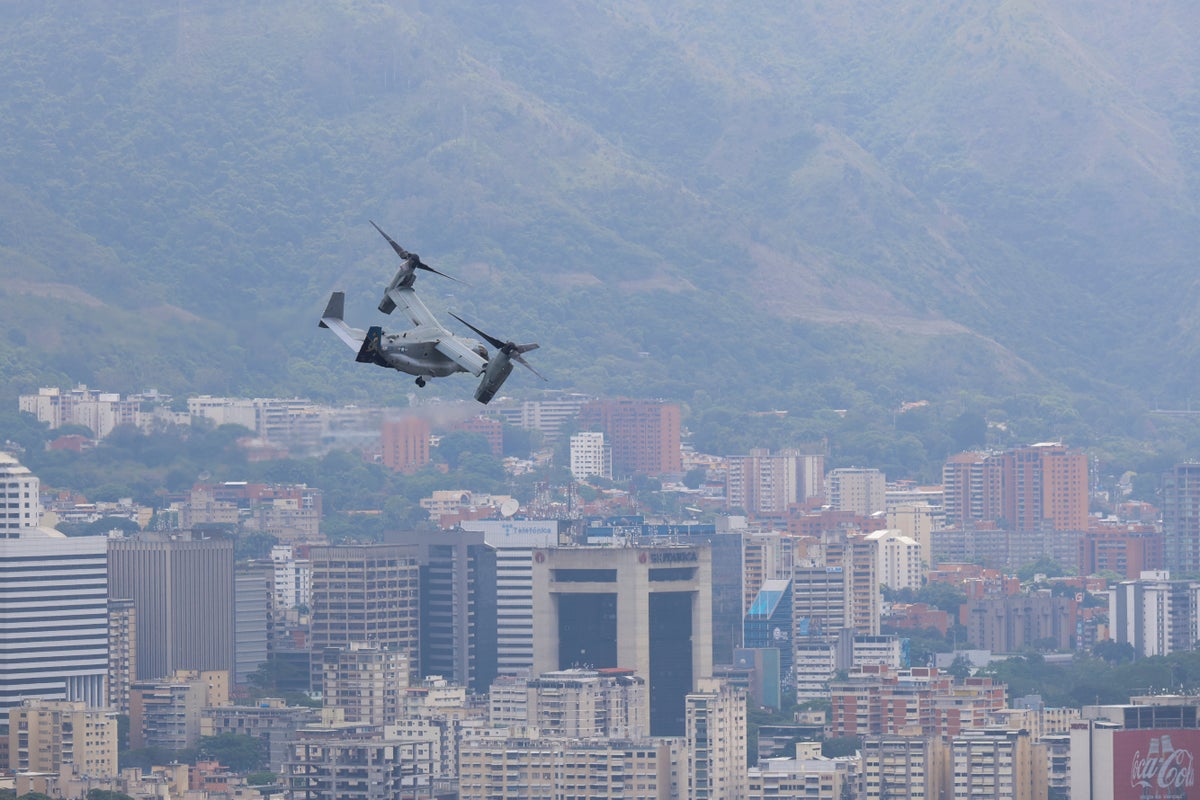
The execution of a "rapid response" drill at a diplomatic compound within a non-permissive environment is not a mere display of force; it is a live-fire validation of the Force Protection Equilibrium. This equilibrium balances three competing variables: sovereign sensitivity, kinetic readiness, and the logistical latency of extraction. When the United States conducts such an exercise in Caracas, it signals an inflection point where the perceived risk of local instability has begun to outweigh the diplomatic cost of a visible military footprint.
The baseline reality of diplomatic security in volatile regions relies on the Layered Defense Calculus. This framework dictates that the security of an embassy is not a static wall, but a series of concentric circles where the responsibility shifts from the host nation to internal tactical units. In Venezuela, where the host nation’s reliability is compromised by geopolitical friction, the internal layers must compensate for the failure of the external perimeter.
The Triple Constraints of Urban Extraction
Military drills within embassy grounds are governed by the Extraction Cost Function. The goal is to minimize the time variable ($T$) relative to the threat progression ($P$). If $P > T$, the mission shifts from a "protection" status to a "recovery" status, which carries a significantly higher casualty risk and political price.
1. The Proximity Paradox
Embedding tactical units within a diplomatic mission creates a paradoxical security environment. A larger footprint provides better immediate defense but increases the profile of the target. The "rapid response" drill serves to calibrate the Minimum Viable Force (MVF)—the smallest number of operators required to hold a perimeter until heavy support arrives. In Caracas, the urban density surrounding the embassy creates a "vertical threat" profile, where snipers or drone launches from neighboring high-rises negate traditional ground-level defenses.
2. Signal vs. Noise in Diplomatic Signaling
Every movement of a Marine Security Guard (MSG) or a FAST (Fleet Antiterrorism Security Team) unit is a data point for local intelligence. By conducting a publicized drill, the U.S. creates a Deterrence Offset. This communicates to both state and non-state actors that the cost of an incursion has been recalculated. The drill is a physical manifestation of a "Keep Out" zone, intended to prevent a security breach through psychological conditioning before a single shot is fired.
3. Logistical Latency and Airspace Contestation
The most critical bottleneck in a Venezuelan scenario is the transition from the embassy grounds to an extraction point. Unlike "green zone" environments, Caracas presents a non-permissive airspace. A rapid response drill must account for the Contested Exit Variable. This involves mapping "dead zones" where satellite communication may be jammed and identifying secondary landing zones (LZs) that are not dependent on the primary airport infrastructure, which the local government likely controls.
Structural Anatomy of the Drill
A sophisticated military drill in a capital city is divided into specific operational phases, each designed to test a different failure point in the security architecture.
Perimeter Hardening and Breaching Scenarios
The first phase focuses on the Physical Integrity Ratio. This measures how long standard embassy barriers—reinforced concrete, anti-ram bollards, and ballistic glass—can withstand a sustained assault by a motivated mob or a paramilitary force. The drill tests the deployment speed of "active" defenses, such as non-lethal acoustic devices or rapid-deploy concertina wire, which serve as force multipliers for a limited security detail.
Internal Relocation and High-Value Asset (HVA) Security
Once the perimeter is simulated as "breached," the focus shifts to the Safe Room Transition. This is a high-stress logistical maneuver where civilian staff are moved to hardened interior structures. The efficiency of this movement is measured in seconds. Any friction in this process—due to poor communication or lack of training—creates a "vulnerability window" where assets are exposed to kinetic fire or kidnapping.
Communication Redundancy and the "Blackout" Protocol
The most overlooked aspect of these drills is the Information Integrity Loop. In a real crisis, local cellular towers and internet backbones are typically the first systems to be seized or shut down by the host government. The drill validates the embassy’s ability to maintain a dedicated uplink to Southern Command (SOUTHCOM) via independent satellite arrays. If the "handshake" between the ground unit and the regional command center fails, the mission is effectively blind.
The Geopolitical Friction Coefficients
Conducting a drill in a city like Caracas is not a neutral act. It introduces specific "friction coefficients" into the bilateral relationship between the U.S. and the Maduro administration.
- Sovereignty Violation Perception: The host nation views any uncoordinated military movement—even within the legal confines of an embassy—as a violation of the Vienna Convention on Diplomatic Relations. This creates a diplomatic bottleneck where the U.S. must weigh the tactical necessity of the drill against the risk of the host nation revoking diplomatic credentials or seizing assets.
- The "Proxy" Trigger: In regions where Russian or Chinese influence is high, a U.S. military drill acts as a catalyst for counter-posturing. Local forces may respond with their own exercises, leading to a Tactical Escalation Spiral. This increases the probability of a miscalculation on either side, where a drill is mistaken for the start of a genuine intervention.
Tactical Requirements for Embassy Defense in Non-Permissive Environments
To outclass standard security protocols, an embassy in a high-risk zone must adopt an Integrated Defense Matrix. This moves beyond simple guards and gates toward a proactive, intelligence-led posture.
Automated Surveillance and Predictive Analytics
Modern rapid response units utilize AI-driven surveillance that monitors "pattern of life" data around the embassy perimeter. A deviation from this pattern—such as an unusual gathering of vehicles or a sudden dip in civilian foot traffic—triggers an automated alert. This reduces the Recognition Lag, giving the security team a head start before an actual breach occurs.
Modular Weaponry and Scalable Lethality
The unit must be equipped with tools that allow for Escalation Control. This means having the ability to switch from non-lethal crowd control to high-intensity suppression without changing platforms. In an urban environment, "over-penetration" of rounds is a massive liability; therefore, the use of specialized ammunition and precision-guided small arms is a technical requirement to minimize collateral damage that could further inflame local sentiment.
The Strategic Path Forward
The "rapid response" drill in Caracas indicates that the U.S. has moved its risk assessment from "Stagnant" to "Active Threat." For organizations or diplomatic entities operating in similar corridors, the following strategic maneuvers are required:
- De-couple Security from Host-Nation Infrastructure: Assume all local utilities, including water, power, and telecommunications, will be weaponized or severed during a crisis. Invest in closed-loop life support and communication systems.
- Validate the "Zero-Trust" Perimeter: Treat the embassy walls not as a final defense, but as a delay mechanism. The true defense lies in the ability to move HVAs (High-Value Assets) through subterranean or aerial routes that bypass the street-level chaos.
- Quantify the Human Factor: Drills must include "stress-testing" for civilian personnel. The failure point in most evacuations is not the military unit, but the panic-induced delays of untrained staff. High-frequency, low-intensity training for all embassy residents is the only way to lower the Chaos Variable.
The drill is a diagnostic tool. The data gathered from the Caracas exercise will be used to refine the Probability of Successful Extraction (PSE). If the PSE falls below a critical threshold, the only logical move is a preemptive reduction in staff—a move that often precedes a total diplomatic withdrawal. Monitor the "drawdown" of non-essential personnel in the 14 days following any rapid response drill; that is the true indicator of the mission's viability.