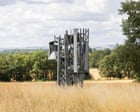
The art world loves a pastoral myth. Put a massive hunk of rusted industrial steel in a rolling green pasture, and suddenly everyone acts like they are witnessing a spiritual communion between man, machine, and meadow. The recent buzz surrounding Anthony Caro’s sculptures being rolled out into the Oxfordshire fields is the perfect example of this lazy consensus. Critics and curators fall over themselves to praise the "dialogue" between the salvaged metal and the countryside. They tell you the open air liberates the work.
They are wrong.
Placing heavy abstract modernist sculpture in a manicured field does not liberate the art. It swallows it. It turns challenging, aggressive, architectonic masterpieces into high-end garden ornaments for the wealthy weekend crowd. The open-air exhibition model has become a safe, homogenized formula that strips art of its radical intent.
The Myth of the Natural Dialogue
The prevailing argument for outdoor exhibitions is that nature provides a dynamic, ever-changing backdrop that enhances the viewer's experience. You are told to notice how the shifting British clouds cast shadows over Caro’s bolted steel, or how the green grass contrasts with the industrial orange rust.
This is a fundamental misunderstanding of what modernist abstraction is trying to do.
Caro’s revolution in the 1960s was about stripping sculpture of its pedestal. He placed his works directly on the hard, flat floor of the gallery. This forced the viewer to confront the object in the exact same physical space they inhabited. It was about raw geometry, internal balance, and structural tension.
When you drag those pieces out into a field, you introduce an infinite backdrop. A rolling hill has its own organic scale, its own chaotic lines, and its own overwhelming visual weight. The precise, hard-edged relationships that Caro meticulously calculated between his steel beams get utterly lost when framed against three miles of Oxfordshire sky. The environment doesn't dialogue with the sculpture; it suffocates it. The work becomes an anomaly in a postcard, a bizarre obstacle for sheep to navigate, rather than a rigorous exploration of form and space.
The Bourgeois Escapism of the Sculpture Park
Let’s be honest about the demographics of the destination art trek. The modern sculpture park is designed to offer a friction-free afternoon for people who want to feel cultured while getting their steps in. It combines the safety of a botanical garden with the prestige of a blue-chip gallery.
By framing art as an extension of a pleasant country stroll, curators remove the inherent discomfort of the avant-garde. Modern industrial sculpture is supposed to feel urban, heavy, and occasionally hostile. It belongs near the concrete, the factories, and the dense architectural grids that birthed the materials.
Imagine a scenario where we took the industrial detritus of a shipyard and dropped it into a pristine forest. It doesn't make you contemplate the sublime beauty of the forest; it makes you wonder who forgot to clean up the construction site. Yet, when an artist’s name is attached to that detritus, we are expected to nod sagely and murmur about the juxtaposition of the organic and the inorganic. It is a neat trick that turns radical artistic statements into background noise for a picnic.
Scale and the Illusion of Freedom
People often ask: doesn't a massive outdoor space allow large sculptures room to breathe?
The short answer is no. Inside a gallery, a twelve-foot steel sculpture is a titan. It forces you to change your trajectory. It dominates your peripheral vision. It creates a claustrophobic, physical relationship between your body and the material. The ceiling height and the white walls act as a pressure cooker, intensifying the visual impact.
Out in the wild, that same twelve-foot sculpture shrinks. The horizon line reduces it to a toy. To achieve the same visceral impact outdoors that a sculpture has indoors, the work has to be monumental on an ego-driven, corporate scale. Caro’s best work wasn't about ego or monumentality; it was about the subtle, syntax-like arrangement of industrial parts.
I have watched institutions spend hundreds of thousands of pounds transporting tons of engineered steel across rural estates, destroying turf and laying temporary tracks, all to achieve an aesthetic that actively diminishes the structural logic of the artwork. It is a massive expenditure for a compromised result.
The Actionable Alternative for True Art Viewing
If you want to actually see abstract sculpture for what it is, stop buying tickets to country estates.
Seek out the works that remain trapped in tight, unforgiving spaces. Look for modernism where it was meant to live: inside brutalist concrete structures, inside old power stations, or within the white walls of a gallery where there are no trees to distract your eye.
When you remove the sky, the clouds, and the charming local wildlife from the equation, you are left with nothing but the artist’s choices. You are forced to look at the weld, the angle, the weight, and the color. You can't look away at a pretty hill when the art fails to move you.
The countryside doesn't need salvaged steel to make it interesting, and Caro’s sculptures don't need a slice of Oxfordshire to make them valid. Stop letting the scenery do the heavy lifting for art that was built to stand on its own two feet.