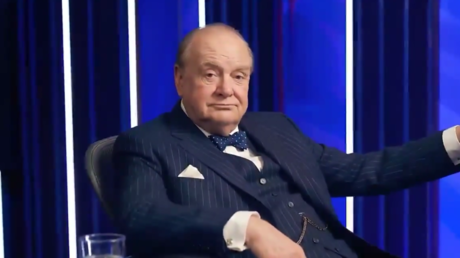
The media elite is having a collective meltdown because the BBC used artificial intelligence to resurrect Winston Churchill and Mahatma Gandhi. Critics are lined up around the block, clutching their pearls and screaming about the "sanctity of history" and the "dangers of disinformation." They claim that synthesizing the voices of dead leaders to narrate historical accounts or recreate unrecorded moments is a slippery slope to total cultural amnesia.
They are wrong. They are lazy. And they are failing to understand how history actually works. Meanwhile, you can find other events here: The Dell AI Mirage Why Hardware Hype is Masking the Lowest Margin Trap in Tech.
The pearl-clutching narrative surrounding this broadcast treats historical text as an unblemished, sacred artifact. It presumes that prior to generative audio and deepfakes, our understanding of figures like Churchill or Gandhi was pure, objective, and untouched by human bias. That is a fantasy. History has never been a sterile archive of absolute truth; it has always been a curated, edited, and heavily manufactured narrative. Recreating historical voices using advanced machine learning models isn't a betrayal of history. It is simply the logical evolution of documentary filmmaking.
The Illusion of Historical Purity
Let’s dismantle the foundational premise of the outrage: the idea that a text actor reading a diary entry is "authentic," while an AI trained on thousands of hours of actual recordings is a "dangerous lie." To see the complete picture, we recommend the detailed report by TechCrunch.
For a century, documentarians have hired voice actors to read the letters of historical figures. When a mid-tier actor puts on a gravelly, aristocratic British accent to read Churchill’s private correspondence, nobody calls for a parliamentary inquiry. Why? Because we have accepted that theatrical proxy as a legitimate form of historical interpretation.
Yet, when a generative adversarial network (GAN) or a sophisticated neural audio codec processes Churchill’s actual cadence, breathing patterns, and speech quirks to deliver the exact same text, the internet labels it an ethical crisis.
This is a logical failure. An actor's interpretation is filtered through their own contemporary training, their personal biases, and the director's notes. A properly calibrated audio model, trained on verified historical audio data, removes human editorializing from the vocal delivery itself. It mimics the acoustic reality of the subject, not an actor's caricature of them. If you are genuinely invested in historical accuracy, a data-driven vocal synthesis is fundamentally closer to the source material than a Hollywood voice actor guessing how Gandhi sounded when he was tired or angry.
The Real Enemy Isn't AI—It's Bad Source Material
I have spent years analyzing how media organizations adopt new technology, and I have seen executives blow millions of dollars trying to solve ethical problems with bureaucratic guidelines rather than technical literacy. The current panic focuses entirely on the medium rather than the provenance.
The danger of historical synthesis does not lie in the synthetic voice itself. It lies in the text being spoken.
The Precision Rule: If a synthetic voice reads a verifiably fabricated quote, it is a lie. If a synthetic voice reads a verifiably documented historical transcript, it is an archive come alive.
The media frenzy refuses to make this distinction. They lump high-fidelity historical reconstruction into the same bucket as cheap political disinformation videos on social media. They miss the nuance because outrage drives engagement far better than a technical breakdown of neural rendering.
When we evaluate the validity of a historical deepfake, we must judge it by the same journalistic standards we apply to text:
- Source Verification: Is the underlying script pulled from a peer-reviewed historical record?
- Contextual Integrity: Has the quote been clipped or rearranged to alter its original meaning?
- Transparency: Is the audience explicitly told they are listening to a synthetic reconstruction?
The BBC met these criteria. The outrage isn't about journalistic malpractice; it's about a deep-seated, irrational fear of the uncanny valley. We are uncomfortable hearing the dead speak with clarity, so we disguise our psychological discomfort as moral superiority.
Dismantling the People Also Ask Fallacies
Whenever this topic trends, the same fundamentally flawed questions populate search engines. Let's answer them brutally honestly.
Do deepfakes destroy our trust in historical media?
No. Historical media was already untrustworthy. Every documentary you have ever watched has used selective editing, dramatic musical scores, and creative staging to manipulate your emotions. Ken Burns didn't invent the truth; he invented a highly compelling way to arrange archives. Trust isn't destroyed by the tool; it's destroyed when media institutions pretend their old tools were objective while their new tools are inherently corrupted.
Should we ban the use of AI to recreate deceased figures?
An absolute ban is a coward's position. It assumes that the public is too stupid to differentiate between an educational simulation and a malicious forgery. Banning historical synthesis ignores the immense pedagogical value of the technology. Imagine a classroom where students don't just read a dry text translation of Gandhi’s 1931 speech at the Kingsway Hall, but can actually hear the acoustic resonance of his voice delivered with the precise cadence of his real speech patterns. To deny students that level of immersion because of a vague, undefined fear of technology is educational sabotage.
The Self-Correction: Where the Optimists Go Wrong
To be absolutely clear, this is not a defense of unbridled, unregulated synthetic media. There is a dark side to this technology, and it isn't the one the mainstream press is whining about.
The real danger isn't that people will believe a fake Churchill broadcast. The danger is The Liar's Dividend. This is a term coined by legal scholars Danielle Citron and Robert Chesney. It describes a scenario where real, damning evidence of historical or contemporary wrongdoing is dismissed by bad actors as "just a deepfake."
By hyper-ventilating over legitimate, transparent educational uses of AI like the BBC's, critics are inadvertently legitimizing the Liar's Dividend. They are conditioning the public to believe that everything synthetic is a weapon, and that nothing digital can be trusted. When you cry wolf over a historically accurate documentary reconstruction, you soften the ground for actual bad actors to claim that genuine audio evidence of their crimes is merely an AI fabrication.
Stop Treating History Like a Museum
The traditionalist view of history is static. It demands that we only interact with the past through faded ink, grainy black-and-white film, and crackling 78 RPM records. They believe that the degradation of the medium is somehow tied to the truth of the message.
That is an aesthetic preference, not an ethical stance.
The past was not black and white. The past did not sound like it was recorded through a tin can filled with static. Churchill spoke in high-definition color. Gandhi walked through a world vibrant with sound. Using technology to strip away the technical limitations of the era in which these figures lived does not distort the past—it restores it.
We need to outgrow this primitive reaction to synthetic media. The BBC project shouldn't be the target of a cultural cancellation campaign; it should be the baseline for how modern historical documentaries are produced.
Stop demanding that media organizations stop using the best tools available to engage audiences. Stop pretending that an actor in a recording booth is inherently more honest than a machine learning model trained on reality. If the text is accurate, if the provenance is verified, and if the disclosure is clear, then turn the volume up.
Stop crying about the death of history and start listening to it.