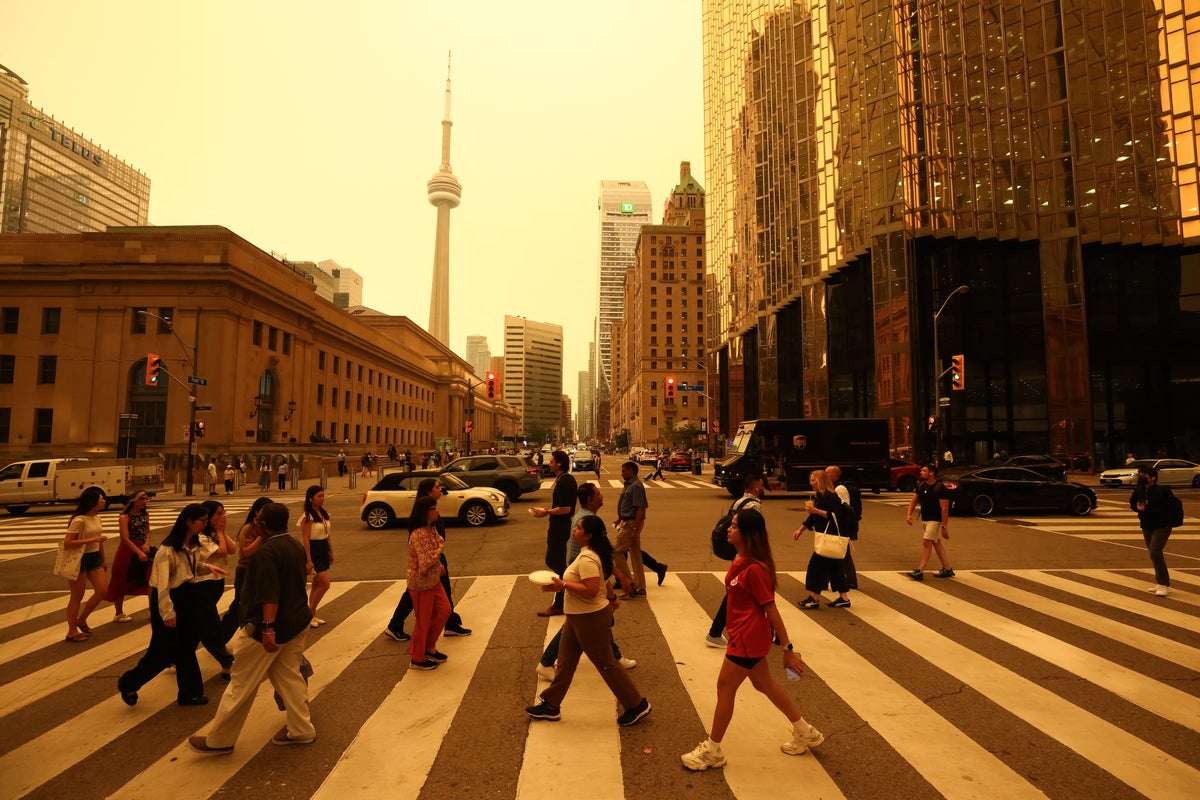
The sky over Toronto turned the color of a bruised apricot, and the collective mind of the city shattered.
Sirens wailed. Phones buzzed with emergency alerts. The media deployed the kind of breathless, apocalyptic vocabulary usually reserved for alien invasions or nuclear fallout. "Unprecedented." "Toxic." "Apocalyptic."
People locked themselves indoors, taped their window seams, and stared at air quality index (AQI) apps on their phones like day traders watching a market crash.
It was a masterclass in performative panic. And it missed the entire point.
The yellow haze choking Canadian and American cities is not a freak, black-swan anomaly. It is the bill coming due for a century of catastrophic environmental mismanagement. By treating wildfire smoke as an unexpected, villainous invasion from the north, we ignore a brutal reality: we built this tinderbox ourselves, and our frantic reactions are doing absolutely nothing to keep us safe.
The Smokey Bear Lie and the Ecological Debt
For over a century, North American forestry policy operated under a simple, childish premise: all fire is bad. If a tree burns, put it out immediately.
This policy was highly successful at protecting timber company profits and suburban expansion. It was also an ecological disaster.
Boreal forests are not museum exhibits to be preserved in amber. They are dynamic, fire-adapted systems. Species like the jack pine literally require the intense heat of a wildfire to open their cones and release their seeds. By aggressively suppressing every single spark since the early 20th century, we did not stop fires. We just postponed them.
Imagine a financial system where you never pay off your debts, but instead roll them over into a high-interest account year after year. That is what we did with forest fuel. Every dead branch, fallen leaf, and overcrowded sapling that should have burned in a minor, natural ground fire over the last eighty years is still sitting on the forest floor.
We have accumulated an ecological debt of dry biomass so massive that when fires do break out, they are no longer natural ecological resets. They are unstoppable, high-intensity crown fires that incinerate everything in their path and pump millions of tons of particulate matter into the upper atmosphere.
The smoke over Toronto was not an act of God. It was the interest on a century of ecological debt, paid in full by our lungs.
The Performative Absurdity of the AQI Watchers
During the peak of the smoke event, air quality tracking became a spectator sport. People who could not tell you the difference between carbon monoxide and carbon dioxide were suddenly debating the nuance of PM2.5 levels on social media.
This sudden obsession with atmospheric metrics is almost entirely useless.
Most people tracking the AQI from their living rooms assume that staying indoors solves the problem. It does not. The average North American home is not a sealed space capsule. It is a sieve.
Unless you are living in a modern, passive-house-certified structure with a dedicated, balanced ventilation system and sub-micron filtration, the air inside your home is exchanging with the outside air constantly. In typical suburban homes, the indoor air completely replaces itself with outdoor air every two to four hours.
When you look at a yellow sky and decide to stay indoors to work from home, you are still breathing that smoke. You are just breathing it in a room with a TV.
Furthermore, the focus on outdoor PM2.5 ignores the baseline toxicity of typical indoor environments. The average kitchen during a Sunday roast, or a living room with damp carpets and chemical cleaning residues, frequently registers air quality metrics that would trigger an outdoor health advisory. Yet, we panic only when the sky turns a dramatic color.
If you want to actually protect your respiratory system, stop checking the AQI every ten minutes. It is a passive, anxiety-inducing habit that changes nothing. Instead, look at the physical reality of your indoor air exchange.
The Chemistry of Smoke is Not Just Ash
To understand why our current reaction to wildfire smoke is failing, we must understand what we are actually breathing.
Most media reports focus on PM2.5—particulate matter smaller than 2.5 micrometers. This is a useful metric for regulatory compliance, but it tells you nothing about chemical composition. Wildfire smoke is not just wood ash. It is a complex, reactive chemical soup.
+-------------------------------------------------------------------------------+
|                        ANATOMY OF WILDFIRE SMOKE                              |
+----------------------------+--------------------------------------------------+
| Component                  | Human Impact                                     |
+----------------------------+--------------------------------------------------+
| PM2.5 (Fine Particulates)  | Penetrates deep into lungs, enters bloodstream.  |
| Benzene & Formaldehyde     | Volatile carcinogens released by burning biomass.|
| Acrolein                   | Highly reactive toxin; causes severe eye/throat  |
|                            | irritation.                                      |
| Carbon Monoxide            | Reduces oxygen delivery to vital organs.         |
| Syringol & Guaiacol        | Methoxyphenols that give smoke its distinct odor |
|                            | and irritate mucosal membranes.                  |
+----------------------------+--------------------------------------------------+
When a fire tears through a modern forest, it does not just burn pine needles. It burns abandoned structures, vehicles, plastic agricultural piping, and pesticide residues. The smoke drifting hundreds of miles to urban centers contains volatile organic compounds (VOCs) that undergo photochemical reactions in transit. By the time the plume reaches a city, it has been baked by sunlight into an even more toxic slurry than what was produced at the ignition site.
A standard cloth mask or a loose-fitting surgical mask does absolutely nothing to filter these gases. It does very little to filter PM2.5. Wearing a baggy blue surgical mask while walking down a smoky street is the atmospheric equivalent of using a chain-link fence to keep out mosquitoes. It is a security blanket designed to project safety where none exists.
The Infrastructure Failure We Refuse to Address
Cities like Toronto, New York, and Chicago treat wildfire smoke as a temporary weather event—like a heavy rainstorm that will eventually wash away. This is a fundamental structural error.
Our building codes are designed for a climate that no longer exists. They assume a world where the outdoor air is clean and the primary goal of ventilation is to dump indoor stale air outside and draw fresh outdoor air inside.
When the outdoor air becomes a toxic hazard, this entire design philosophy collapses.
Most commercial office buildings run on HVAC systems that draw in a percentage of outdoor air to meet carbon dioxide reduction standards. When the air outside is thick with PM2.5, these systems simply pump the pollution directly into office cubicles, straining low-grade MERV 8 filters that were never designed to handle heavy smoke loads.
If we want to survive the coming decades without spending every summer locked in air-conditioned misery, we have to change how we build.
- Positive Pressure Filtration: Buildings must be designed to maintain positive internal air pressure using highly filtered outdoor air (using MERV 13 or HEPA systems). This physically prevents unconditioned, smoky air from leaking through cracks in windows and doors.
- Active Carbon Integration: Standard particulate filters do not catch gases like benzene or formaldehyde. Buildings must integrate activated carbon filtration into their standard mechanical systems to scrub gaseous pollutants.
- The Demise of Operable Windows as a Ventilation Strategy: For decades, green building movements championed natural ventilation—opening windows to cool buildings. In an era of routine wildfire smoke, this strategy is not just obsolete; it is dangerous.
These changes are expensive. They require massive capital investment and a complete overhaul of building engineering standards. But they are the only real solution. Everything else is just rearranging deck chairs on a burning ship.
Why Prescribed Burns are the Only Way Out
If you want fewer yellow skies, you have to support more fire, not less.
This is the hardest pill for urban populations to swallow. The only way to stop catastrophic, uncontrollable summer wildfires is to deliberately set controlled, low-intensity fires during the spring and fall.
Prescribed burning reduces the fuel loads that make summer fires so explosive. It is a practice that Indigenous populations managed successfully for thousands of years before European settlement introduced the flawed ideology of total fire suppression.
But prescribed burns produce smoke.
And here lies the hypocrisy of the modern city dweller: we want pristine, smoke-free summers, but we refuse to tolerate the minor, controlled smoke of prescribed burns in April. Whenever a forestry agency attempts a controlled burn near an urban wildland interface, local residents complain about the smell, politicians panic, and the operation is shut down.
So instead of a little bit of smoke on our own terms in the spring, we get choked by millions of tons of toxic smoke on the forest’s terms in July.
We must choose our smoke. There is no third option where the forest magically remains a manicured, static park forever. We either manage the fire, or the fire manages us.
Stop Panicking and Start Adapting
The yellow sky over Toronto was not the end of the world. It was a warning shot.
The era of cheap, clean, effortless air is over for anyone living downwind of a major forest ecosystem. No amount of climate anxiety, angry tweets, or cheap air purifiers will change the physical reality of the fuel loads sitting in our northern forests.
Stop waiting for the government to "fix" the wildfires. They cannot. The scale of the boreal forest is too vast, the ecological debt is too deep, and the climate trends are too entrenched.
Instead, look at your own immediate space. Upgrade your home's air filtration. Demand that your employer disclose the MERV rating of your office building's ventilation system. Support local initiatives for prescribed burns, even if it means your car gets dusty in April.
Get comfortable with the smoke. It isn't going away.