Pope Leo XIV's early moves in France represent a radical shift in how the Vatican interacts with a secularized European state. When French media outlets like Le Monde scrambled to unpack the initial phases of this pontificate through a dozen distinct analytical angles, they missed the bigger picture. This isn't just about traditional diplomacy or standard diplomatic handshakes between the Holy See and the Élysée Palace. It's a calculated, high-stakes ideological reset.
If you think modern religious authority is simply fading into the background of European politics, you haven't been paying attention. Let's break down what's actually happening behind the stained glass and what most political commentators keep getting wrong.
Breaking the Mold of Vatican Diplomacy
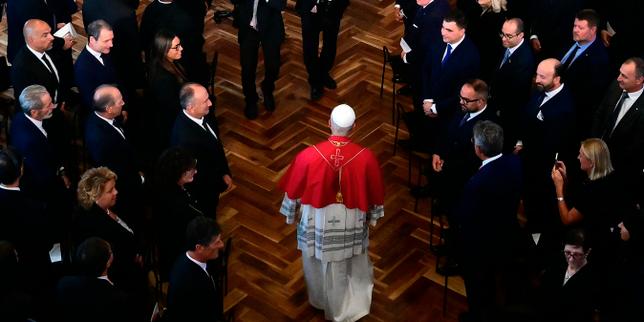
Traditional papal visits to France usually follow a predictable script. You get grand masses, polite speeches about Europe's Christian roots, and plenty of behind-the-scenes negotiations regarding church-state separation, known locally as laïcité. Leo XIV threw that playbook out the window within his first few months.
Instead of leaning on tired institutional rhetoric, the new pontiff adopted a direct, grassroots-focused approach that bypassed the usual bureaucratic channels. He addressed secular skepticism head-on. Rather than scolding the French public for drifting away from the pews, he leaned into the discomfort of a post-Christian society.
Think about how remarkable that is. Most global leaders try to shore up their base by preaching to the converted. Leo XIV walked straight into the lion's den of French secular intellectualism and started a conversation on his own terms. He didn't apologize for Catholic dogma, but he completely reframed how it applies to modern ethics, climate anxiety, and digital isolation.
The Reality of Laïcité and the Vatican
France treats secularism like a religion. The state's strict separation from religious institutions means any foreign faith leader walking onto French soil faces immediate scrutiny. Commentators in Le Monde spent weeks analyzing how the government would handle protocol. Would they treat him like a head of state or a religious agitator?
The truth is, Leo XIV didn't care about the protocol trap. He weaponized cultural humility. By addressing the deep-seated French anxieties over identity, immigration, and national unity without sounding like an orthodox lecture machine, he disarmed his fiercest critics.
Let's look at the actual mechanics of his early strategy:
- Direct engagement with secular intellectuals rather than relying solely on local bishops to mediate cultural disputes.
- Reframing social justice away from partisan political talking points and toward universal human dignity.
- Addressing the youth directly through open forums that prioritized listening over lecturing.
This wasn't just PR. It was an exercise in modern religious survival. If an institution wants to stay relevant in a country where weekly church attendance sits below five percent, you can't just repeat doctrines from the sixteenth century. You have to prove you understand why people left in the first place.
What the Media Missed About the French Episcopate
Most reports focused entirely on the macro-level political fallout. They wrote thousands of words about diplomatic tensions and theological conservatism versus progressivism. They completely ignored the silent crisis happening inside the French Catholic Church itself.
The local clergy is exhausted. Decades of institutional scandals, plummeting vocations, and an aging demographic left French parishes running on fumes. When Leo XIV stepped onto the scene, he didn't offer empty platitudes about a miraculous revival. He challenged local leaders to drop their defensive posture.
I've watched religious institutions try to outrun their problems by doubling down on nostalgia. It never works. Leo XIV understood that the French church needed permission to shrink in size while growing in authenticity. That means letting go of massive, empty buildings and focusing instead on small, highly engaged faith communities that actually reflect modern urban and rural realities.
Navigating the Political Minefield
France is perpetually on the brink of an ideological culture war. Every election cycle brings new friction over national identity, immigration, and secular values. When a pope wades into that environment, every sentence is parsed for political endorsement.
Leo XIV walked a very narrow tightrope. He avoided becoming a tool for right-wing traditionalists who want to weaponize Catholicism as a shield for nationalism. At the same kiel, he refused to pander to progressive factions looking to rewrite core dogmas overnight.
This middle ground frustrates political analysts who love clean labels. Is he a reformer or a traditionalist? The answer is neither. He's a pragmatist navigating a crumbling secular landscape. He knows that if the church becomes a political party, it loses its soul. If it stays entirely silent on public suffering, it loses its relevance.
Where This Leaves Us Now
The early pontificate of Leo XIV in France serves as a case study for how ancient institutions must adapt to a rapidly changing world. You cannot force people back into the pews through guilt or historical nostalgia. You earn their attention by addressing the raw, unvarnished problems of contemporary life—loneliness, economic precarity, and the search for meaning in an increasingly automated world.
Stop waiting for a miraculous institutional turnaround. Watch how local communities respond to leaders who choose authenticity over authority. If you want to understand where global religion is heading over the next decade, keep your eyes on Paris. The battle for the soul of modern secularism isn't being fought in Rome. It's happening right there on the streets of France, one difficult conversation at a time.