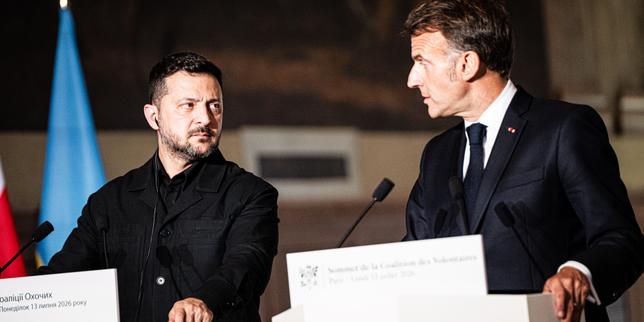
Volodymyr Zelensky’s announcement of an "important defense agreement" with France marks another high-water mark in wartime diplomacy, yet the strategic reality on the ground remains stubbornly unchanged. While the political optics project solidarity, the mechanics of European industrial production cannot support the rhetoric. The agreement promises enhanced security cooperation and hardware transfers, but it fails to address the structural deficit in ammunition manufacturing and the prolonged timelines required to deploy heavy weaponry to the front lines. Ukraine needs shells, not signing ceremonies.
The Friction Between Diplomacy and Factory Floors
Bilateral security agreements have become the standard currency of European support for Kyiv. They signal long-term commitment. They soothe nervous markets and reassure domestic electorates that Western powers are not abandoning the conflict. But a signed document does not instantly generate a 155mm artillery shell.
The European defense apparatus is structured for peacetime efficiency, not protracted industrial warfare. For three decades, continental militaries optimized supply chains to minimize inventory costs. They adopted just-in-time manufacturing principles. When Russia shifted to a full wartime economy, Western Europe remained shackled by regulatory bureaucracy, procurement delays, and a severe shortage of raw materials like nitrocellulose.
France has pledged to accelerate its production of the Caesar self-propelled howitzer. The system is highly capable. It offers exceptional mobility and precision, making it a favorite among Ukrainian artillery crews in the Donbas. However, increasing monthly production from two units to eight takes years, not weeks. Factories require machine tools that face global backlogs. Skilled labor cannot be trained overnight. The gap between a political declaration in Paris and an active battery firing in eastern Ukraine spans months of logistical friction.
The Strategy of Fractured Commitments
By securing individual agreements with European capitals rather than waiting for consensus from the North Atlantic Treaty Organization or the European Union, Kyiv is playing a calculated diplomatic hand. This approach bypasses the veto power of Moscow-friendly enclaves within the bloc. It forces larger Western European states to outbid each other in displays of geopolitical leadership.
Estimated European 155mm Ammunition Production vs. Ukraine Burn Rate (2025-2026)
+-------------------------+-------------------------+-------------------------+
| Metric                  | Current European Output | Minimum Ukrainian Need  |
+-------------------------+-------------------------+-------------------------+
| Monthly Shell Volume    | ~85,000 rounds          | ~200,000 rounds         |
| Annual Capability       | ~1.02 million rounds    | ~2.4 million rounds     |
+-------------------------+-------------------------+-------------------------+
This table illustrates the fundamental math problem confronting Ukraine's general staff. Even with French commitments scaled to their absolute maximum capacity, the aggregate European output covers less than half of what is required to sustain defensive operations, let alone mount a major counteroffensive.
The reliance on bilateral pacts also reveals a deeper vulnerability. These agreements are non-binding executive understandings. They lack the treaty-level enforcement of collective defense clauses. If political winds shift in Paris or Berlin, the flow of capital and material can be choked off by simple budgetary reallocation. They are expressions of intent, not ironclad guarantees.
The Problem of Technological Fragmentation
Every European nation supplying hardware introduces a unique logistics trail. Ukraine now operates a mosaic of Western equipment.
- Challenger 2, Leopard 2, and M1 Abrams tanks all require distinct spare parts, maintenance protocols, and specialized mechanics.
- Artillery systems from four different countries utilize slightly different software systems, complicating real-time battlefield integration.
- Logistics hubs in Poland and Romania are choked with vehicles waiting for proprietary components that must be shipped from deep within Western Europe.
France’s defense package adds layers to this complex network. While the delivery of precision-guided munitions like the SCALP-EG cruise missile provides long-range strike capabilities, these systems must be retrofitted onto aging, Soviet-era Su-24 bombers. The engineering workarounds are brilliant, but they are inefficient stopgaps rather than systemic solutions.
Escalation Management and the Red Line Illusion
The underlying friction within the Franco-Ukrainian agreement is the unresolved debate over escalation management. Western capitals remain paralyzed by the fear of a direct clash with Moscow. This anxiety manifests in geographic restrictions placed on the deployment of provided weapons.
"You cannot win a war when your adversary possesses an asymmetric sanctuary."
📖 Related: The Clock and the Crown
Ukrainian commanders have repeatedly pointed out the tactical absurdity of seeing Russian troop concentrations and missile launchers just across the border but being forbidden from striking them with Western-supplied artillery. France has hinted at greater flexibility regarding these restrictions, yet the operational reality remains constrained by a web of tacit understandings between Washington, London, and Paris.
This hesitation grants the Russian military a perpetual operational advantage. They can mass logistics hubs, command posts, and staging areas just beyond the geopolitical boundary line, knowing that Western political calculations insulate them from devastating strikes. Until this policy shifts entirely, defense agreements serve primarily to prolong the stalemate rather than alter the trajectory of the war.
Financing the Long War
The true test of the French defense agreement lies in its financing mechanism. European states have exhausted their immediate stockpiles of surplus Cold War material. Future deliveries must be purchased fresh from production lines, requiring billions in sustained multi-year funding.
France has utilized its domestic defense budget and contributions from the European Peace Facility to fund these transfers. But the European Peace Facility is facing severe strain as member states debate the reimbursement rates for donated equipment. Some capitals are accused of inflating the value of aging hardware to secure modern upgrades at the collective expense.
Meanwhile, the defense industrial base inside Ukraine itself is under constant bombardment. Kyiv is attempting to co-produce Western hardware locally to shorten supply lines. This is where the French agreement could prove genuinely useful, focusing on joint ventures for drone production and electronic warfare systems within western Ukraine. Yet, these facilities remain vulnerable to long-range cruise missile strikes, forcing manufacturers to operate underground or in highly dispersed networks.
The war has entered a grueling phase of material attrition. Victory will not be determined by the eloquence of communiqués or the grandeur of signing ceremonies in European palaces. It will be decided by the crude physics of industrial capacity, the availability of basic explosives, and the political will to sustain massive financial losses over half a decade. Zelensky’s new accord with France keeps the lights on in Kyiv, but it does not provide the power to drive the occupying forces back across the border. The factory floor remains the true center of gravity.

