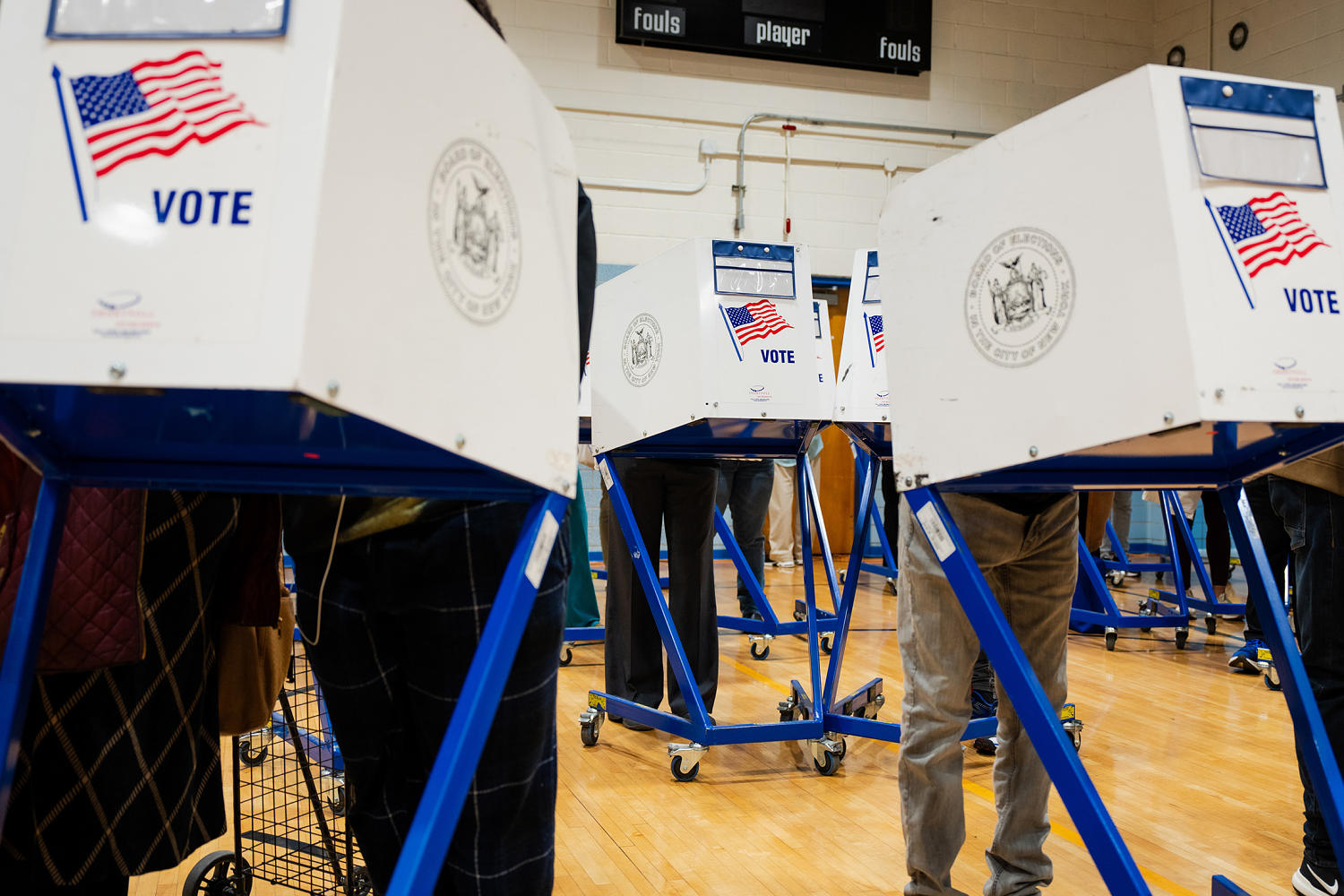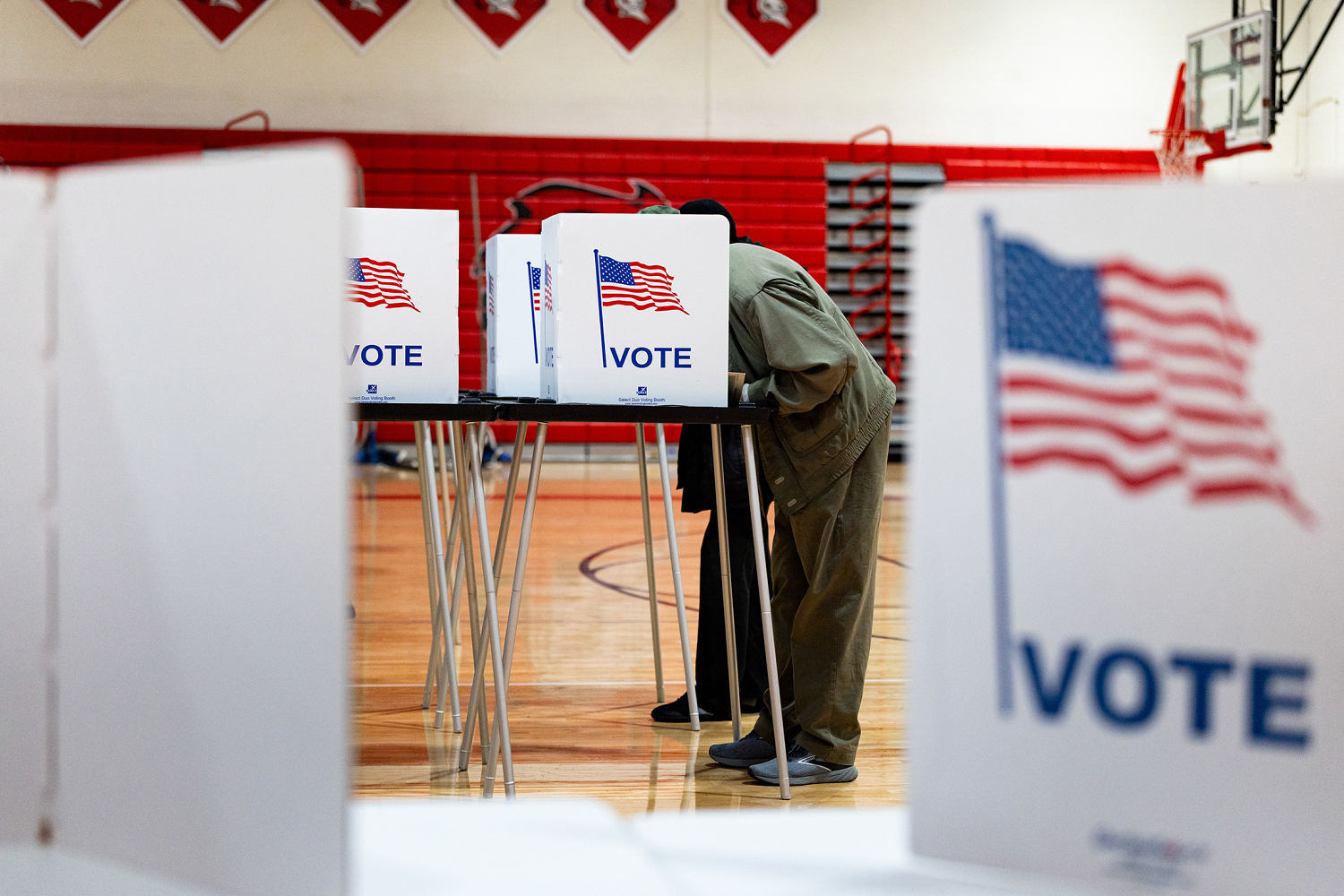
It happens at 7:14 AM in a middle school gymnasium that still smells faintly of floor wax and damp sneakers.
Marcus, a retired high school history teacher volunteering his Tuesday for forty dollars and a lukewarm cup of coffee, stands beside an optical ballot scanner. He has done this for six election cycles. His hands shake just slightly from too much caffeine and too little sleep. Across from him stands Elena, a thirty-two-year-old nurse who got off a twelve-hour shift at 6:30 AM and came straight here before going home to sleep. She feeds her crisp, heavy paper ballot into the machine.
The scanner whirs. It hesitates. A small amber light blinks twice, and a soft, apologetic chime echoes off the cinderblock walls.
"Paper jam," Marcus mutters, reaching for the maintenance key.
In the past, Elena would have sighed, rubbed her eyes, and waited ninety seconds while Marcus cleared the rollers and fed the sheet back through. Today, she doesn't sigh. She pulls out her phone.
By 7:18 AM, a grainy fourteen-second video of Marcus opening the side panel of that machine is uploaded to a local community group. By 8:30 AM, it has been shared four thousand times with a caption claiming poll workers are "tampering with the internal memory cards" to reject ballots from Elena's neighborhood. By noon, state election officials are fielding death threats, and three other precincts in the county are experiencing massive delays because anxious voters are demanding to watch their ballots drop into the physical lockbox rather than trusting the rollers.
Nothing illegal happened in that gymnasium. No votes were lost. No algorithms were altered. A twenty-cent rubber roller simply lost its grip on slightly humid cardstock.
Yet, the damage was absolute.
We are living through an era where the mundane friction of human logistics has become indistinguishable from malice. When millions of people try to execute any massive, synchronized physical task on a single Tuesday in November, things break. Printers run out of toner. Keys get misplaced. Volunteers misread a line in a binder. These are the unglamorous, predictable realities of running an election. But in a hyper-connected information ecosystem starved for outrage, routine voting issues no longer look like friction. They look like a smoking gun.
The Anatomy of an Ordinary Tuesday
To understand why a jammed scanner can trigger a statewide panic, you first have to understand the sheer, staggering scale of what an election actually is.
Imagine trying to organize a pop-up retail operation across more than 100,000 temporary locations simultaneously. You have to staff those locations with nearly a million temporary workers, most of whom only work this specific job once every two years. You have to distribute tens of millions of unique paper documents, calibrate hundreds of thousands of sensitive optical sensors, and open the doors at the exact same minute across multiple time zones.
If Amazon or Walmart attempted a single-day physical rollout of that magnitude using part-time volunteers, we would expect thousands of localized glitches. We would expect delayed trucks, broken barcode scanners, and confused cashiers. We wouldn't blink.
In elections, however, we have developed an expectation of sterile, instantaneous perfection. And when reality inevitably falls short of that impossible standard, confusion rushes into the vacuum.
Consider the mechanics of the most common Election Day headaches. None of them are secret. Election administrators budget for them, train for them, and build layers of physical redundancy around them.
Take the dreaded "Sharpiegate" phenomenon, which resurfaces like clockwork every two years. Poll workers in many jurisdictions hand out felt-tip pens because the ink dries instantly. Ballpoint pen ink takes a fraction of a second longer to set; when hundreds of damp ballots stack on top of each other inside a warm scanner, wet ballpoint ink smears onto the optical lenses, blinding the machine. Felt-tip markers prevent this. Yet, because marker ink sometimes bleeds through to the back of the paper, voters panic, convinced their votes are being invalidated. What they rarely realize is that modern ballots are designed with offset columns specifically so bleed-through cannot register on the reverse side.
Or consider the sudden disappearance of a voter's name from the electronic poll book.
Let's look at a hypothetical scenario—though one that plays out thousands of times every cycle. David moves three miles across town in August. He updates his address at the DMV, assuming that automatically updates his voter registration. In many states, it does. Sometimes, due to a clerical lag or a mismatched apartment number, the data sits in a pending queue. David shows up at his new neighborhood church at 5:30 PM on Election Day, exhausted from traffic, only to be told he isn't on the active roster.
To David, standing under harsh fluorescent lights while a line of impatient neighbors grows behind him, it feels targeted. It feels like erasure.
In truth, it is the exact reason the provisional ballot exists. A provisional ballot is essentially an envelope-wrapped pause button. It allows David to cast his vote right then and there, sealing his selections away until county clerks can verify his DMV record over the next forty-eight hours. Once confirmed, the envelope is opened and his vote is counted. It is a fail-safe built specifically for human error.
Yet, when someone films a frustrated voter being handed a provisional ballot and posts it online with the caption, "They are refusing to let citizens vote at Precinct 4," the fail-safe is reframed as a weapon.
Why Our Brains Mistake Glitches for Conspiracies
I have spent years watching local election boards operate, sitting in the back of quiet county warehouses where fluorescent tubes hum over long tables of sorted envelopes. If you spend enough time in those rooms, the absurdity of grand, coordinated election conspiracies becomes almost laughable. These are places run by people who label their staplers with masking tape and argue passionately over the best way to alphabetize precinct binders.
So why are so many smart, rational people so quick to believe the worst?
Because uncertainty is terrifying, and conspiracy theories offer an intoxicatingly simple cure for anxiety.
Psychologists call it proportionality bias—the deep-seated human instinct to believe that big events must have big causes. An election determines the trajectory of taxes, healthcare, judges, and wars. The stakes feel monumental. When the outcome of something so massive seems threatened by something as trivial as a dead battery in a poll pad or a misprinted batch of ballots in a rural county, our brains reject the mismatch. A monumental crisis cannot possibly be caused by a clerical typo. There must be a mastermind behind the curtain.
There is also the cruel distortion of the availability heuristic.
In the past, if a precinct in Ohio opened thirty minutes late because the janitor overslept with the keys to the gymnasium, only the forty people standing in the rain on that specific sidewalk ever knew about it. They grumbled, dried off, cast their ballots, and went to work.
Today, one person in that rain takes a video. That video is plucked out of its geographic context and dropped into the algorithmic bloodstream alongside a video of a printer jam in Arizona, a tabulation software update in Georgia, and a mislabeled drop box in Pennsylvania. Viewed back-to-back on a glowing smartphone screen at midnight, four isolated, mundane logistical hiccups merge into a single, terrifying illusion of systemic collapse.
You aren't seeing a coordinated attack. You are seeing the statistical inevitability of scale, compressed into a thirty-second highlight reel.
The Invisible Cost of Lost Trust
It is easy to mock viral misinformation from a distance, to roll our eyes at the latest absurd rumor swirling around local message boards. That is a mistake. The consequences of this confusion are deeply personal, quietly corrosive, and entirely real.
Walk into any county election office today and look at the turnover rates. Over the last four years, America has experienced an unprecedented exodus of veteran election administrators. These are not partisan operatives. They are career civil servants—people who spent twenty years mastering state statutory deadlines, typography standards for ballot readability, and chain-of-custody logs.
Many of them left because they couldn't take the abuse anymore.
When routine voting issues are weaponized into viral outrage, the target isn't an abstract institution. The target is Sarah, the county clerk whose kids go to the local high school, who suddenly finds her home address posted on a forum because a tabulation machine needed a routine recalibration at 9:00 PM.
When those veterans walk out the door, they take decades of institutional memory with them. And here is the bitter irony: losing experienced administrators makes routine voting issues much more likely to happen in the future.
A rookie clerk managing their first major election is far more likely to make a formatting error on a mail-in ballot envelope or miscalculate the number of backup paper ballots needed for a high-turnout precinct. Those rookie mistakes then become fresh fuel for the next wave of outrage, driving out the next wave of workers. It is a self-fulfilling doom loop that weakens the very system critics claim they want to protect.
Even more damaging is what happens to the voters themselves. Confusion breeds paralysis. When people are bombarded with conflicting, hysterical warnings about whether their pen color is valid, whether drop boxes are safe, or whether machines are flipping votes, some simply decide the system is too broken to bother with. They stay home. Disillusionment achieves what no broken scanner ever could: it silences them permanently.
How to Read the Chaos Like an Insider
We cannot stop printers from jamming. We cannot guarantee that every volunteer in America will execute a twelve-hour shift without making a single clerical mistake. What we can change is how we interpret those moments when they inevitably arrive.
If you want to insulate yourself from the panic that descends every election week, you have to learn to look at the mechanics behind the curtain. You have to look for the redundancies.
In almost every jurisdiction, an election is not a single fragile thread; it is a woven net of overlapping checks designed specifically to catch human error.
First, understand the paper trail. More than ninety-five percent of ballots cast in the United States today are either hand-marked on paper or produce a voter-verified paper record before being scanned. A scanner is essentially just a high-speed calculator that reads those marks so we can get unofficial results on Tuesday night instead of waiting three weeks. If a scanner jams, breaks, or catches fire, the paper ballot itself remains untouched inside a locked, tamper-evident steel or heavy plastic bin. The physical proof of your intent never disappears into the ether.
Second, pay attention to bipartisan chain of custody. Whenever a ballot box is opened, a memory card is transported, or a provisional ballot is reviewed, election law almost universally requires representatives from opposing political parties to be physically present, watching each other and signing off on every movement. For a widespread fraud scheme to succeed in a modern precinct, a lifelong Republican volunteer and a lifelong Democrat volunteer—who often spend the whole day arguing politely over snacks—would have to spontaneously form a secret pact to falsify federal documents and risk prison time, all without leaving a paper discrepancy.
Third, learn the difference between unofficial results and certified counts.
On election night, television networks race to project winners using raw, unofficial data uploaded as precincts close. Sometimes, a tired clerk enters a number into a reporting spreadsheet incorrectly—adding an extra zero to a county's total, for example. Within twenty minutes, someone spots the mathematical impossibility, the clerk corrects the typo, and the public dashboard updates.
To an untrained eye watching a live tracker at 11:00 PM, that sudden drop in a candidate's vote total looks like theft. To anyone who understands canvassing, it is simply a human being correcting a typo before the real work even begins. Certification takes weeks precisely because officials spend days cross-checking poll book signatures against total ballots cast, auditing machine counts by hand, and reconciling every single discrepancy down to the last sheet of paper.
The Quiet Heroism of the Gymnasium
Let's go back to that middle school gymnasium at 7:14 AM.
Marcus opens the side panel of the scanner. He doesn't touch a screen. He doesn't alter a tally. He simply lifts a green plastic lever, gently pulls out Elena's slightly damp ballot, and hands it back to her so she can feed it into the slot herself—because under state law, poll workers aren't even allowed to insert a voter's ballot for them unless explicitly asked for assistance.
Elena takes the paper, smooths the corner with her thumb, and slides it back into the machine.
This time, the rollers catch. The paper disappears smoothly into the locked bin below. A small American flag icon appears on the tiny LCD screen, accompanied by a counter ticking up by one.
Marcus offers a tired smile. Elena nods, grabs her "I Voted" sticker, and walks out into the cool morning air toward her car, ready to finally go to sleep.
It wasn't sleek. It wasn't instantaneous. It didn't look like the frictionless, one-click world we have grown accustomed to on our phones. It was clunky, analog, and dependent on the patience of two exhausted strangers sharing a Tuesday morning in a room that smelled like floor wax.
Democracy has never been a flawless machine humming quietly in the dark. It is a loud, messy, deeply human endeavor held together by masking tape, backup keys, and ordinary neighbors willing to sit in folding chairs for fourteen hours just to make sure the rollers keep turning.