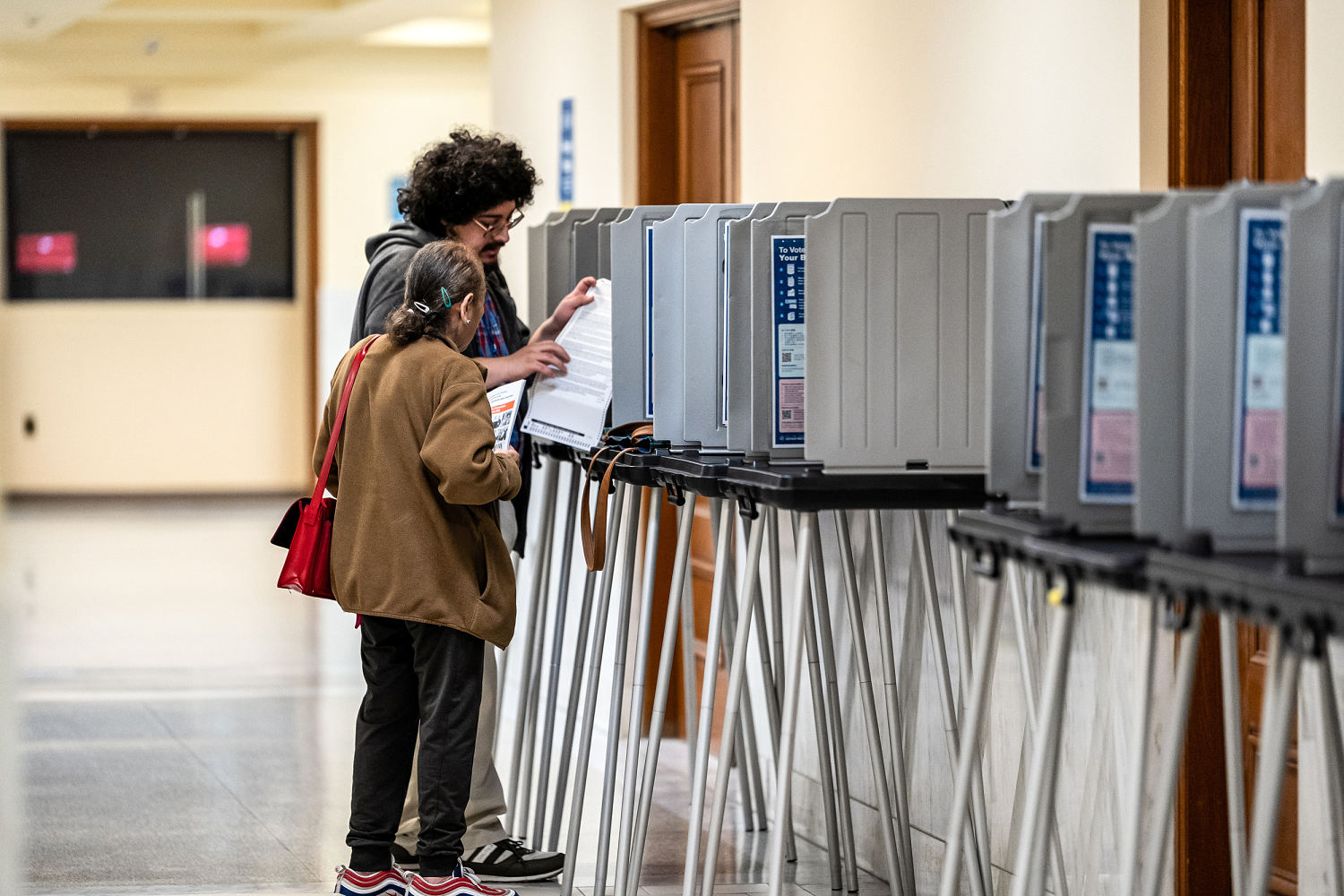
The fluorescent lights in a county registrar’s office hum at a frequency designed to keep tired bureaucrats awake at two in the morning. I spent six years working alongside municipal election clerks in the American West, and I still remember the smell of those rooms: burnt coffee, toner cartridges, and damp cardboard boxes stuffed with provisional ballots. We weren't shadowy operatives. We were retirees, college students, and civil servants making nineteen dollars an hour to check signatures against smudged driver’s license scans.
That mundane reality collided with federal muscle when the Department of Justice issued subpoenas to local election officials in California, demanding mountains of voter registration records to investigate claims of noncitizen voting. Recently making headlines recently: Why Another Wave of Childcare Charges Changes Nothing Without Fixing Blind Spots.
Silence.
That is what usually follows when federal prosecutors knock on the door of a county office carrying a subpoena. Suddenly, a system built on public trust and local transparency transforms into a crime scene, even before a single crime has been proven. More details on this are covered by The Guardian.
To understand what is actually happening in California right now, you have to look past the cable news shouting matches and step inside the shoebox of American election administration. On the surface, the story sounds simple: federal investigators want to verify that only United States citizens are casting ballots in the nation's most populous state. Who could possibly argue against that? Nobody wants illegal votes diluting legitimate ones.
But the real problem lies elsewhere. When federal authorities sweep into local jurisdictions demanding raw, unredacted voter files based on broad claims of noncitizen voting, they aren't just looking for needles in a haystack. They are setting fire to the barn to see what runs out.
The Anatomy of a Modern Voter File
Let us build a hypothetical scenario to see how this works in practice. Meet Elena. Elena is a hypothetical character, a composite of dozens of real residents I watched navigate the registration system during my years in county offices. She moved to California from Guadalajara fifteen years ago, worked as a pediatric nurse, paid her taxes, and finally raised her right hand at a naturalization ceremony in Los Angeles three autumns ago.
On her way home from the courthouse, clutching a miniature American flag, Elena stopped by the Department of Motor Vehicles to renew her driver’s license.
In California, the DMV operates under an automatic voter registration system known as "Motor Voter." Unless you actively opt out, applying for or renewing a license automatically transmits your eligibility data to the Secretary of State. For Elena, it was a moment of quiet pride. She checked the box confirming her brand-new citizenship, and two weeks later, a voter registration card arrived in her mailbox.
Now consider what happens when a federal subpoena lands on a county clerk's desk demanding every record tied to potential noncitizen registrations.
Database matching is a blunt instrument. Imagine trying to find out if anyone in a packed football stadium is wearing a stolen watch by arresting everyone whose name matches a list of local pawnshop customers. Government databases do not talk to each other in clean, poetic sentences; they clash in messy spreadsheets filled with typos, maiden names, missing middle initials, and outdated immigration statuses.
When the Department of Motor Vehicles transfers data to election officials, clerical errors happen. Sometimes a clerk hits the wrong key. Sometimes a green card holder forgets to check the opt-out box, gets registered by mistake, never casts a ballot, and realizes the error years later. Under federal and state law, a clerical mistake is not a conspiracy. Yet when federal prosecutors subpoena those raw records, every administrative hiccup suddenly looks like criminal intent on a prosecutor's whiteboard.
What the Numbers Actually Say
I used to worry terribly about database errors when I worked in election administration. You lie awake at night wondering if a software glitch between the DMV and the county server might accidentally put an ineligible person on the rolls, handing ammunition to critics who already believe the whole apparatus is rigged. That fear is real, and pretending the system is flawless does nobody any favors.
When you look at the actual verified audits across the country, however, the scale of the issue snaps into sharp focus.
Study after study—conducted by conservative think tanks, liberal voting rights groups, and state secretaries of state alike—shows that noncitizen voting in federal elections is vanishingly rare. Take the Brennan Center for Justice’s landmark review of 42 jurisdictions across the United States, covering 23.5 million votes cast in a single general election. Election officials found roughly 30 incidents of suspected noncitizen voting referred for further investigation. That is 0.0001 percent of the votes cast. Even in California, when the state audited its Motor Voter rollout after discovering that the DMV had mistakenly registered roughly 1,500 potentially ineligible individuals due to processing errors, state officials found zero evidence that any of those individuals had intentionally defrauded the system, and the vast majority never cast a single ballot.
So why deploy the heavy artillery of Department of Justice subpoenas over a statistical phantom?
Follow the psychology of intimidation. If you are a naturalized citizen—someone like our hypothetical nurse, Elena—and you read headlines announcing that the federal government is seizing voter records in your county to hunt down noncitizens, what do you do next November? You might have your naturalization certificate framed on your living room wall. You might be completely, undeniably eligible to vote. Yet the sheer terror of ending up on a federal target list because a DMV clerk misspelled your last name is enough to make you stay home.
You don't need to arrest a single person to suppress ten thousand votes. You just need to make the voting booth feel like an interrogation room.
The Local Clerks Caught in the Crossfire
While politicians in Washington trade press releases about election integrity, the people actually bearing the weight of these subpoenas are local election administrators—ordinary civil servants who are already quitting in record numbers.
Since 2020, roughly two in five local election officials nationwide have left their jobs, driven out by death threats, relentless public records requests, and partisan harassment. When the Department of Justice issues sweeping demands for voter rolls, signature histories, and DMV transmission logs, it paralyzes small and mid-sized county offices.
Think about what compliance actually requires. A county registrar cannot simply hit "print" on a master file. Under state privacy laws, voter registration rolls contain sensitive personal data: driver's license numbers, partial Social Security numbers, home addresses, and confidential protections for domestic violence survivors and law enforcement officers. County attorneys have to spend hundreds of hours reviewing every line of code and every page of paper to determine what can legally be handed over without violating California's strict privacy statutes, and what must be fought in federal court.
Every hour a registrar spends haggling with Department of Justice lawyers is an hour stolen from testing ballot scanners, recruiting poll workers, and updating precinct maps.
This is the invisible cost that never makes the evening news. Democracy doesn't collapse in a single dramatic explosion; it erodes when the mechanics who keep the engine running are buried under so much legal gravel that the gears grind to a halt.
History Repeats Itself in Sharp Suits
We have seen this exact movie before, and we know how it ends.
In 2017, a presidential commission on election integrity demanded that all fifty states hand over the full names, addresses, birth dates, party affiliations, and partial Social Security numbers of every registered voter in America. Even conservative secretaries of state—including Mississippi’s Delbert Hosemann, who famously told the commission they could "go jump in the Gulf of Mexico"—refused to comply, recognizing the request as a massive federal overreach that threatened voter privacy without proving a shred of fraud.
A few years later, in Texas, state officials announced with great fanfare that they had uncovered nearly 100,000 noncitizens on the state's voter rolls, triggering immediate threats of criminal prosecution. Within weeks, the entire claim collapsed. Tens of thousands of people on that list were naturalized citizens who had simply gotten their driver's licenses before taking their citizenship oath. The state settled the resulting lawsuits, paid hundreds of thousands of dollars in legal fees, and quietly shelved the purge.
The pattern is unmistakable. First comes the explosive accusation of widespread noncitizen voting. Second comes the sweeping demand for local records, draped in the solemn authority of law enforcement. Third comes the quiet, unpublicized realization months later that the "fraud" was actually just routine bureaucratic friction—stale DMV files, un-updated naturalization records, and clerical typos.
By the time the correction is printed on page fourteen, the election is over, the doubt has already been planted, and thousands of eligible citizens have been scared away from the polls.
The Quiet Courage of the Paper Trail
If you want to know why California’s election officials are pushing back against broad federal fishing expeditions, you have to understand how deeply protective local clerks are of the chain of custody.
In my old county office, we treated the voter roll like a sacred ledger. Every change—an address update, a party switch, a removal due to a death certificate—left a digital footprint. When someone died, the county vital statistics office sent a notice, and two clerks had to verify the match before a single name was struck from the rolls. Why were we so obsessive? Because removing an eligible voter by mistake is just as grave a sin as letting an ineligible person cast a ballot.
California already maintains rigorous safeguards to catch genuine errors. When the DMV flags a record as ineligible, automated checks bounce it back before it ever reaches a precinct roster. If a noncitizen accidentally ends up registered, state law provides a clear path to cancel the registration without ruining an innocent person's life or immigration status—provided they did not intentionally lie or vote.
Targeted investigations, backed by specific evidence of wrongdoing, are a legitimate tool of justice. If federal prosecutors have concrete proof that a specific ring is registering noncitizens to sway a congressional race, they should subpoena those exact records and prosecute the culprits to the fullest extent of the law.
Dragnet subpoenas are the opposite of targeted justice. They invert the basic American presumption of innocence, treating entire communities of naturalized citizens and local civil servants as suspects first and citizens second.
What Happens When the Lights Go Out
Step back into that fluorescent-lit county office for a moment.
Imagine a twenty-four-year-old data analyst sitting at a scarred metal desk in Sacramento or Fresno, staring at a federal subpoena that demands ten years of raw voter registration logs by Friday afternoon. She took the job because she believed in public service. She likes puzzles, clean spreadsheets, and the quiet satisfaction of watching the precinct map turn green on election night as every ballot box is accounted for.
Now she has to call a lawyer before she even opens her email.
Outside her window, millions of Californians are going about their lives—teaching third grade, pouring concrete, staffing emergency rooms, raising kids. Most of them will never read a federal subpoena. They will never know the statutory difference between a Motor Voter opt-out error and a felony perjury charge. They only know that voting is supposed to be their voice, the one place where a pediatric nurse from Guadalajara carries the exact same weight as a billionaire in Silicon Valley.
When federal power is used to rattle the cages of local election offices without hard evidence, it doesn't protect the ballot box. It hollows it out from the inside.
Late tonight, after the lawyers go home and the press releases fade from the news cycle, a clerk in a California county basement will lock the heavy steel door to the ballot vault, turn off the humming fluorescent lights, and walk out to their car alone in the dark, wondering if simply counting the votes is still worth the cost.