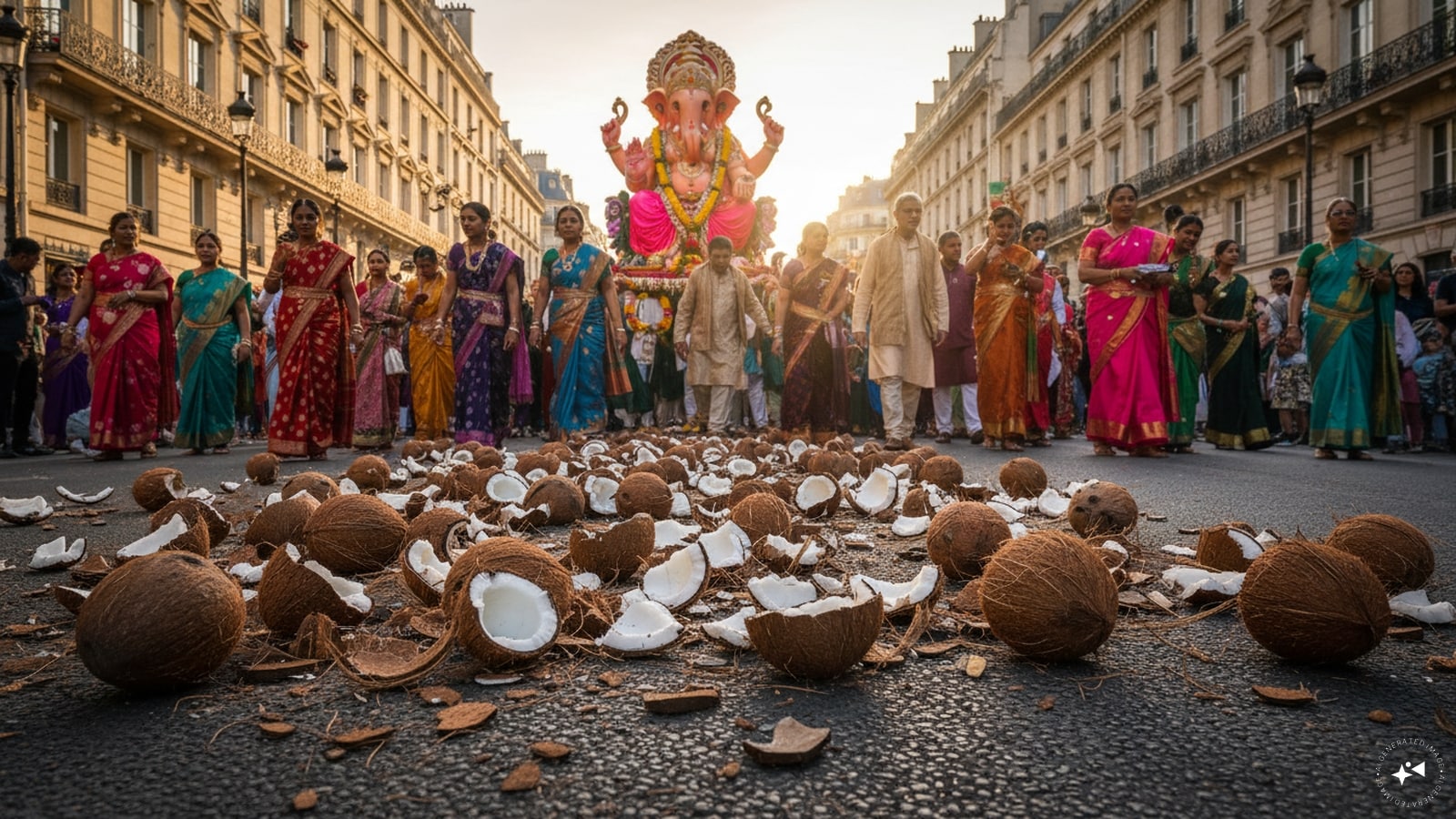
Thousands of people flooded the streets of La Chapelle in northern Paris, chanting prayers and beating drums. Amid the sea of red and yellow marigold garlands, something else caught the attention of local commuters and curious onlookers. Hundreds of split coconuts were left strewn across the pavement.
If you stumble upon news clips of Ganesh Chaturthi celebrations in the French capital, you might wonder why an ancient Hindu festival leaves behind a tropical fruit trail on European asphalt. It looks chaotic. It looks messy. But there's a profound ritual logic behind those shattered shells, and missing that context turns a sacred tradition into a simple litter problem.
Let's look at what actually happens during these massive diaspora celebrations.
The Ritual Significance of Breaking Coconuts
You don't just crack open a coconut for a snack during an offering to Ganesha. In Hindu traditions, the fruit represents the human ego. The hard outer shell is our stubborn exterior, our pride, and our material attachments. The sweet white kernel inside represents the pure soul, and the water symbolizes our inner impurities, desires, and egoistic tendencies.
When devotees smash a coconut on the ground during worship, they're performing a physical act of surrender. You break your ego at the feet of the divine. You smash away your pride so that your pure inner self can be revealed to the remover of obstacles.
When this festival travels thousands of miles from Mumbai or Pune to the bustling streets of Paris, the rituals travel with it. The temple associations in Paris organize massive public processions complete with ornate chariots, traditional musicians, and thousands of participants. Local authorities coordinate street closures, turning Parisian neighborhoods into vibrant extensions of South Asian festivities.
Yet, translating a vibrant religious practice onto tight European urban infrastructure creates friction.
Logistics Meets Faith on Parisian Pavement
Paris isn't built for spontaneous fruit processing on a massive scale. When a procession moves through the 18th arrondissement, devotees break thousands of coconuts as an offering of gratitude and a plea for safe new beginnings.
The immediate aftermath is striking. Streets look like a massive fruit market exploded. City sanitation departments face an unusual cleanup operation. It's a fascinating collision of municipal order and unbridled cultural expression.
Critics sometimes point to the mess on social media, complaining about civic tidiness. But miss the forest for the trees and you miss the entire point of cultural integration in modern European cities. Paris hosts diverse communities that bring their color, noise, and ancient customs right into the open air.
Organizers and local authorities have learned to adapt. Cleanup crews typically follow closely behind the procession trail, sweeping up the organic debris quickly. The coconuts don't go entirely to waste either. Many communities coordinate with local composting initiatives or animal shelters where appropriate, ensuring the organic offerings return to the earth rather than simply clogging landfills.
Understanding the Diaspora Experience
Public celebrations like Ganesh Chaturthi in Paris serve a vital purpose. They offer immigrants and second-generation families a tangible connection to their roots. Moving across continents means leaving behind familiar sounds, smells, and community structures. Recreating those spaces on foreign soil takes immense effort.
When you see a Paris boulevard lined with broken coconut shells, you're looking at community resilience. You're seeing people claim space in a city that can sometimes feel fiercely rigid about its cultural identity.
If you ever find yourself walking through northern Paris during late August or early September, keep your eyes open. Expect the unexpected. Step carefully past the remnants of devotion, and remember that every shattered shell represents someone letting go of their burdens on a busy European street corner.