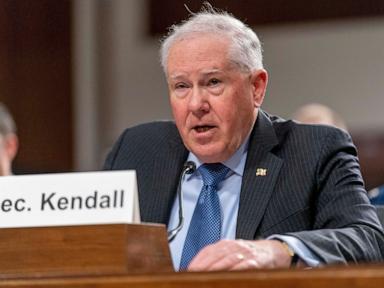
The revocation of a former Air Force secretary's classified information access marks a sharp escalation in how the Department of Defense polices its highest-ranking civilian and military alumni. When the Pentagon strips security clearances from former officials who once sat at the apex of national security, it sends shockwaves through the defense establishment. This aggressive posture reflects rising institutional anxiety over information security, the post-service consultancy pipeline, and the blurry lines where public service ends and defense industry profit begins.
For decades, the revolving door between the Pentagon and defense contracting giants operated with quiet predictability. High-ranking officials retired, shed their uniforms or civilian titles, and walked straight into lucrative advisory roles or executive boardrooms. They carried with them invaluable institutional knowledge, personal relationships with active commanders, and, crucially, active security clearances. That access allowed defense corporations to navigate complex procurement cycles with inside information. Now, the security apparatus is pushing back.
The Mechanics of Clearance Revocation
Striking a former secretary of the Air Force from the access lists requires a deliberate, multi-layered bureaucratic assault. Security clearances do not simply expire when a political appointee leaves office. Many officials maintain active or dormant clearance statuses for years, citing the potential need for advisory boards, congressionally mandated panels, or emergency consultations during national security crises.
When the Department of Defense moves to revoke these privileges, the action bypasses standard administrative renewals. It involves an active threat assessment or a policy shift regarding post-government employment cooling periods.
The immediate catalyst often points to outside entanglements. Foreign government lobbying, unverified advisory contracts with foreign entities, or unauthorized disclosures of sensitive discussions routinely trigger internal investigations. The Pentagon maintains that protecting classified networks requires eliminating dormant access points that could be exploited by foreign intelligence services or commercial competitors.
Yet, treating former cabinet-level leaders as security risks creates a profound institutional paradox. If an individual was trusted to oversee the entire Air Force budget, technological development, and nuclear modernization programs yesterday, what changes tomorrow? The answer lies in the transition from public trust to private incentive.
The Consultancy Trap and Foreign Entanglements
The modern defense industrial base relies heavily on former senior leaders to decode Pentagon priorities. When a retired civilian secretary or four-star general joins a major defense contractor or a private equity firm specializing in aerospace, they sell proximity. They sell the ability to pick up the phone and reach active-duty decision-makers.
The Pentagon's security apparatus has grown increasingly intolerant of how these post-service relationships intersect with foreign military sales. Modern defense contractors do not just sell to the United States military; they supply allied nations across the Middle East, Europe, and the Indo-Pacific. When a former American defense official consults for a foreign government or a multinational firm tied to foreign capital, the risk of classified data bleeding across international boundaries skyrockets.
Counterintelligence investigators look closely at conflicts of interest that violate the spirit, if not the strict letter, of post-employment restrictions. The rules governing classified information handling stipulate that a clearance is tied strictly to a "need-to-know" basis. Once an official enters the private sector, that need-to-know evaporates. Maintaining access anyway served as an unwritten perk of high office. The recent revocation signals that this perk is officially dead.
Historical Precedent and Institutional Paranoia
This crackdown does not occur in a vacuum. Over the past decade, the intelligence community and the Pentagon have systematically tightened access controls across the board. The motivation stems from high-profile leaks, insider threats, and a general erosion of trust in institutional safeguards.
During the Cold War, the elite club of retired defense officials operated under an unwritten code of discretion. Breaches were rare, and when they occurred, they were handled with quiet administrative demotions rather than public spectacles. Today, every security action carries political weight.
When a former Air Force secretary gets cut off from classified systems, it highlights a broader institutional paranoia. The Department of Defense fears two distinct nightmares. First, the inadvertent or intentional leakage of next-generation weapons programs to adversaries like China or Russia through commercial intermediaries. Second, the perception of corruption—the idea that the highest levels of military procurement are rigged by retired officials wielding active clearances to sway active competitions.
By severing these ties, the Pentagon attempts to insulate itself from both vulnerabilities. However, the move risks alienating a generation of experienced leaders who argue that restricting their access harms national security by cutting off vital institutional memory.
The Fallout for Defense Procurement
The ripple effects of this policy shift extend far beyond individual security files. Defense contractors are scrambling to reassess their advisory boards and consulting rosters. If former secretaries and chiefs of staff can have their clearances revoked overnight, their value as corporate assets diminishes.
This disruption forces a cultural reckoning within the defense sector. Companies can no longer rely purely on the Rolodex of a former political appointee to secure multi-billion-dollar weapon system contracts. They must compete on the technical merits of their bids, engineering capabilities, and cost efficiency.
Critics of the revocation argue that it is politically motivated, designed to punish dissent or silence former officials who critique current procurement strategies. Proponents counter that national security demands absolute adherence to clearance protocols, regardless of past rank or title. In the high-stakes arena of modern great power competition, the margin for error is razor-thin, and the Pentagon has decided that the risk of maintaining well-connected insiders in the classified ecosystem is simply too high to bear.
The door between public service and private enterprise remains open, but the locks have been changed, and the guards are no longer looking the other way.