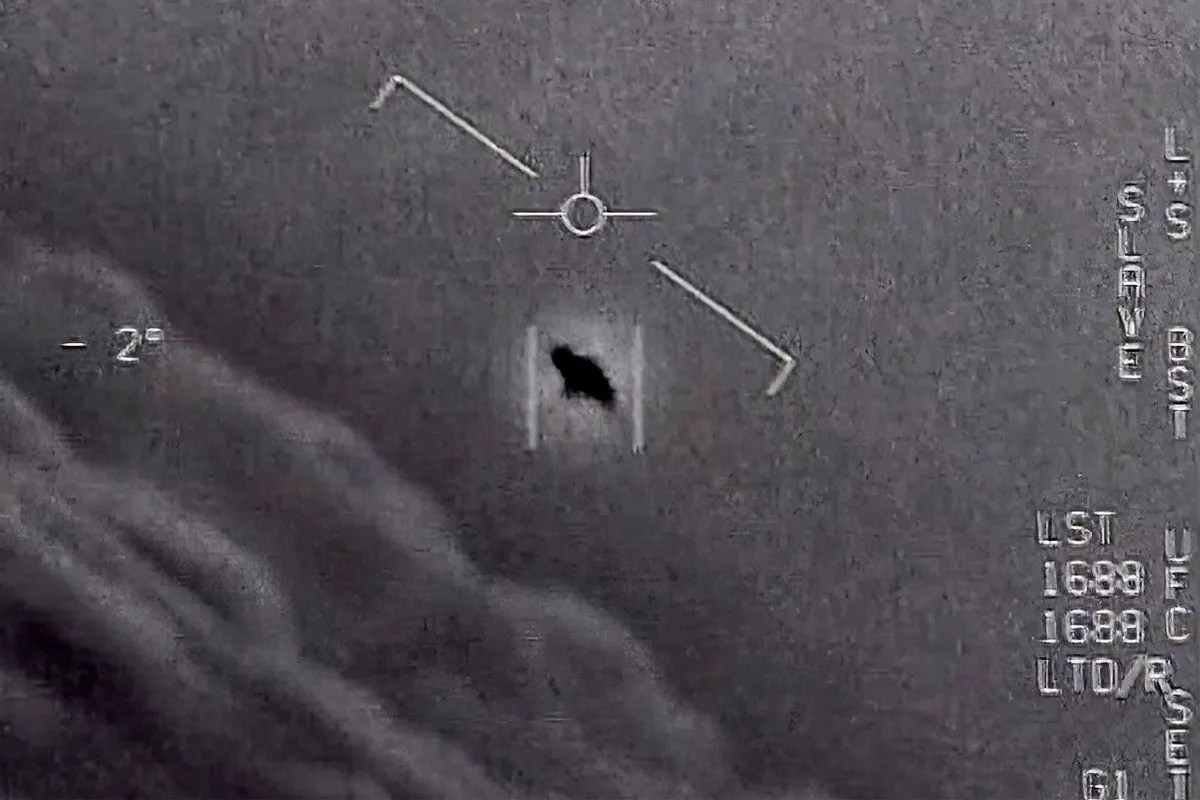
The recent flood of declassified files from the Pentagon regarding Unidentified Anomalous Phenomena (UAP) isn't the victory for transparency that activists think it is. It is a strategic data dump designed to achieve the exact opposite of clarity. While the public treats these releases like a slow-motion reveal of a galactic federation, the reality is far more mundane and significantly more concerning for national security.
The "lazy consensus" suggests that the government is finally "coming clean" because the truth is too big to hide. That is a fantasy. Governments don't "come clean" unless the disclosure serves a specific, tactical utility. This isn't disclosure. It’s a distraction. Recently making news lately: Structural Mechanics and Software Redundancy An Analysis of Tesla Fleet Reliability.
The Signal To Noise Ratio Is The Point
In intelligence circles, if you want to hide a needle, you don't put it in a haystack. You build a mountain of needles that all look slightly different. By releasing thousands of pages of grainy footage, sensor glitches, and eyewitness accounts from 1954, the Department of Defense (DoD) is effectively drowning meaningful data in a sea of irrelevance.
Most of these files are a catalog of technical failures. We are looking at "bokeh" effects on night-vision lenses, weather balloons catching the sun at high altitudes, and thermal artifacts that occur when a sensor reaches its physical limits. When the All-domain Anomaly Resolution Office (AARO) releases a report stating they have found "no empirical evidence" of extraterrestrial technology, they aren't lying. They are simply pointing out that a blurry smudge on a screen isn't a spaceship. More insights on this are explored by Ars Technica.
The real story isn't what is in the files. It's the fact that we are still using 1970s-era logic to interpret 21st-century electronic warfare.
Stop Looking For Little Green Men And Start Looking At Electronic Warfare
The obsession with "aliens" is the greatest gift ever given to foreign intelligence agencies. While the American public argues over whether a tic-tac-shaped object is piloted by Grays, our actual adversaries—China and Russia—are laughing.
Electronic Warfare (EW) has reached a point where "spoofing" a radar system into seeing a physical object that doesn't exist is trivial. This is called Digital Radio Frequency Memory (DRFM). It allows a drone or a high-altitude platform to capture a radar pulse and send it back with a delay or a frequency shift. To the operator on a Navy destroyer, it looks like an object just moved from 80,000 feet to sea level in a fraction of a second.
Physics didn't break. The sensor was lied to.
If the Pentagon admits that a "UAP" is actually a Chinese electronic warfare platform successfully spoofing our most advanced carrier strike groups, they have to admit a massive vulnerability. It is much easier, and much more politically convenient, to categorize it as "unexplained." It preserves the illusion of total air superiority while avoiding a diplomatic crisis or a panic about domestic surveillance capabilities.
The Budgetary Incentive For Mystery
Follow the money. Transparency isn't the motive; funding is.
The military-industrial complex thrives on "unknown threats." Throughout the Cold War, the "bomber gap" and the "missile gap" were used to justify astronomical increases in defense spending. Today, the "capability gap" represented by UAPs serves the same purpose.
If you describe a threat as a foreign drone, you get a specific, capped budget to build a counter-drone system. If you describe a threat as an "unidentified phenomenon with trans-medium capabilities," you get a blank check for "advanced aerospace research."
I have seen programs where millions are funneled into "anomalous materials research" that yield nothing but standard alloys. But because the project is wrapped in the mystique of "the phenomenon," it escapes the standard oversight that would kill a failing conventional project. The mystery is the product.
Why The "Disclosure" Movement Is Doing The Government's Work
The most ironic part of this saga is that the UAP "truthers" are the Pentagon's most effective unpaid PR firm. Every time a former intelligence officer goes on a podcast to hint at "recovered craft" without providing a single shred of physical evidence, they reinforce the narrative that the government possesses god-like technology.
This creates a "security theater" that deters adversaries. If I am a foreign power, and I believe the U.S. has back-engineered gravity-defying craft from a 1947 crash, I am much less likely to engage in a conventional conflict. The Pentagon doesn't need the technology to exist; they only need you to believe they might have it.
We are seeing a repeat of "Project Blue Book" logic. During the 1950s, the Air Force knew many UFO sightings were actually U-2 spy plane test flights. They didn't debunk the UFO sightings with the truth because they preferred people thinking about Martians rather than top-secret domestic reconnaissance.
The Sensor Trap
We need to address the "People Also Ask" obsession: "If these aren't aliens, why do pilots see them?"
Pilots are highly trained, but they are still human. More importantly, they are increasingly reliant on Augmented Reality (AR) and sensor fusion. When you are flying an F-35, you aren't looking out a window; you are looking at a digital reconstruction of the world projected onto your visor.
If the software has a bug, or if the sensor suite—which includes Radar, Infrared (FLIR), and Distributed Aperture Systems (DAS)—receives conflicting data, the AI tries to "resolve" that conflict. This often results in a visual "ghost."
The pilots aren't lying. They are seeing what their instruments tell them is there. But we are reaching a point where the map is no longer the territory. We are mistaking digital glitches for physical entities.
The Hard Truth About Declassification
There is a reason the most interesting files remain "classified" even after these "major releases." It isn't because they contain photos of alien bodies. It’s because they contain the signatures of our own secret platforms.
If the DoD releases a crystal-clear video of an anomalous object, they also reveal:
- The exact resolution of the sensor that took the video.
- The location of the platform (which might be where it shouldn't be).
- The frequency and wavelength at which the sensor operates.
The "mystery" is the only thing protecting the technical specifications of our surveillance state.
Stop Asking "Are We Alone?"
The question is a distraction. It’s a philosophical campfire story that keeps us from asking the harder, more immediate questions:
- How many of these "phenomena" are actually sovereign incursions by adversaries using sub-orbital drones we can't reliably intercept?
- Why is the military using the "UFO" label to bypass congressional oversight on black-budget aerospace programs?
- To what extent is our sensor technology being manipulated by low-cost electronic warfare decoys?
The Pentagon isn't opening a door to the stars. They are closing the door on their own incompetence and their secret test flights by letting you stare at the shiny lights in the sky.
If you want the truth, stop reading the declassified files. Start reading the patents for high-energy laser systems and plasma-based aerial decoys. The "aliens" aren't coming from another galaxy. They are being projected from a shipping container in the South China Sea or a skunkworks lab in Nevada.
The files aren't the story. The fact that you think they are is the real achievement of the intelligence community.
Your wonder is their camouflage.