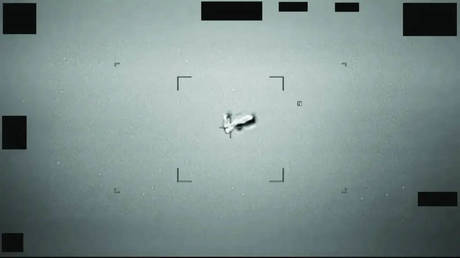
The Pentagon finally declassified UFO files that actually matter, and it’s about time. For decades, we’ve been told that grainy footage and pilot testimonies were just "glitches" or "swamp gas." Then, the Department of Defense (DoD) decided to open the vault. They didn't just release some blurry photos. They dropped thousands of pages and several videos that confirm one thing. Our military is seeing things in the sky it cannot explain.
If you’re looking for a smoking gun that proves little green men are hiding in a basement in Nevada, you won't find it here. What you will find is a terrifying admission of ignorance. The Pentagon isn't saying it’s aliens. It’s saying it has no idea what these objects are, how they move, or who owns them. That’s a massive shift in the official narrative.
Why the Pentagon is finally talking about UAPs
The term "UFO" is dead. Long live "UAP." The government switched to Unidentified Anomalous Phenomena because UFOs carry too much baggage. When you hear UFO, you think of 1950s sci-fi movies. When you hear UAP, you think of a national security threat. This rebranding wasn't an accident. It was a calculated move to make the topic respectable for Congress and the scientific community.
The All-domain Anomaly Resolution Office (AARO) is the lead on this. They’re the ones sifted through years of radar data, thermal imaging, and eyewitness accounts. They’ve admitted that a small percentage of sightings remain truly "anomalous." We’re talking about objects that pull 700 Gs of force without wings, engines, or visible exhaust. No human pilot could survive that. No known airframe could hold together.
I’ve looked at the data. It’s not just about what’s in the files, but the tone of the people writing them. They aren't laughing anymore.
The Tic Tac and the Gimbal videos
You’ve probably seen the videos. The "Tic Tac" incident from 2004 and the "Gimbal" footage from 2015 are the anchors of this entire disclosure movement. Commander David Fravor and Lt. Cmdr. Alex Dietrich, both highly trained Navy pilots, chased a white, pill-shaped object over the Pacific. It mirrored their movements. It moved faster than their F/A-18 Super Hornets. Then it vanished.
The declassified files confirm these weren't sensor errors. Multiple platforms—radar from the USS Princeton and the cameras on the jets—tracked the same thing simultaneously. When you have independent sensors seeing the same impossible physics, it’s not a "glitch." It’s a physical object.
Critics love to say these are just Chinese drones or secret US tech. Maybe. But the files show these objects have been recorded since the 1940s. Did China have trans-medium drones that can fly from space to the ocean in seconds back when we were still using vacuum tubes? Unlikely.
What the declassified documents actually say
The meat of the recent releases comes from the AARO Historical Record Report. It covers sightings from 1945 to today. The Pentagon claims it found no evidence of "off-world" technology. Of course they’d say that. Admitting to alien tech would be the biggest intelligence failure in human history.
Instead, the files focus on the "Range Fouler" reports. These are accounts from modern Navy pilots who encounter these things almost daily off the East Coast.
- Objects shaped like cubes inside spheres.
- Craft that remain stationary in hurricane-force winds.
- Lights that dive into the ocean without a splash.
The Pentagon is stuck. If they admit these are foreign adversaries, they’re admitting Russia or China has leaped ahead of us by a thousand years. If they admit they’re ours, they’re admitting to a massive secret program that’s been hidden from Congress. If they say "we don't know," they look incompetent. They chose the "we don't know" route. It's the safest bet for a bureaucrat.
The role of whistleblowers like David Grusch
You can't talk about these declassified files without mentioning David Grusch. He’s the former intelligence official who went to the Inspector General with claims that the US has "intact and partially intact" non-human craft. The Pentagon’s public files don't confirm his claims, but they don't exactly debunk them either.
Grusch’s testimony forced the Pentagon to be more transparent. The files we see today are a direct result of political pressure. Congress is tired of being kept in the dark. Senator Chuck Schumer even introduced the UAP Disclosure Act, which used the phrase "non-human intelligence" over twenty times. That’s not something a high-ranking politician does for fun. They know something we don't.
The science of the impossible
The declassified reports mention "trans-medium" travel. This is the stuff of nightmares for physicists. Imagine a craft that can fly at Mach 20 in the atmosphere, then dive into the water at 100 knots without slowing down. Water is dense. Crashing into it at high speed is like hitting concrete.
Standard propulsion relies on Newton’s third law. You push something out the back to go forward. These objects don't have intakes or nozzles. They seem to manipulate gravity or space-time itself. If the Pentagon is declassifying these files to "come clean," they’re doing a poor job of explaining the physics.
Dissecting the skepticism
It's easy to be a skeptic. I get it. Most "UFO" sightings are just Starlink satellites, birds, or weather balloons. AARO claims that 95% of cases have mundane explanations. But it’s that 5% that keeps people up at night.
The declassified files show that even when the government "resolves" a case, the explanation is often flimsy. They'll label something a "likely balloon" even if it was moving against the wind at supersonic speeds. They’re trying to close the books as fast as possible to avoid a panic.
Why now
The timing is suspicious. We’re in an era of hyper-partisanship and global instability. Dropping UFO files is a great distraction. Or, perhaps more likely, the technology has become so common in our airspace that the military can no longer hide it from commercial pilots and civilian trackers.
With high-resolution cameras on every smartphone and private satellite constellations like Maxar, the government’s monopoly on "the truth" is over. They’re declassifying these files because they have to. They’re trying to get ahead of a story they can no longer control.
What you should do with this information
Don't just take the Pentagon’s word for it. Read the reports yourself on the AARO website. Look at the data. You’ll notice huge sections are still redacted. Black bars cover the most interesting bits—usually the "sources and methods" part. That’s where the real sensor data lives.
Stop looking for a "landing on the White House lawn" moment. It isn't coming. Disclosure is a slow drip. It’s a series of boring reports, Congressional hearings, and technical papers.
Keep an eye on the James Webb Space Telescope data and the upcoming NASA UAP studies. The civilian side of science is finally catching up to what the military has known for decades. Check the flight paths of UAP sightings—they’re almost always near nuclear assets or military training ranges. That’s a pattern you can't ignore.
Demand more from your representatives. The UAP Disclosure Act was gutted before it passed. Ask why. If there’s nothing to hide, why are certain politicians fighting so hard to keep the files classified?
The truth isn't just "out there." It's sitting in a declassified PDF on a government server, waiting for enough people to actually pay attention to the details. The Pentagon hasn't given us the whole story, but they’ve given us enough to know that the sky isn't as empty as we thought.