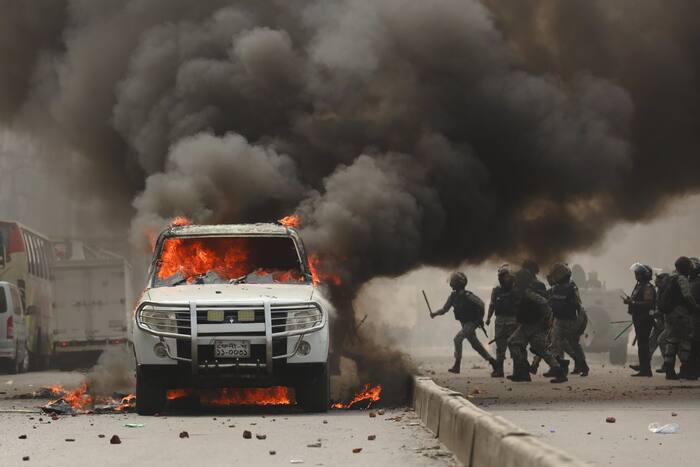
Tear gas in Gazipur. Rubber bullets in Ashulia. Factories burned to the ground while major Western fashion brands stay conspicuously quiet.
When headlines announce that police in Bangladesh clash with garment workers demanding higher minimum wages, the Western media usually treats it like a sudden, isolated flare-up. It isn't. It's the predictable result of a broken global supply chain colliding with brutal domestic inflation. If you think these street battles are just about a few extra dollars a month, you're missing the real story behind the clothes in your closet. Don't miss our previous post on this related article.
I've spent years tracking labor economics across South Asia's manufacturing hubs, and the pattern in Dhaka never changes. Every five years, the Bangladeshi government convenes a wage board. Every five years, workers hit the streets because the numbers simply don't cover basic survival. And every time, the state responds with batons, arrests, and lethal force to protect an industry that brings in over 80% of the nation's export earnings.
Why Garment Workers Are Clashing With Police in Bangladesh
Let's look at the actual math that pushed tens of thousands of workers into the streets of Dhaka, Gazipur, and Narayanganj. Before the late 2023 wage revision, the legal minimum wage for an entry-level garment worker in Bangladesh sat at 8,000 taka per month. That's roughly $75. If you want more about the background here, Associated Press provides an informative summary.
Try feeding a family on $75 a month when food inflation in Bangladesh is hovering near 10% to 12%. You can't. Workers weren't asking for luxury. Unions demanded 23,000 taka (around $208) a month just to cover rent, rice, lentils, and basic medical care.
The government-appointed wage board countered with 12,500 taka—about $113.
That wasn't a compromise. It was a slap in the face. For workers already drowning in debt to local grocers, a 56% raise on paper meant almost nothing in real purchasing power after years of runaway inflation and currency devaluation. So they walked out. Hundreds of factories shut down across the industrial belts outside Dhaka.
The state's reaction was swift and unforgiving. The Industrial Police, Border Guard Bangladesh (BGB), and Rapid Action Battalion (RAB) deployed in full riot gear. Instead of negotiating, authorities treated an economic strike like a security threat.
- At least four garment workers died during the height of the late 2023 demonstrations, including workers killed by police gunfire and factory arson.
- Over 100 workers were injured by rubber bullets, sound grenades, and batons.
- Police filed sweeping criminal cases against tens of thousands of unnamed workers, a classic tactic used in Bangladesh to terrorize union organizers into silence.
- Dozens of factories indefinitely closed their gates under Section 13(1) of the Bangladesh Labour Act, which allows owners to withhold pay during illegal strikes.
Honest reporting requires acknowledging both sides of the street violence. Yes, small groups of protesters threw bricks, blocked highways, and torched several factory buildings and vehicles. Factory owners point to these property losses as justification for calling in riot police. Yet human rights groups like Human Rights Watch and Amnesty International documented that security forces routinely used excessive, indiscriminate force against peaceful demonstrators and bystanders alike.
The Economics Behind the Bangladesh Minimum Wage Crisis
You can't understand why factory owners fight a $208 wage so fiercely without understanding who actually pockets the money from a $25 t-shirt.
Bangladesh is the world's second-largest apparel exporter, trailing only China. The Ready-Made Garment (RMG) sector employs roughly 4 million people, the vast majority of them women who migrated from rural villages. Giants like H&M, Zara (Inditex), Gap, Walmart, and Primark rely heavily on Dhaka's factories because production costs are rock-bottom.
Here's the catch. Factory owners in the Bangladesh Garment Manufacturers and Exporters Association (BGMEA) operate on razor-thin margins. Western buyers constantly squeeze suppliers for lower unit prices and faster turnaround times, even when raw material and energy costs spike.
When workers demand higher pay, factory owners look at their balance sheets and panic. They argue that jumping straight to 23,000 taka would bankrupt smaller factories and drive global brands toward competitors in Vietnam, Cambodia, or India.
They aren't entirely lying about the squeeze. Studies from the Center for Global Workers' Rights at Penn State have repeatedly shown that the real price paid by Western brands to Bangladeshi suppliers actually dropped in the years following the 2013 Rana Plaza collapse, even while factories spent millions upgrading fire and building safety.
Still, passing that financial squeeze onto a woman earning $75 a month is morally bankrupt. Many large Bangladeshi conglomerate owners own luxury properties abroad, run private banks, and wield massive political influence in parliament. In fact, a significant percentage of Bangladeshi lawmakers own stakes in garment factories. When workers protest against factory owners, they're fighting the exact same people who control the police force.
What Happened After the Wage Board Ruling
Even after the new 12,500 taka wage officially took effect in December 2023, the unrest didn't magically evaporate. Why? Because wage hikes on paper rarely translate cleanly onto factory floors in Dhaka.
First, factories immediately raised production targets. If a sewing machine operator previously had to stitch 100 collars an hour, supervisors suddenly demanded 130 or 140. Fail to hit the new quota, and you face verbal abuse, unpaid overtime, or summary firing.
Second, landlords in industrial hubs like Ashulia and Savar raised rents the exact week the wage increase was announced. Local shopkeepers hiked prices on staples. The wage bump vanished before workers even cashed their first checks.
Third, the crackdown decimated independent labor organizing. Union leaders like Kalpona Akter of the Bangladesh Center for Worker Solidarity have spent decades pointing out that without genuine freedom of association, every wage cycle ends in bloodshed. When workers can't form independent unions without getting blacklisted or beaten by local thugs, street protests become their only megaphone.
How Global Fashion Brands Dodged Accountability
Whenever police in Bangladesh clash with garment workers, Western apparel companies issue the exact same sanitized press releases. They express "deep concern" over the violence. They urge "peaceful dialogue." They claim to support "living wages" in principle.
Look past the PR fluff and examine what they actually did.
During the wage negotiations, a coalition of major global brands—including H&M, Adidas, Gap, and Levi Strauss—sent a letter to the Bangladeshi government pledging to support responsible purchasing practices and account for higher wage costs. Sounds great in theory.
In practice, almost none of those brands publicly backed the workers' 23,000 taka demand. None of them guaranteed specific price increases per garment to fund a living wage. Worse, when factory owners filed criminal charges against thousands of workers and fired union activists in the aftermath of the protests, most Western brands failed to use their massive financial leverage to demand those charges be dropped.
It's a convenient setup for multinational corporations. Brands outsource the manufacturing, outsource the legal liability, and outsource the state violence used to keep labor cheap. Meanwhile, consumers in New York, London, and Berlin buy cheap fast fashion without ever seeing the tear gas canisters spent in Gazipur.
What Needs to Change Before the Next Explosion
If nothing changes structurally, Bangladesh will repeat this exact cycle of strikes, police shootings, and inadequate wage boards. Real reform requires pressure from multiple directions at once, not empty corporate pledges.
If you want to understand what actually moves the needle in global apparel supply chains—or how you can apply pressure as a consumer, investor, or industry professional—watch these four concrete levers:
- Enforceable Brand Agreements Over Voluntary Codes: Voluntary corporate social responsibility audits are completely broken. Look at the International Accord for Health and Safety in the Textile and Garment Industry. It only worked because it was legally binding on brands. Wage agreements need the exact same legal teeth, forcing brands to pay a ring-fenced labor premium directly tied to worker wages.
- Transparent Purchasing Practices: Track which brands actually disclose their Tier 1 and Tier 2 supplier lists through platforms like the Open Supply Hub. Transparency makes it harder for companies to quietly abandon factories when workers unionize.
- Dropping Mass Criminal Cases: Watch whether Bangladeshi authorities dismiss the blanket FIRs (First Information Reports) filed against thousands of unnamed garment workers. As long as those warrants hang over workers' heads, any talk of "social dialogue" is pure theater.
- Support Independent Worker-Led Unions: Skip generic charity donations that treat workers like passive victims. Follow and support grassroots, worker-led federations inside Bangladesh—such as the Bangladesh Garment and Industrial Workers Federation (BGIWF)—that fight for collective bargaining rights on the ground.
Until global brands pay prices that reflect the real cost of human labor, and until Dhaka stops treating hungry workers like criminals, the streets outside Bangladesh's garment factories will remain a powder keg.