Washington DC summers are brutal. The humidity feels like a wet blanket, and the sun beats down on the National Mall without mercy. If you want to build a giant, shallow concrete basin right in the middle of that swampy heat, you're practically building an incubator. That's the basic reality of the Lincoln Memorial Reflecting Pool. It's a gorgeous monument, but it's also a biological time bomb.
A massive controversy has exploded over a fourteen million dollar renovation project designed to fix this exact problem. Instead of fixing it, the project turned into a high profile mess of bright green slime and peeling blue paint.
Everyone is pointing fingers. Some internet commentators blame political sabotage. Others blame cheap contractor work. The truth is much simpler, much funnier, and rooted in basic high school chemistry. Someone poured a ton of concentrated hydrogen peroxide onto fresh paint.
Here is what really happened to the nation's front yard, why the fixes backfired so spectacularly, and what it says about rushed public works projects.
The Fourteen Million Dollar Paint Job
The whole situation started in April when the Trump administration decided to overhaul the century old reflecting pool. The pool had been drained because it looked dirty. The administration wanted to spruce up the capital city just in time for the upcoming United States semiquincentennial celebrations. The goal was simple. Make the water look deep, clean, and beautiful.
To achieve this, the administration awarded a no bid contract to a Virginia company called Atlantic Industrial Coatings. This company had previously worked on a swimming pool at one of the president's golf clubs. That detail alone raised eyebrows across the capital. What started as a project initially estimated to cost around one point eight million dollars quickly ballooned. By the time the workers finished, federal spending databases showed the total cost skyrocketed past fourteen point seven million dollars.
The core of the plan involved coating the entire stone floor of the basin with a special industrial sealant. The president personally picked out the color. He wanted a specific shade he called American flag blue. The idea was that a dark blue bottom would make the water look like a pristine mountain lake instead of a murky pond.
On June 6, the administration announced the job was complete. The water was pumped back in, filling up an area larger than six soccer fields. For a brief second, it worked. The blue coating shimmered under the sun. It looked exactly like a postcard.
Then the heat wave hit.
The Chemistry of a DC Green Out
By June 14, less than two weeks after the big reveal, the pool didn't look like an American flag anymore. It looked like lime Jell-O. A massive algae bloom took over the shallow water, turning the expensive blue expanse into a vibrant, fluorescent green soup.
Algae blooms aren't new here. This has happened regularly since the monument was dedicated way back in 1922. The pool is huge, holding millions of gallons of water, but it's only about two to three feet deep. It has no shade. It sits out in the open, absorbing the blazing summer sun. To make matters worse, the pool gets its water supply pumped in from the Tidal Basin, which is already full of organic matter and nutrients.
When you combine stagnant water, heavy sunlight, and tons of organic nutrients, you get an algae paradise. Marine biologists from the Smithsonian Institution have pointed out that if you wanted to deliberately farm algae on a massive scale, you would build exactly what the reflecting pool is.
The dark blue paint actually made the problem worse. Basic physics tells us that dark colors absorb more heat than light colors. The new dark blue coating absorbed the sun's rays, warming up the shallow water even faster than the old gray concrete did. The pool became a literal hot tub for microbes.
The Interior Department initially tried to downplay the green tint. They claimed it was just residual algae from the supply lines that had sat dormant during the eight weeks of construction. They promised it would clear up soon as part of the normal startup process.
It didn't. The green slime kept growing.
Tiny Bubbles and Harsh Chemicals
Panicking because the national monument looked like a swamp, the National Park Service deployed two main strategies to kill the bloom. They started using an ozone nanobubbler filtration system. This technology injects microscopic oxygen bubbles into the water to break down organic matter and suffocate the algae.
That system wasn't working fast enough for a high profile monument in the middle of Washington. The crews decided they needed something faster and more aggressive. They brought out the heavy duty chemicals.
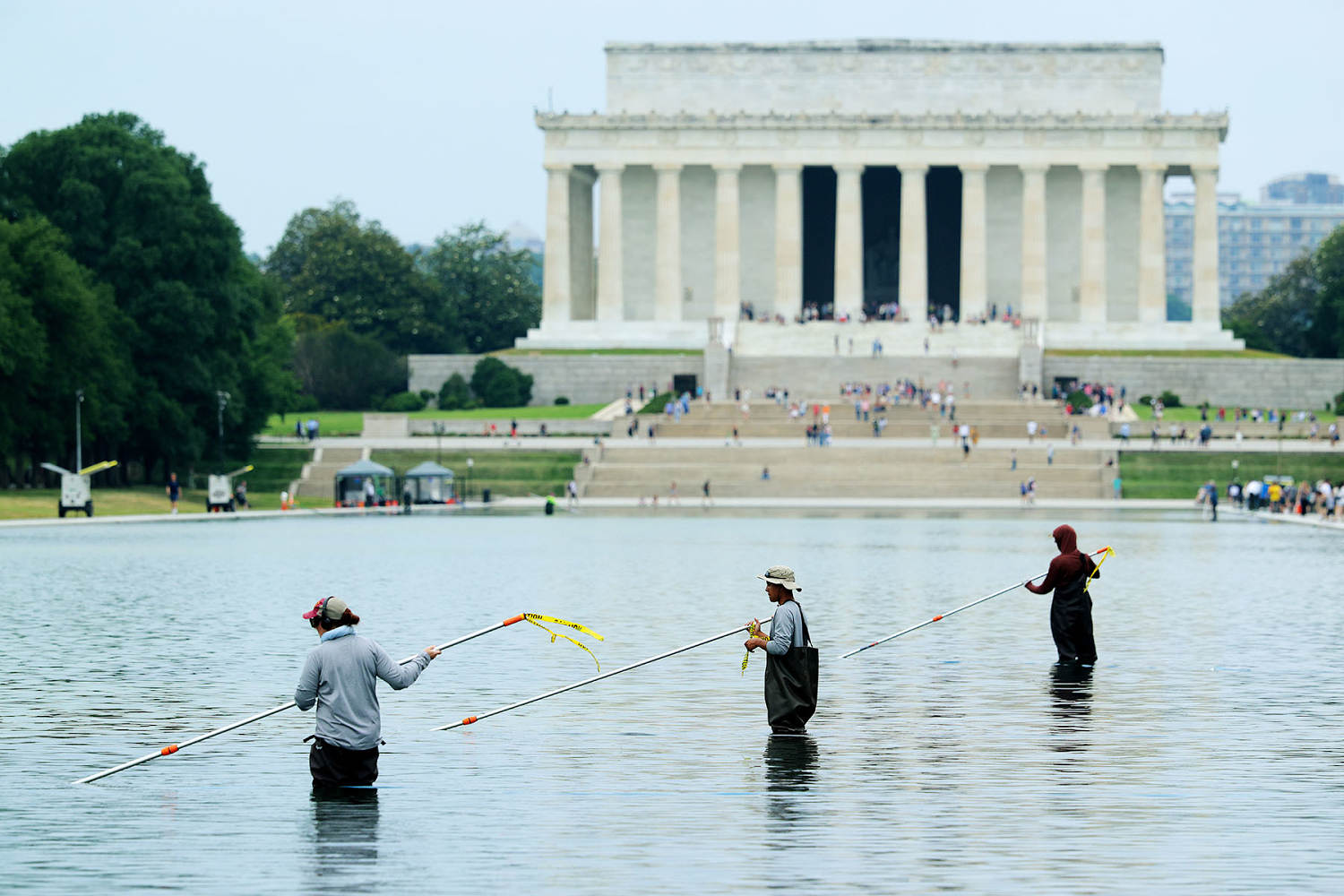
Park workers in waders began dumping massive amounts of industrial hydrogen peroxide directly into the reflecting pool. Hydrogen peroxide is usually considered an eco friendly algaecide because it breaks down into water and oxygen. It doesn't leave behind the harsh toxic residues that chlorine does. That makes it safer for the local duck populations that hang out on the National Mall.
There was just one critical flaw in this plan. Concentrated hydrogen peroxide is incredibly reactive. It doesn't just attack biological organisms like algae. It attacks chemical bonds.
Chemical engineers have known for a long time that hydrogen peroxide is an active ingredient in several heavy duty commercial paint stripping formulations. When workers dumped buckets of the stuff into the pool to clear the green water, the chemical started interacting with the fresh industrial coating on the floor.
The paint job was barely two weeks old. Even industrial strength sealants need proper curing times and can fail when exposed to high concentrations of oxidizing agents. The peroxide seeped into the microscopic pores of the new sealant, breaking down the adhesion between the blue layer and the underlying stone.
The Great Peeling Disaster
By June 18, tourists visiting the Lincoln Memorial didn't see a beautiful blue pool or even a green pool. They saw giant, dark blue sheets of rubbery material floating to the top of the water.
An underwater video shared on social media confirmed the worst. Huge patches of the fourteen million dollar blue coating were completely gone, exposing the raw gray stone underneath. In other spots, massive flaps of the sealant were partially detached from the floor, waving back and forth in the water like blue seaweed.
Internet rumors immediately went wild. People claimed political opponents had snuck into the pool overnight with knives to rip up the liner. Others insisted the floating blue sheets were just plastic trash or debris from the crowd.
The physical evidence pointed straight to a chemical failure. The combination of intense heat, trapped moisture under the sealant, and a sudden dumping of concentrated hydrogen peroxide caused the material to blister, rip, and peel away from the stone basin.
While the physical structure was falling apart, the public relations machine went into overdrive. The Department of the Interior posted a bizarre statement on social media declaring complete victory over the algae. They claimed the nanobubbler technology had worked flawlessly. They even compared the dead algae sitting on the bottom of the pool to the destroyed Iranian navy resting on the bed of the Persian Gulf.
The tweet drew immediate mockery online. Visitors standing at the edge of the pool could look right down and see that the crystal clear water was simply revealing a wrecked, peeling paint job.
The Mistakes of Rushed Infrastructure
This whole mess highlights a classic problem with modern public works projects. Speed is often prioritized over proper planning and expertise.
The administration bypassed the standard competitive bidding processes to hand the contract to a familiar firm. They rushed the project to meet a political deadline for the nation's birthday celebrations. They ignored the fundamental environmental realities of the D.C. climate.
When you skip regular architectural review boards and push past standard engineering protocols, you end up with major technical blind spots. Expert pool operators in Virginia noted that trying to treat untreated river water after it's already filled a giant, sun baked basin is a losing battle. The proper way to handle an algae prone feature of that scale is to treat the water as it flows into the system, or to accept that a natural gray concrete bottom is far easier to manage than a bright blue aesthetic feature.
Instead, the city is left with a patchy, multi colored eyesore that looks worse than it did before the fourteen million dollars was spent.
What Happens Next
Fixing this isn't as simple as throwing on another coat of paint. You can't just slap new sealant over a surface that is actively peeling and contaminated with chemical residues.
The National Park Service faces a difficult choice. They can drain the entire six-soccer-field-sized basin all over again, which requires millions of gallons of water and completely shuts down one of the city's main tourist draws during the peak summer travel season. If they drain it, crews will have to manually scrape off every single square inch of the remaining blue sealant, pressure wash the stone, let it dry completely, and start the entire process from scratch.
The alternative is even uglier. They can leave it as it is for the summer, watching more blue sheets peel off and float away while trying to vacuum up the debris daily. This leaves a patchy, messy pool for the big national celebrations.
If you are planning a trip to Washington DC anytime soon, don't expect the pristine blue waters promised in the press releases. Bring your camera, look past the floating blue flakes, and enjoy the history of the monuments. The real lesson here isn't about sabotage or secret plots. It's a reminder that nature and chemistry don't care about political deadlines or million dollar price tags. If you dump paint stripper onto fresh paint in the middle of a heat wave, the paint is going to come off every single time.