Turn on any mainstream news broadcast during a French protest and you'll see the exact same footage. Black hoodies. Shattered bank windows. Tear gas rolling down wet Parisian cobblestones while riot police advance in tight formation.
That’s the easy story. It’s also wildly incomplete.
If you actually spend a night walking the boulevard with the Paris ultra-left protesters, you quickly realize the crowd isn't a uniform army of cartoon villains. It’s a messy, loud, deeply fractured coalition of people who share a common enemy—usually the French state, corporate capitalism, or whatever reform the Élysée Palace just pushed through—but disagree fiercely on almost everything else.
Most outsiders lump every radical demonstrator under one scary label. Doing that misses the entire reality of modern French street politics.
The Myth of the Monolithic Mob
The French Interior Ministry loves clean categories. Police intelligence units routinely classify radical demonstrators under the umbrella term ultragauche (ultra-left), often pointing to the Black Bloc tactic as proof of a single coordinated underground network.
Here’s the truth on the ground. The Black Bloc isn't an organization. It’s a tactic borrowed from 1980s German Autonomen movements, where individuals wear black clothing and masks to maintain anonymity and prevent police surveillance from singling out specific people.
When you walk through Place de la République or down Boulevard Voltaire during a major mobilization—whether it was the Yellow Vest (Gilets Jaunes) uprisings, the 2023 pension reform battles, or subsequent austerity protests—you see dozens of distinct micro-cultures colliding in real time.
- Autonomists and anarchists who reject traditional political parties and unions entirely, viewing property damage against banks and luxury storefronts as legitimate political expression.
- Anti-fascist (antifa) collectives organized around neighborhood defense and street-level counter-protesting.
- Radicalized students and precarious gig workers who came for a peaceful march, got kettled by riot police (CRS), and decided they weren't leaving quietly.
- Old-school Trotskyists and revolutionary socialists handing out physical newspapers and arguing theory while smoke grenades pop fifty meters away.
They don't answer to a central commander. Honestly, half the time they don't even like each other.
Why "All Colors" Actually Matters
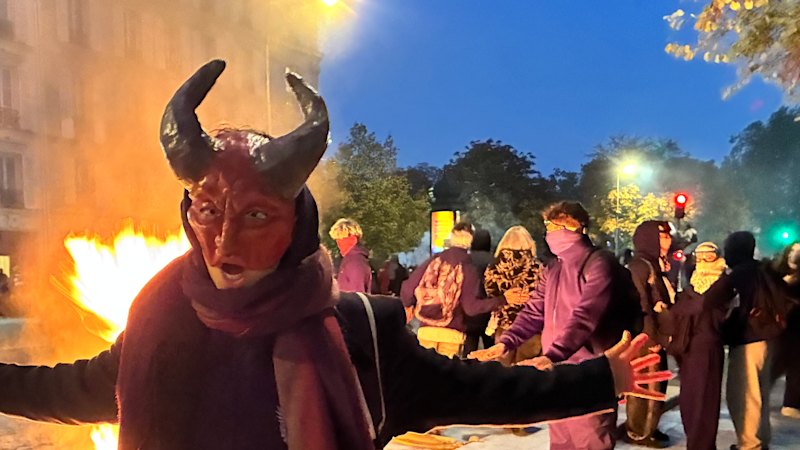
Look past the black windbreakers and you'll spot a chaotic mix of symbols, banners, and subcultures. You'll see purple feminist flags from groups like NousToutes, green climate-justice banners from Les Soulèvements de la Terre, Kurdish solidarity flags, and traditional red union flags from radicalized branches of the CGT or Sud Rail.
That’s what pundits miss when they reduce Parisian street clashes to simple hooliganism. French protest culture operates as an ecosystem.
During major demonstrations, the cortège de tête—literally the "head of the march"—forms ahead of the official trade union floats. Historically, unions negotiated strict routes with the Paris Police Prefecture and used their own marshals (service d'ordre) to keep protesters orderly. Over the last decade, radicalized youth and independent activists broke away from that script. They seized the front of the march, turning a predictable parade into an unpredictable confrontation.
What a Night on the Boulevard Actually Feels Like
Television cameras compress distance and time. A three-hour standoff looks like nonstop war on a thirty-second cable news clip.
In reality, a night with Paris protesters is mostly waiting, walking, and watching the air.
You hear the low thrum of helicopters overhead long before anything happens. Then comes the rhythmic clack-clack-clack of CRS batons hitting polycarbonate shields. Experienced protesters immediately recognize the shift in posture. Street medics—volunteers wearing red crosses made of electrical tape on their backpacks—move toward the edges with bottles of saline solution and Maalox mixed with water to wash tear gas out of people's eyes.
Then the wind changes.
Tear gas (gaz lacrymogène) doesn't just make you cry; it sears your throat and triggers instant panic in anyone who hasn't experienced it before. You see hardened twenty-something autonomists calmly handing swimming goggles and lemon slices to middle-aged teachers who simply marched too close to the front line.
That shared vulnerability creates temporary solidarity. People who would never share a coffee shop table end up pulling each other out of police kettles (nasses), a controversial crowd-control tactic where police surround an entire block for hours, blocking exits while firing canisters into the center.
The Role of the Street Medics and Legal Observers
If you want to understand how organized—and simultaneously disorganized—these nights are, watch the people who aren't throwing anything.
Groups like the Ligue des Droits de l'Homme (Human Rights League) send official observers in bright vests to document police conduct and arrests. Alongside them operate informal legal defense teams. Protesters write the phone number of Paris defense lawyers directly onto their forearms in permanent marker before leaving home. Why? Because if you're detained for garde à vue (police custody, which can last up to 48 hours), your phone is confiscated immediately.
It's a sobering detail. Beneath the theatrical graffiti and burning trash cans (poubelles), there's a grim routine that both protesters and police know by heart.
Why France Keeps Producing Radical Street Movements
You can't explain the Paris ultra-left without talking about French institutional politics.
Under the Fifth Republic, the French presidency holds extraordinary executive power. Article 49.3 of the French Constitution allows the government to force legislation through the National Assembly without a final vote unless the opposition passes a no-confidence motion. President Emmanuel Macron’s government used Article 49.3 repeatedly to pass its unpopular pension reform raising the retirement age from 62 to 64.
When millions of people march peacefully for months, strike across major industries, and watch the government bypass parliament anyway, parliamentary democracy starts looking like a rigged game to younger generations.
Sociologists who study French social movements, such as researchers at the CNRS (French National Centre for Scientific Research), have noted a clear generational shift. Younger activists increasingly view traditional voting and polite petitioning as dead ends. To them, disruptive street action isn't a breakdown of politics—it is politics.
The State Response and Escalation Cycle
French policing doctrine hasn't exactly cooled the temperature.
Unlike policing models in countries like Germany or the UK that prioritize de-escalation and dialogue units, French crowd control relies heavily on deterrence, area denial, and mobile units like the BRAV-M (motorized brigades created during the Yellow Vest protests). Human rights organizations, including Amnesty International and the Council of Europe, have repeatedly criticized France for its heavy use of rubber bullets (LBD 40), sting-ball grenades, and mass preventative arrests.
Here's the catch. Heavy-handed policing rarely intimidates committed radicals. Instead, it radicalizes moderates who get caught in the crossfire. When a university student takes a baton hit while trying to walk home from a peaceful rally, they don't go home grateful for law and order. They show up next week wearing black.
Separating Real Threats from Political Theater
Does genuine political violence exist on the French ultra-left? Yes. Pretending otherwise would be dishonest.
Small clandestine cells have carried out targeted arson against infrastructure, telecommunications relays, and construction equipment, particularly around environmental flashpoints like the Sainte-Soline mega-basin protests in western France. The French intelligence service (DGSI) monitors dozens of individuals it considers capable of severe sabotage.
Still, conflating a small fringe of clandestine saboteurs with thousands of noisy, angry Parisian demonstrators serves a clear political purpose. It allows politicians to avoid debating the underlying grievances—stagnant wages, housing costs in Paris, climate anxiety, and democratic alienation—by framing the entire opposition as dangerous extremists.
Media coverage amplifies this distortion. A peaceful march of 100,000 people gets forty seconds on the evening news; three masked kids smashing a bus shelter gets looped for forty-eight hours.
How to Actually Read News About Paris Protests
Next time footage from Paris dominates your feed, look closer before jumping to conclusions.
- Check who called the protest. Was it an official inter-union coalition (intersyndicale), a grassroots collective, or an unannounced wildcat call on Telegram? The organizer tells you everything about the crowd's makeup.
- Look at the geography. Marches between Bastille, République, and Nation follow historic labor routes. Clashes near the Champs-Élysées or Place de la Concorde usually signal a deliberate break from union-approved paths toward symbols of state and wealth.
- Distinguish tactics from numbers. Ten people can set a massive barricade on fire and generate dramatic photography. That doesn't mean ten thousand people are rioting.
- Follow independent local reporting. Outlets like Mediapart, StreetPress, and independent photojournalists on the ground routinely capture the police tactics and crowd dynamics that international wire services miss.
Parisian street politics has always been loud, theatrical, and fiercely contested. Writing off the crowd as a single faceless menace makes for easy headlines, sure, but it leaves you completely blind to why the streets keep catching fire in the first place.


