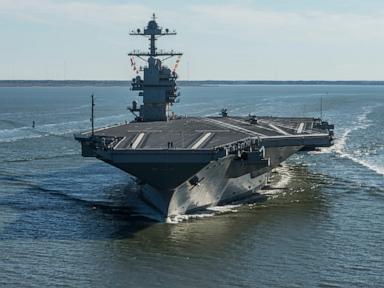
Reverting the United States Navy’s newest aircraft carriers from electromagnetic launch systems back to traditional steam catapults is not a simple procurement adjustment; it is a fundamental collision between executive nostalgia, congressional industrial policy, and the hard physics of naval architecture. When former President Donald Trump signaled his intent to mandate steam catapults on future Gerald R. Ford-class aircraft carriers, the immediate resistance from Republican lawmakers on the House and Senate Armed Services Committees exposed a structural divide within defense policymaking. While political rhetoric frames the dispute as a debate over reliability versus unproven modernization, the underlying reality is dictated by thermodynamics, power generation architecture, and multi-billion-dollar sunk costs in the defense industrial base.
To evaluate the feasibility and strategic consequences of abandoning the Electromagnetic Aircraft Launch System (EMALS) in favor of legacy steam catapults, one must deconstruct the engineering mechanics of both systems, map the legislative incentives driving Republican opposition, and quantify the operational trade-offs facing naval aviation.
The Engineering Divergence Between Steam and Electromagnetic Propulsion
An aircraft carrier’s primary function is to generate sortie rates—launching and recovering tactical aircraft as rapidly and safely as possible under combat conditions. The launch mechanism is the critical bottleneck in this operational chain.
Legacy Steam Catapult Architecture
For over six decades, U.S. supercarriers relied on the C-13 series of steam-powered catapults. The mechanism operates by diverting high-pressure steam from the ship’s nuclear reactors into a pair of long, slotted cylinders embedded beneath the flight deck. Pistons inside these cylinders connect to a shuttle that attaches to the aircraft’s nose gear. When the steam valves open, pressure builds rapidly, driving the pistons forward and accelerating a 50,000-pound fighter jet from zero to 165 miles per hour in roughly two seconds.
This system presents three severe engineering constraints:
- Binary Energy Delivery: Steam catapults lack granular force modulation. Once the steam valves open, the system delivers a massive, minimally adjustable surge of kinetic energy. While sufficient for heavy fighters like the F/A-18 Super Hornet, this violent acceleration profile exceeds the structural airframe tolerances of lighter unmanned aerial vehicles (UAVs) and delicate reconnaissance drones.
- Thermal and Mechanical Inefficiency: Steam systems lose substantial energy through thermal dissipation along extensive piping networks. They require immense quantities of purified freshwater, demanding continuous desalination capacity from the ship’s engineering plant. Furthermore, the mechanical wear on seals, valves, and slotted cylinders necessitates intensive, round-the-clock maintenance by large crews of machinist's mates.
- Reset Latency: After each launch, the system must bleed off residual steam, retract the pistons, and repressurize the accumulators. This thermal and mechanical reset imposes a hard ceiling on the maximum theoretical sortie generation rate.
Electromagnetic Aircraft Launch System (EMALS) Mechanics
The Gerald R. Ford class (CVN-78 and subsequent hulls) was designed from the keel up to eliminate steam dependency. EMALS replaces pressurized piping with a linear induction motor. Instead of steam pushing a piston, alternating electrical current flows through stator coils arranged along the launch track, generating a traveling magnetic field that pulls a carriage—and the attached aircraft—down the deck.
The operational advantages of EMALS stem directly from solid-state physics:
- Continuous Force Modulation: Software controls the electrical current flowing into the stator coils in real time. Operators can dial in the exact acceleration curve required for a specific airframe, enabling the same catapult to launch a heavy, fully loaded F-35C Lightning II on one cycle and a lightweight, fragile unmanned drone on the next without inducing structural fatigue.
- Energy Storage and Recovery: Because nuclear reactors generate steady electrical power rather than instantaneous spikes, EMALS utilizes a kinetic energy storage system consisting of high-speed motor-generators (flywheels). Between launches, the ship's electrical grid spins up these rotors. During the two-second launch window, the rotors discharge a massive burst of electricity into the linear motor, then immediately begin recharging, shortening the reset cycle.
- Reduced Topside Weight and Volume: Eliminating heavy steam accumulators, piping, and water tanks frees up internal hull volume and reduces topside weight, improving the carrier's stability and leaving margin for future weapons systems, such as directed-energy lasers.
The Structural Impossibility of Retrofitting the Ford Class
The core technical flaw in any directive to reinstate steam catapults on Ford-class carriers lies in the ships' fundamental power architecture. A nuclear aircraft carrier is not a modular hull where subsystems can be swapped like commercial off-the-shelf components; the propulsion plant and the launch system are thermally and electrically integrated.
The A1B nuclear reactors aboard the Gerald R. Ford class were specifically engineered to produce roughly three times the electrical generating capacity of the A4W reactors found on the older Nimitz class. Conversely, the A1B reactors were designed to produce significantly less auxiliary steam, because the ship was built to be all-electric—eliminating steam not only from the catapults, but also from arresting gear, galley equipment, and space heating.
Reverting to steam catapults on hulls currently under construction—such as the John F. Kennedy (CVN-79) or the Enterprise (CVN-80)—would require ripping out the existing electrical distribution architecture, redesigning the nuclear secondary loops to generate high-pressure steam, carving out massive internal compartments to house steam accumulators and piping runs, and re-engineering the hull's weight distribution. According to naval engineering assessments, such a redesign would delay ship deliveries by years and add billions of dollars in non-recurring engineering costs per hull, effectively paralyzing the Navy’s carrier replacement schedule.
The Three Pillars of Republican Congressional Pushback
When executive directives collide with congressional appropriations, legislative resistance rarely stems from abstract ideological disagreements. Republican opposition on the Armed Services Committees—led by defense hawks responsible for oversight of naval shipbuilding—is anchored in three concrete operational and political realities.
1. Industrial Base Disruption and Sunk Costs
Defense manufacturing relies on long-lead supply chains that span dozens of congressional districts. General Atomics, the prime contractor for EMALS, alongside hundreds of sub-tier suppliers across the United States, has already tool-up, hired specialized engineering workforces, and manufactured components for multiple hulls in the Ford class.
Canceling EMALS mid-production destroys the return on billions of dollars in sunk research, development, test, and evaluation (RDT&E) funds. Simultaneously, the industrial base required to manufacture C-13 steam catapult components has largely atrophied. Reconstituting extinct foundry capabilities and specialized steam-valve manufacturing lines would force the Pentagon to pay exorbitant premiums for obsolete technology, a direct violation of conservative fiscal oversight principles.
2. Fleet Readiness and Deterrence Gaps
Senior Republicans on defense committees prioritize maintaining the statutory requirement of an 11-carrier fleet to counter peer competitors in the Indo-Pacific. Every month a new carrier is delayed in the shipyard at Newport News, Virginia, extends the deployment cycles of the aging Nimitz-class fleet.
Many Nimitz-class hulls are approaching the end of their 50-year service lives, requiring complex, multi-year refueling and complex overhauls (RCOH). If construction on CVN-79 and CVN-80 were halted to re-engineer steam systems, the Navy would face a severe carrier gap in the late 2020s and early 2030s, degrading American power projection during a period of heightened strategic competition with China. For defense lawmakers, preserving the delivery timeline overrides executive preferences regarding subsystem mechanics.
3. The S-Curve of Defense Acquisition Maturity
Critics of EMALS frequently cite the system's early reliability metrics during sea trials aboard the USS Gerald R. Ford, where mean cycles between operational mission failure (MCBOMF) fell well short of the Navy’s threshold requirement of 4,166 cycles. However, defense acquisition specialists recognize that complex mechanical-electrical systems follow a predictable reliability growth curve.
The C-13 steam catapult itself suffered catastrophic failures and dismal reliability rates during its introduction in the 1950s before decades of incremental refinement turned it into a reliable workhorse. By the time political pressure mounted to scrap EMALS, the system had already completed thousands of successful shipboard launches and recoveries, and software patches had resolved the primary fault-isolation bottlenecks that initially forced engineers to shut down all four catapults to repair a single unit. Aborting a technology just as it exits the costly development phase and enters operational maturity is an acute failure of acquisition discipline.
Distinguishing Known Facts from Political Hypotheses
Analyzing defense procurement disputes requires separating verifiable engineering data from political signaling.
- Known Engineering Fact: EMALS experienced severe early reliability deficits, particularly regarding power conversion subsystems and software fault isolation, which delayed the Ford’s initial operational deployment.
- Known Financial Fact: Re-engineering the Ford class to accommodate steam catapults would cost billions of dollars per ship and forfeit the multi-billion-dollar investment already spent on electromagnetic launch and recovery systems.
- Political Hypothesis: Executive demands to return to steam are rarely intended as literal engineering blueprints; rather, they function as public leverage against defense contractors to force accountability for cost overruns and schedule delays on major acquisition programs.
The friction between the White House and GOP defense lawmakers illustrates the structural check-and-balance built into the U.S. defense budget. While the President serves as Commander-in-Chief, Article I of the Constitution grants Congress the power to raise and support armies and maintain a navy. Through the annual National Defense Authorization Act (NDAA), lawmakers insert statutory language prohibiting the use of appropriated funds to alter baseline ship designs without explicit congressional certification, effectively insulating multi-year shipbuilding programs from abrupt executive reversals.
Strategic Trajectory for Naval Aviation Launch Systems
The debate over steam versus electromagnetic catapults serves as a case study in the path dependency of modern military hardware. Once a naval platform's core power generation architecture is locked in—in this case, trading thermal steam capacity for high-density electrical output—the downstream subsystems are permanently constrained by that foundational choice.
For defense planners and legislative oversight committees, the optimal strategic path is not regression to legacy mechanics, but the ruthless enforcement of reliability milestones on existing electromagnetic architectures. Future procurement oversight must focus on decoupling software validation from hull construction, ensuring that complex power-management code is fully stressed in land-based testing facilities years before installation aboard a warship. Furthermore, the Navy must accelerate the integration of unmanned combat air vehicles into the Ford-class air wing to fully exploit the variable-force launch capabilities that justify the electromagnetic transition in the first place.