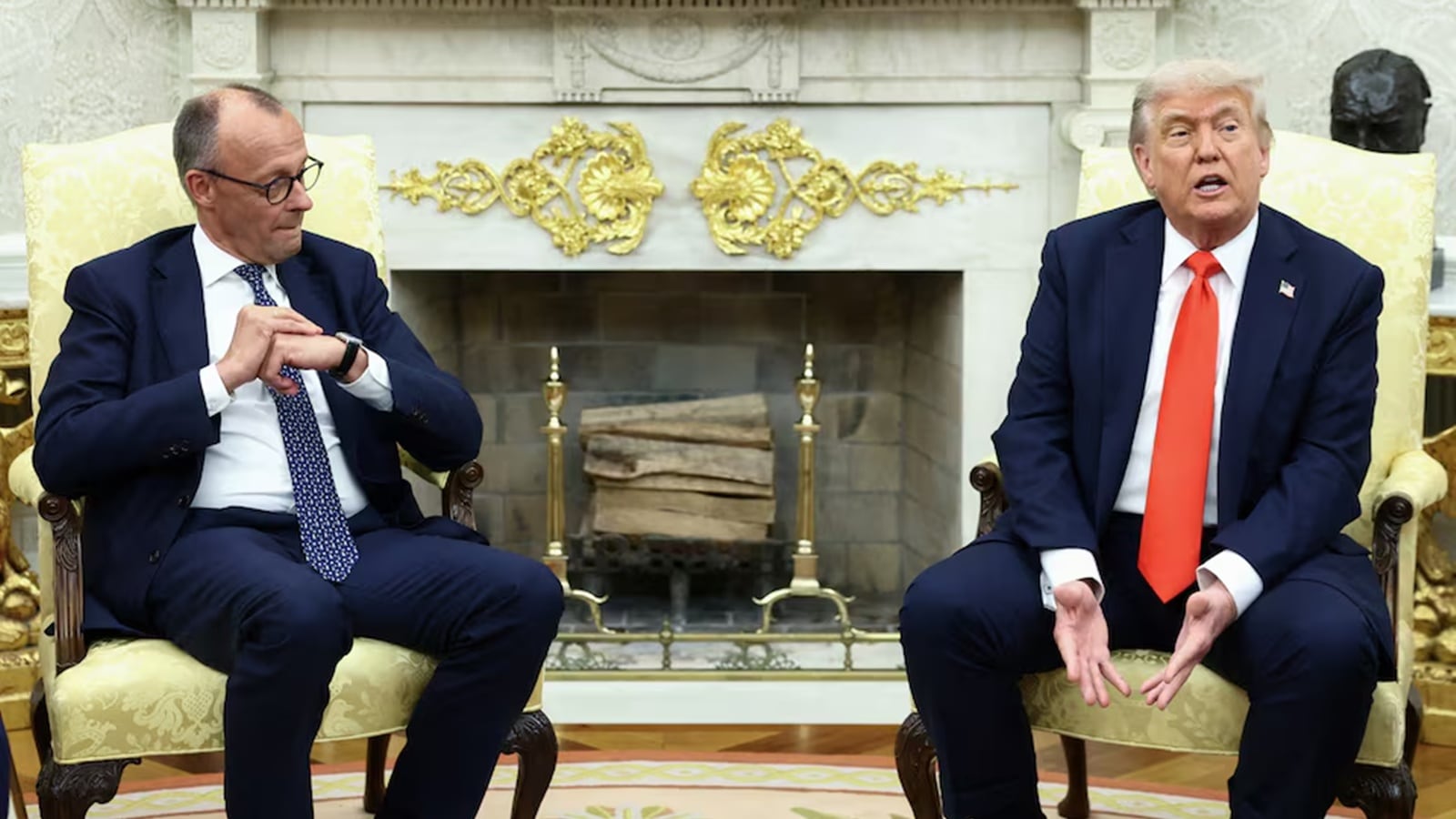
The air in the Chancellery in Berlin has a specific weight. It smells of old paper, floor wax, and the quiet, crushing pressure of history. When Friedrich Merz sits at his desk, he isn't just a man in a well-tailored suit; he is the custodian of a relationship that has defined the post-war world. But lately, that relationship feels less like a partnership and more like a high-stakes card game where the rules change every time the dealer breathes.
Washington is five hours behind, but its influence is everywhere. It’s in the digital flicker of the stock tickers and the urgent briefings on energy security. For months, the whispers in the corridors of power have focused on a single friction point: Iran. The disagreement isn't merely academic. It is a visceral clash of philosophies. On one side, a United States led by Donald Trump that views Tehran through a lens of maximum pressure and scorched-earth economics. On the other, a Germany that clings to the belief that trade and dialogue are the only things keeping the Middle East from a total collapse.
Then came the spat. A sharp, public disagreement that sent the pundits into a frenzy, claiming the "special relationship" was finally on life support.
But Merz is a man who understands the difference between a storm and a climate shift. He knows that in the theater of international relations, what you see on the stage is rarely what is happening in the wings.
The Human Cost of a Cold Shoulder
To understand why Merz is working so hard to smooth the ruffled feathers of the Trump administration, you have to look past the grand speeches. You have to look at the medium-sized factory in Baden-Württemberg.
Imagine a shop floor manager named Lukas. Lukas doesn't care about the nuances of the Joint Comprehensive Plan of Action. He cares about the fact that his company, which makes specialized valves, has seen its order book vanish because of secondary sanctions. He sees the anxiety in his workers' eyes when they ask about Christmas bonuses. For Lukas, the tension between Berlin and Washington isn't a headline; it’s a threat to his mortgage.
Merz carries the weight of thousands of men like Lukas. He knows that Germany’s economic engine—the famous Mittelstand—is inextricably linked to American markets. If the relationship with Trump soured to the point of no return, the fallout wouldn't just be felt in the halls of the Bundestag. It would be felt at the kitchen tables of families across the Rhine.
This is the invisible stake. It is the realization that a Chancellor cannot afford the luxury of a personal grudge. When Merz speaks of "good relations" despite the Iran disagreement, he isn't being naive. He is being a pragmatist. He is playing the long game.
The Art of the Disagreement
How do two leaders stay on speaking terms when they fundamentally disagree on how to handle one of the world’s most volatile regions?
It requires a certain kind of political alchemy. Merz has leaned into his background as a man of business, a language that Trump speaks fluently. He has framed the German position not as a moral lecture—a tactic that rarely works with this White House—but as a matter of regional stability and economic necessity.
The friction over Iran is real. There is no point in pretending otherwise. The U.S. sees German trade with Tehran as a betrayal of Western security. Germany sees the U.S. withdrawal from the nuclear deal as a catalyst for chaos. It is a classic deadlock.
Yet, Merz has managed to compartmentalize the conflict. He has signaled to Washington that while Berlin will not be bullied into abandoning its principles on Iran, it remains a steadfast ally on NATO spending, trade technology, and countering the influence of Eastern powers. He is offering a trade-off. He is saying, "We will disagree here, so that we can lead together there."
It is a delicate balancing act. One wrong word, one poorly timed tweet from either side, and the whole structure could come tumbling down.
The Shadow of the Past
There is a historical ghost haunting these negotiations. For decades, Germany lived under the security umbrella provided by the United States. It was a comfortable arrangement, one that allowed Berlin to focus on rebuilding its economy while Washington handled the messy business of global policing.
That era is over.
The "America First" doctrine wasn't a passing fad; it was a fundamental shift in how the U.S. views its obligations. Merz understands this better than most. He recognizes that the old ways of sycophancy and quiet compliance no longer work. Trump respects strength. He respects those who bring something to the table.
By standing his ground on Iran while simultaneously emphasizing the strength of the broader relationship, Merz is attempting to redefine what it means to be a junior partner. He is trying to turn Germany into a peer.
Consider the optics of their recent communications. There is a lack of the stiff, formal platitudes that characterized the Merkel era. Instead, there is a brashness, a directness. It is the language of two CEOs trying to hammer out a merger. It’s messy. It’s loud. It’s often uncomfortable to watch. But for Merz, it is the only path forward.
The Ripple Effect
The stakes extend far beyond the borders of Germany and the United States. The rest of Europe is watching this dance with bated breath. If Merz can successfully navigate the Trump temperament, he provides a blueprint for Paris, Rome, and Warsaw.
But if he fails—if the Iran spat becomes a wedge that splits the Atlantic alliance—the consequences are dire. A fractured West is a gift to those who wish to see the liberal world order dismantled. It would mean a world where smaller nations are forced to choose sides, where trade becomes a weapon, and where the threat of conflict looms larger every day.
Merz is walking a tightrope over a canyon of geopolitical uncertainty. He has to convince his own public that he isn't kowtowing to a volatile American president, while simultaneously convincing that president that Germany is an indispensable friend.
He is doing this in an environment where the truth is often obscured by noise. The media focuses on the "spat," the "clash," and the "feud." These words sell papers, but they don't capture the reality of the work being done in the quiet hours of the night.
The Quiet Persistence of Diplomacy
The real work happens in the phone calls that don't make the news. It happens in the folders passed between aides in the back of armored cars. It is the slow, grueling process of finding common ground where none seems to exist.
Merz has been criticized by some for being too conciliatory, for not taking a harder line against the rhetoric coming out of Washington. But those critics don't have to look into the eyes of the workers in Baden-Württemberg. They don't have to worry about the heat staying on in the winter or the stability of the global financial system.
The Chancellor is betting that his personal rapport with Trump can withstand the policy disagreements. He is betting that the shared interests of the two nations—intelligence sharing, military cooperation, and trillions of dollars in bilateral trade—are stronger than a dispute over a single treaty.
It is a gamble. Every day brings a new headline, a new potential flashpoint.
The disagreement over Iran remains a jagged rock in the middle of the stream. The water is churning around it, white and violent. But the stream itself is still flowing. As long as Merz and Trump are talking, as long as the channels remain open, there is a chance to navigate the rapids.
In the end, international relations are not about finding total agreement. That is a fantasy. They are about managing disagreement. They are about ensuring that a fight over one thing doesn't lead to a fight over everything.
Friedrich Merz is standing at the window of the Chancellery, looking out at the Berlin skyline. He knows the world is watching. He knows the margin for error is non-existent. He picks up the phone, adjusts his tie, and prepares for the next round of the game, knowing that the most important thing isn't the cards you're dealt, but how you play the man across the table.
The lights in the Chancellery stay on late into the night.