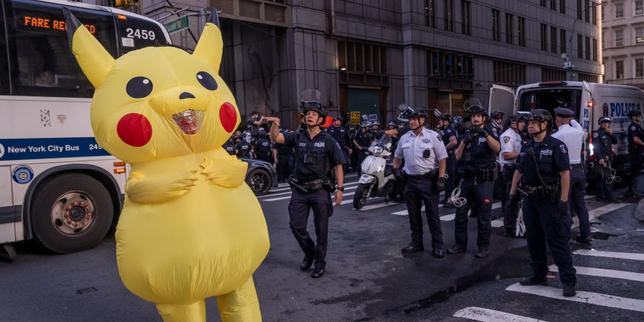
Politicians love borrowing things they don't understand. It happens every election cycle. They raid the toy box, grab whatever cultural artifact happens to be sitting on the rug, and try to slap a party badge on it. Recently, Washington bureaucrats and campaign strategists started acting like classic puzzle games and Japanese pocket monsters represent nationalistic political movements.
Spoiler alert: they don't.
If you try to map partisan ideology onto a falling brick or an electric mouse, you lose your grip on reality. You also look ridiculous. Tetris is a Soviet-era geometric puzzle. Pikachu is a global mascot for a multi-billion dollar entertainment franchise created by Game Freak and Nintendo. Neither cares about congressional hearings or campaign slogans.
Let's clear the air. We need to look at why political operatives keep dragging harmless pop culture into toxic debates, and why ordinary fans are exhausted by the performance.
The Absurdity of Assigning Politics to Pixels
Think about Tetris for a second. Alexey Pajitnov wrote the code on a Soviet Elektronika 60 computer in Moscow back in 1984. He wanted to make something fun. He didn't build an ideological manifesto. He built an addictive grid where lines disappear when you fill them up.
Yet, cultural commentators occasionally try to spin retro gaming through a heavy political lens. They talk about cold war anxieties or capitalist accumulation because blocks pile up until you lose. That is a massive stretch. When you're frantically trying to slot an L-piece into a tight corner at speed three, you aren't contemplating the fall of the Eastern Bloc. You are just trying to beat your high score.
The same goes for Pokémon. When politicians or pundits try to claim global entertainment phenomena for specific national identities, they completely miss the point of transnational art. Pikachu belongs to Tokyo, to New York, to kids in São Paulo, and to adults playing handheld consoles on the London Underground. Culture crosses borders effortlessly because it taps into human joy, not voting districts.
[Entertainment Franchise] ---> Created for Fun ---> Loved Globally
[Political Machine]       ---> Created for Power -> Divided Locally
Trying to force these two completely different spheres together causes cognitive dissonance. It exposes a deep insecurity inside modern political communication. When campaigns struggle to connect with real human experiences, they reach for whatever recognizable icon is trending on social media.
Why Campaigns Co-Opt Nostalgia
Political messaging relies heavily on safe nostalgia. If a candidate can tie themselves to a beloved childhood memory, they borrow some of that innocence. It is a shortcut to emotional resonance.
You saw this strategy peak during recent trade disputes and cultural protectionism debates in Washington. Officials want to frame economic policies through the lens of everyday goods. But they often stumble. Instead of talking about supply chains or semiconductor manufacturing, they invoke consumer toys and video games as cultural symbols of national strength.
This approach backfires because gamers and pop culture enthusiasts possess a fierce bullshit detector. They know the provenance of their favorite hobbies. They remember that Nintendo is Japanese, that Tetris has Soviet roots, and that creativity thrives precisely because art transcends national borders.
When a political figure tries to claim these properties fit neatly into a specific nationalist box, fans push back. They call out the ignorance immediately on platforms like Reddit, X, and gaming forums. Authenticity matters in geek culture. You cannot fake fandom.
The Real Power of Global Media
True cultural power comes from exchange, not isolation. Tetris conquered the world because Game Boy bundles packaged it brilliantly in 1989. It worked because the rules are universal. You do not need to speak Russian or English to stack blocks.
Pokémon became a planetary obsession because the core loop of catching, training, and trading creatures speaks to a fundamental human desire for exploration and mastery. The creators at Game Freak didn't design Pikachu to win a culture war. They designed it to sell merchandise and spark imagination.
When governments try to nationalize or politicize international media, they misunderstand the modern attention economy. People consume media to escape politics. They turn on a console to unwind after a brutal workday. Dragging partisan talking points into the living room ruins the experience.
Moving Past Manufactured Outrage
We need to stop letting campaign spin doctors dictate how we talk about entertainment. Every time a politician misuses a gaming reference, we give them free oxygen.
Instead of reacting with manufactured outrage, treat these gaffes for what they are: transparent attempts by desperate communicators to look culturally relevant. Ignore the noise. Keep playing your games, watching your anime, and enjoying art on your own terms.
Tetris remains a masterpiece of minimalist design. Pikachu remains a yellow icon of pure joy. Neither needs Washington's permission to exist, and neither belongs to any political movement. Play the game, drop the spin, and leave the pop culture alone.


