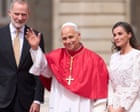
Political rage is a highly profitable commodity, and Pope Leo XIV just walked straight into the middle of it. Arriving in Madrid for his weeklong tour of Spain, the American-born pontiff didn't waste any time playing nice with the diplomatic crowd. Standing inside the Royal Palace alongside King Felipe VI and Queen Letizia, he took aim at the exact thing driving modern politics into the dirt: the deliberate manufactured outrage that keeps leaders popular and societies broken.
It's his first major European trip, and picking Spain wasn't an accident. The country is currently a pressure cooker of political scandals, immigration debates, and intense secularization. By choosing this moment to visit, Leo is setting up a direct confrontation with the identity-driven narratives dominating the West. He explicitly warned against the temptation to fan the flames of polarization just to score cheap political points. It's an aggressive stance for a global religious leader, and it reveals exactly how he plans to use his papacy to challenge the current cultural landscape.
The Trap of Sterile Simplifications
We live in an era where complex human issues get reduced to punchy soundbites and angry social media posts. Leo called these "sterile simplifications" and begged both politicians and regular citizens to abandon them. He wants people to appreciate complexity instead of running away from it.
Look at what's happening on the ground in Spain. The Socialist-led government of Prime Minister Pedro Sánchez is currently fighting for survival amid a wave of corruption scandals. On the other side, the far-right Vox party is gaining massive ground by hammering the government on its immigration policies. It's a classic political deadlock where nobody actually talks to each other; they just yell louder to rally their base.
Leo noted that human dignity is constantly violated when leaders treat societal issues like a zero-sum game. To drive the point home, he did something fascinating: he pointed to Spain's own history. He brought up the country's 800-year Moorish past, reminding the audience that cities like Toledo and Córdoba were once global hubs where Christians, Muslims, and Jews actually talked to each other and shared knowledge. It was a blunt reminder that coexistence isn't some modern, naive fantasy. It's something Spain has done before.
The Digital Echo Chamber is Killing Discourse
What makes this call for unity different from typical Vatican rhetoric is that Leo is tracking the underlying technology feeding the beast. He didn't just blame bad politicians; he blamed the digital infrastructure we use every day.
Expanding on themes from his recent encyclical, Magnifica humanitas, the pope warned that our modern digital ecosystems are actively degrading the way we think. He described these spaces as an artificial environment engineered to weaken critical thought and amplify our worst prejudices.
Think about how you use the internet. The algorithms are literally built to show you things that make you angry, because anger drives engagement. When political groups use these platforms to turn neighbors into enemies, it creates what Leo called a "dark night" in the soul of a nation. To fight back against this digital decay, he's calling for massive investments in education, universities, and culture. He wants civil society to act as a counterweight to the algorithmic rage machine.
High Stakes in a Fragmented Parliament
The real test of this message happens on Monday, June 8. Leo will make history as the first pope ever to address a joint session of both chambers of the Spanish Parliament. Neither St. John Paul II nor Benedict XVI did this during their trips to the country.
He'll be walking into a room filled with politicians who hate each other's guts. The ruling coalition is incredibly fragile, and conservative opposition factions are waiting to tear them apart. The far-right has been working hard to capitalize on the Catholic vote, but Leo has already signaled he isn't buying into it. Reports from earlier this year showed he warned Spanish bishops in private meetings to stop letting political parties instrumentalize the church for election cycles.
By taking the podium in Las Cortes Generales, Leo isn't trying to bless one political faction over another. He's trying to blow up the entire partisan framework. It's an incredibly risky move that could alienate traditionalists on the right and secularists on the left, but it shows he's willing to risk his own political capital to force a conversation about national unity.
Confronting the Immigration Crisis Head-On
You can't talk about polarization in Europe without talking about migration, and Leo is putting his body right where his mouth is. Later in the week, he's flying to the Canary Islands, a major arrival point for West African migrants risking their lives to cross the Atlantic.
This specific leg of the trip honors his predecessor, Pope Francis, who desperately wanted to visit the islands before his death in 2025 but was too sick to travel. In 2025 alone, nearly 2,000 people died or went missing trying to make that exact crossing. While the Sánchez government has bucked Western trends by moving to regularize hundreds of thousands of undocumented workers to help an aging economy, the issue has sparked deep societal rifts and anti-migrant riots in southern Spain.
Leo's visit to the port of Arguineguín—historically dubbed the "pier of shame" due to its brutal, overcrowded conditions—will force Europe to look at the human faces behind the political statistics. The church's strategy here is deliberate. By approaching migration as a humanitarian emergency rather than a partisan debate, Leo wants to show that human dignity matters more than border security talking points.
Reclaiming a Secularized Generation
There's a strange cultural paradox happening in Spain right now. Since the end of Francisco Franco's Catholic dictatorship in 1975, religion in the country has plummeted. In the 1970s, 90% of Spaniards identified as Catholic. By 2025, that number dropped to 55%, and only 19% of those actually go to Mass regularly.
Yet, as Leo arrived in Madrid, he told reporters he's tracking a strange spiritual awakening among young people. He noted that Gen Z is starting to feel a profound emptiness and a total lack of meaning in modern secular life.
It's a bizarre weekend in Madrid. Hundreds of thousands of young people are packing into a prayer vigil with the pope near the Santiago Bernabéu Stadium, while down the road, Puerto Rican superstar Bad Bunny is pulling massive crowds for his own stadium tour. When asked about competing with a global pop icon for the attention of Spanish youth, Leo was incredibly grounded. He laughed it off, saying he knew plenty of kids would go see Bad Bunny, but he figured there'd still be a few left over to come see the pope. That lack of defensive anxiety is exactly why he resonates with younger crowds. He doesn't judge their world; he just offers an alternative to it.
The Radical Work of Encounter
If you want to apply Leo's perspective to your own life, you have to change how you consume information and interact with people who disagree with you. The temptation to fall into tribalism is real, but it's ultimately a dead end.
Start by auditing your digital media diet. Notice when an article, a video, or a political post is trying to make you furious, and recognize that your outrage is being monetized. Step away from the screen and engage with the actual complexity of local issues instead of the caricature version presented online. Find someone in your community whose political views make your blood boil, and find a way to have a normal, human conversation with them about something totally unrelated. True cultural stability isn't built by winning an argument on the internet; it's built through the incredibly slow, difficult, and face-to-face work of civic friendship.