Big tech ate the digital advertising market long ago. For years, premium publishers watched from the sidelines as Google and Meta vacuumed up the vast majority of ad spend, leaving independent journalism to fight over the crumbs. The open programmatic web became a race to the bottom, filled with clickbait, ad fraud, and sketchy tracking scripts.
It was a broken system. Then came a shift.
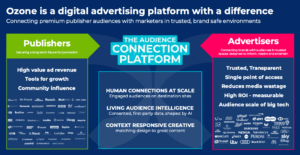
Publishers realized that fighting each other for the remaining 20% of the market was a losing strategy. Survival required cooperation. That is exactly why platforms like Ozone were built. By pooling their digital advertising audiences, premium publishers finally built something they never had alone. Scale.
They created a unified front that rivals the massive reach of the walled gardens. It turns out that when reputable media companies stop treating each other as mortal enemies and start working together, everyone wins. Except, of course, the middlemen who built empires on ad tech hidden fees.
The Problem with the Traditional Programmatic Stack
For a long time, the open web operated on a highly inefficient system. An advertiser wanted to buy an ad spot on a reputable news site. Instead of buying it directly, that money moved through a ridiculously long supply chain. Demand-side platforms, supply-side platforms, data management systems, and verification vendors all took a cut.
By some industry estimates, over 50% of every dollar spent by an advertiser vanished into this tech tax before ever reaching the actual publisher.
Worse yet, this system treated all ad inventory roughly the same. A banner ad on a high-quality investigation piece about global economics was valued similarly to a banner ad on a spam blog generated by a bot farm. Advertisers bought cheap eyeballs instead of quality attention.
Premium publishers invest millions in actual reporting, editing, and fact-checking. They cannot survive on the sub-penny CPMs that define the open programmatic market. They need a way to prove that an ad seen on their site is worth ten times more than an ad on a Made-for-Advertising website.
That proof requires clean data and massive scale. Individual publishers, even huge ones, do not have enough monthly active users to compete with the billions of logged-in users on Facebook or YouTube. Advertisers love big tech because they can log into one dashboard and buy a massive audience instantly.
Ozone changed that dynamic in the UK market by bringing rivals like News UK, Guardian Media Group, Telegraph Media Group, and Reach plc under one roof. Suddenly, a media buyer could buy across all these legendary titles through a single point of entry.
How Premium Publishers Find Strength in Numbers
Think about how advertising actually gets bought today. Agencies do not want to negotiate fifty separate contracts with fifty different sales teams. They want simplicity. They want to check a box and reach thirty million people.
When premium publishers band together, they match that simplicity. Ozone aggregates the first-party data of these distinct publishers into a single, compliant ecosystem. This is not about sharing secret editorial strategies. It is about sharing an audience graph.
This collective approach yields several distinct advantages.
First, it solves the reach problem. Together, these publishers reach nearly the entire online adult population of the UK. Advertisers can no longer claim they only use big tech platforms because independent publishers are too small to move the needle for major brand campaigns.
Second, it cleans up the data. With third-party cookies effectively dead or heavily restricted across modern browsers, tracking people across the internet is incredibly difficult. Big tech relies on logged-in users. Premium publishers have something similar. They have millions of deeply engaged readers who log in, subscribe, and read deeply every day. By combining these first-party signals, the alliance creates a massive pool of authenticated data that does not rely on sketchy tracking pixels.
Third, it guarantees brand safety. Advertisers are terrified of their ads appearing next to hate speech, conspiracy theories, or offensive user-generated content. That happens constantly on social media platforms despite their armies of moderators. A premium publisher environment is edited by real humans. It is inherently safe.
The Financial Reality of Cutting Out the Middlemen
When you bypass the traditional open market, something fascinating happens to the economics of digital ads. More money goes to the people actually creating the content, and more value goes to the brands buying the space.
In a standard programmatic setup, an ad buyer pays a premium for targeting, but much of that premium goes to third-party data brokers. Half the time, that data is wildly inaccurate or outdated.
Alliances change the flow of cash. Because the alliance platform connects the buyer more directly to the publisher inventory, the ad tech tax shrinks significantly. Publishers keep a much larger share of the revenue. That money goes directly toward funding newsrooms, paying journalists, and keeping premium media alive.
Brands get better performance too. Studies consistently show that ads placed in premium, high-attention editorial environments deliver far better brand recall than ads placed on social feeds or junk websites. People trust the editorial content, and that trust transfers to the advertising. You cannot get that from a random banner on a scraping site.
Overcoming the Cultural Hurdles of Media Alliances
Getting fierce rivals to cooperate is not easy. For decades, the sales teams at major newspapers viewed each other as the primary competition. If a major brand spent their quarterly budget with one paper, the other paper felt the loss immediately.
Shifting that mindset requires leadership to acknowledge a harsh truth. The real competitor was never the newspaper down the street. The competitor was the ad platform built in Silicon Valley.
To make an alliance work, publishers have to agree on common standards. They need to standardize how they measure viewability, how they classify content categories, and how they package their first-party data. This requires a high degree of technical integration and operational transparency.
It also requires a distinct corporate entity to run the show. The platform must act as an independent, neutral steward that treats every participating publisher fairly, whether they are a high-end broadsheet or a mass-market tabloid. This neutrality ensures that budget allocation is driven entirely by advertiser performance and audience match, rather than internal politics.
Practical Steps for Independent Media Brands
If you run a media brand or manage digital ad budgets, you cannot afford to keep doing things the old way. The open programmatic web is decaying, and relying entirely on social media distribution is a recipe for sudden traffic death.
First, prioritize your first-party data strategy immediately. Stop relying on external networks to understand your audience. Build registration walls, optimize your newsletter sign-ups, and give readers a clear reason to create an account on your site. Clean, authenticated reader data is the single most valuable asset you own.
Second, look for regional or niche alliances in your market. If you are a local news publisher or a specialized B2B media house, find peers who share your struggles but do not directly overlap your hyper-local audience. Explore building shared ad networks or data pools using modern clean-room technologies.
Third, adjust your pitch to brands. Stop selling mere impressions. Impressions are cheap, and bots can fake them easily. Start selling attention, trust, and verified human audiences. Show advertisers the exact context where their messages will live.
The era of the isolated publisher is over. Standing alone against platform monopolies is a fast track to irrelevance. True strength lies in numbers, collective data, and a shared commitment to quality environments. Brands want accountability, and readers want real journalism. By uniting infrastructure while keeping editorial voices independent, premium publishers can finally build a sustainable digital future.