The paint under his fingernails was probably still fresh.
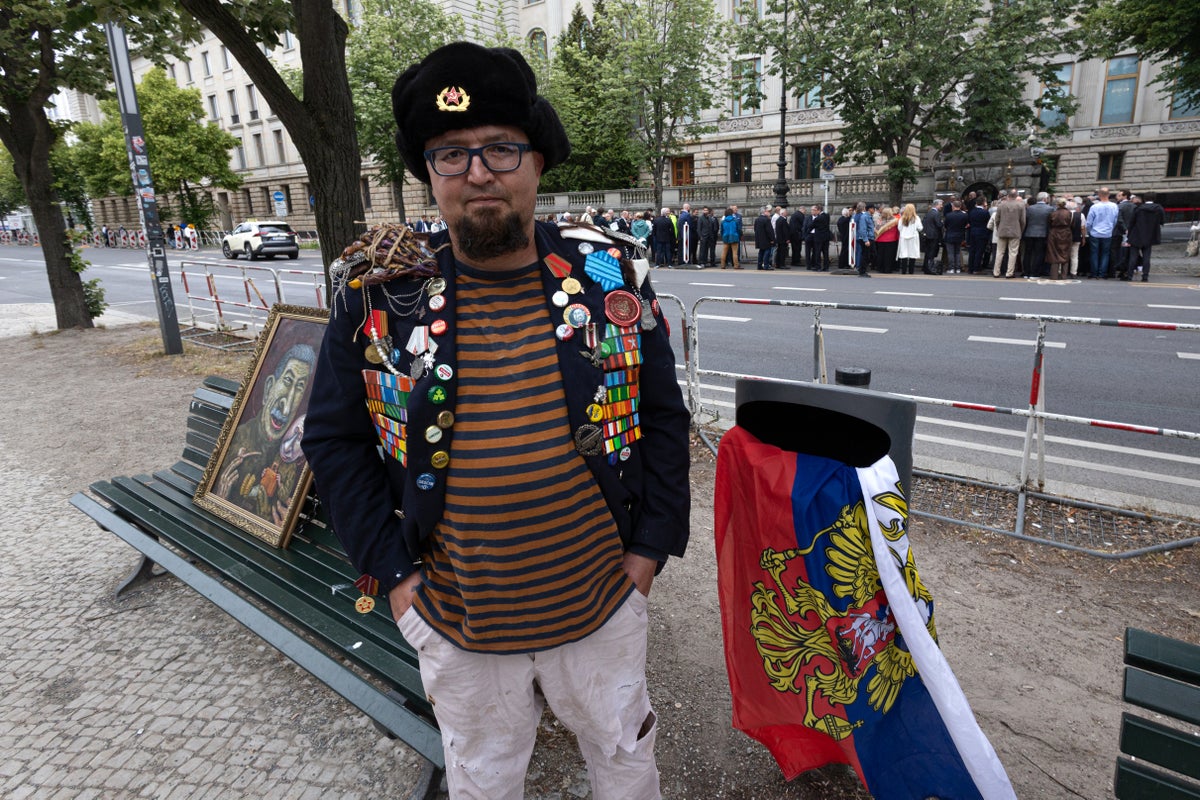
Just seventy-two hours before the morning of June 15, 2026, a 44-year-old man named Robert Kuzovkov stood outside the Russian Embassy in Berlin. To the art world and the thousands who followed his defiant digital footprints, he was Semyon Skrepetsky. On that day, Russia Day, he staged a performance that was less a protest and more a direct, visual eviction of a dictator’s mythology. He held aloft a painting executed in a jarring, neo-primitivist style, a grotesque distortion of a sacred Orthodox icon. In it, Joseph Stalin cradled an infant Vladimir Putin.
It was provocative. It was funny. To certain people, it was unpardonable.
By Monday morning, Robert was back in Biała Podlaska, a quiet Polish city of 55,000 people resting just thirty kilometers from the Belarusian border. It is the kind of place where dissidents go to disappear into the mundane rhythms of European safety. He walked along a pedestrian path near a parking lot, perhaps thinking of his next piece, perhaps thinking of the digital threats that had begun flooding his Telegram channel the night before.
Then came the cracks of gunfire.
Three bullets struck him first, tearing through the quiet morning air and sending him to the pavement. But whoever pulled the trigger was not looking to send a message; they were looking to ensure silence. The gunman stepped closer to the fallen artist, stood over him, and fired twice more at close range into his chest and head. Five wounds in total. A clinical, textbook execution.
The Illusion of Sanctuary
When you flee a regime, you carry a specific kind of naiveté in your suitcase. You believe that crossing a geographical line, showing a passport to a border guard, and registering an apartment in a democracy buys you an unbreachable shield. Robert believed this when he left Russia’s Altai region in 2021, driven out by the suffocating weight of political persecution.
He was offered official state protection by the Polish government. He turned it down.
To accept constant surveillance, even from protectors, is to admit that the monster under the bed has followed you into the new house. It is a psychological surrender that many exiles refuse to make. They want to breathe. They want to believe that a quiet town near the border is just a quiet town.
But geography is a cruel master. Biała Podlaska is not just a dot on a map; it is a frontline. It sits in a region of Poland currently acting as the primary focus of a massive, shadowy campaign of European sabotage. According to data compiled by the International Centre for Counter-Terrorism, Poland has logged at least 31 separate state-linked sabotage incidents since 2022—more than any other nation in Europe. Arson, cyber warfare, and targeted intimidation have turned the eastern edge of NATO into a low-intensity twilight zone.
Consider what happens when the borders are this porous and the stakes are this high: the space between a critical tweet and a bullet shrinks to zero.
Hours after Robert’s body was cleared from the asphalt, Polish police launched a sprawling security sweep. They detained two Belarusian nationals near the Belarusian consulate in the city. As of Tuesday, prosecutors have not filed formal charges against them, and the hunt for the actual gunman continues under the direction of a specially formed investigative task force. Yet, the physical location of the arrests tells a story that diplomacy tries to soften. The shadow of Minsk and Moscow looms over the entire investigation.
The Loneliness of the Permanent Dissident
To understand why Robert was standing in that parking lot, one has to understand the exhausting, isolated existence of the modern political exile. He was a polarizing figure, even among his peers. The investigative outlet IStories noted that Robert was a constant, vocal presence at Russian opposition rallies across Europe, but he was rarely there to cheer. He turned his razor-sharp satirical lens not just on Putin, Alexander Lukashenko, or the brutal Chechen leader Ramzan Kadyrov, but also on the late opposition leader Alexei Navalny.
He was a contrarian by nature. He rejected the neat narratives of both the Kremlin and the fractured factions trying to replace it.
Imagine the psychological toll of that position. You cannot go home because the state wants you in a penal colony. You cannot fully trust the opposition because you see through their internal politics. You live in a small apartment near the border of a country that looks like the one that exiled you, painting nightmares on canvas to keep the reality at bay.
And then, your phone blinks.
The threats that dropped into Robert's Telegram channel on Sunday night weren't anonymous internet noise. They were specific. Supporters of Kadyrov had successfully geolocated his home address. They had pinned down his IP address. They told him exactly what they were going to do to him because of his performance in Berlin.
The horror of his final hours lies in that digital certainty. He knew they were coming. He just didn't know they were already in the parking lot.
The Red Ink of Liquidation
The ultimate tragedy of Robert’s death is how quickly a human life is converted into geopolitical currency. Shortly after the news broke, his profile on Myrotvorets—an unofficial, highly controversial Ukrainian database that logs individuals deemed "enemies of Ukraine" due to his past sweeping criticisms—was updated.
A digital stamp was placed across his face. The word was written in bright, unambiguous red: Liquidated.
It is a chilling reminder of the cold mechanics of modern political warfare. To the Kremlin, he was an irritant to be scrubbed out. To radical factions on the other side, his death was a data point, a box checked, an enemy removed from the board. Lost in the middle is the actual man—the artist who used crude, vibrant brushstrokes to mock the absurd pomposity of men with nuclear codes.
Pina Picierno, the vice president of the European Parliament, pointed out that Robert’s execution fits into a "disturbing pattern of poisonings, killings, and operations targeting the Kremlin's opponents far beyond Russia's borders." She warned that Europe must remain a place where those fleeing repression can find safety.
But the reality on the ground in eastern Poland feels vastly different from the halls of parliament in Brussels. For the dissidents, the writers, the bloggers, and the painters who have fled across the border over the last five years, the world just became significantly smaller, darker, and more terrifying.
Robert’s family has since been moved by Polish authorities to an undisclosed, secure location. Their old life is gone, replaced by the perpetual anonymity of the witness protection program. They are safe for now, protected by the very state guards Robert hoped he would never need.
Back in the parking lot in Biała Podlaska, the police tape has been cleared away. The cars have returned to their spaces. The pedestrian path is open again. But the air remains heavy with a truth that every exile must now confront: in the current war for the soul of Eastern Europe, canvas is no match for lead, and a border is just a line drawn in the dirt.