The sound of modern political survival is not a roar. It is the soft, rhythmic hum of an iPhone resting on a wooden nightstand, vibrating with another notification at eleven past midnight.
A donation has cleared.
Somewhere in a sun-bleached apartment overlooking a congested boulevard, a precinct captain deletes an unanswered email and opens a spreadsheet. The numbers columns stretch downward like an endless ladder of gray cells. At the bottom, totals blink in sharp, unapologetic black text. Two million five hundred thousand dollars.
Not once, but twice.
In the high-stakes theater of municipal governance, money does not merely buy airtime or glossy mailers that end up in recycling bins before the front door closes. Money buys belief. It is liquid oxygen. It tells the room—the skeptical donors, the exhausted precinct workers, the journalists nursing lukewarm coffee in press boxes—that a candidate is viable, that the machine is spinning, that the future is being actively purchased.
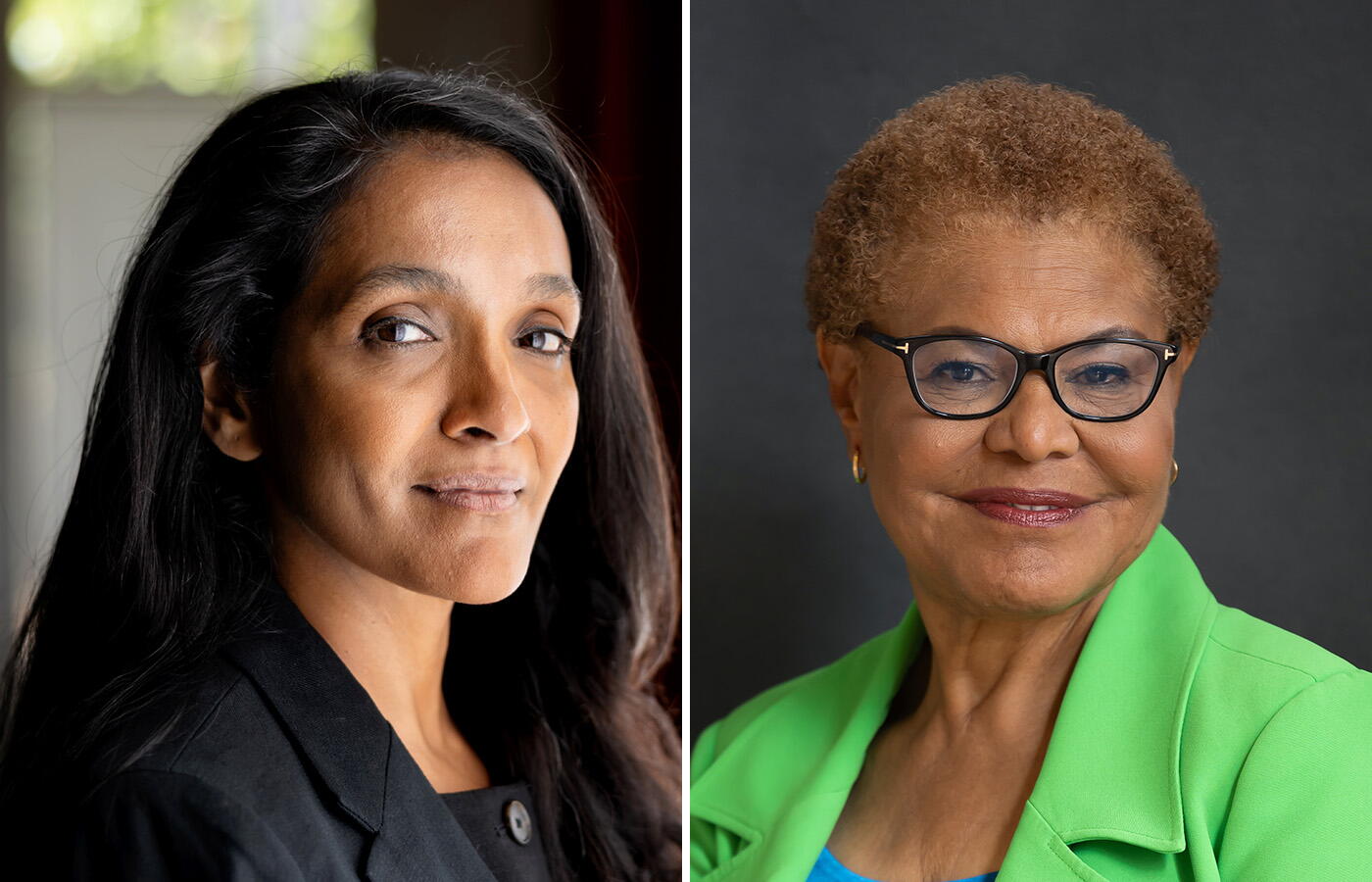
When financial disclosures reveal that Mayor Karen Bass and challenger Nithya Raman have each hauled in roughly two and a half million dollars, the headlines treat it as a ledger entry. A tie. A mathematical equilibrium in the grand casino of local politics. But numbers stripped of context are dead things. They do not smell of hot asphalt in August. They do not capture the exhaustion of a field organizer whose soles have worn through on the cracked sidewalks of Pico-Union, nor do they reflect the quiet, calculating anxiety of a neighborhood council member trying to decode the shifting loyalties of downtown real estate developers.
To understand what those matching figures actually represent, you have to step away from the filings and walk the streets where the money is supposed to work its magic.
The Weight of the Incumbent
Karen Bass knows the heavy gravitational pull of city hall. To hold the office of mayor in a metropolis as vast and fractured as Los Angeles is to stand at the epicenter of competing screams. On any given Tuesday, the demands crash over the mahogany desks in waves: unhoused populations sheltering under concrete overpasses, aging sewer pipes threatening to rupture beneath quiet residential streets, small business owners watching their profit margins evaporate under the weight of inflation, and neighborhood groups fiercely protecting their views of the hills.
Power, when you finally grasp it, is heavier than it looks in campaign brochures.
When an incumbent raises two and a half million dollars, that capital is accumulated through the gravitational physics of office. It comes from the network of institutions, unions, corporate stakeholders, and lifelong political loyalties that have anchored themselves to the executive suite. It is money built on track records, on compromises struck behind closed doors, on the reassurance of continuity.
Imagine Elena, a fifty-eight-year-old nurse from West Adams who has lived through three mayoral administrations. She doesn’t care about political science theory. She cares about whether the streetlights on her block work, whether the bus arrives on time, and whether her grandson can afford a starter home within fifty miles of the hospital where she works. When Elena writes a small check to an incumbent campaign, she is not buying ideology. She is buying stability. She is paying an insurance premium against chaos.
Yet, holding the center is an expensive proposition. Every policy decision is a subtraction. Every compromise alienates a faction. The incumbent’s war chest is not just a weapon of offense; it is a fortress wall, built stone by heavy stone, designed to withstand the relentless battering ram of public dissatisfaction.
The Insurgent's Arithmetic
Across town, in a cramped campaign office lit by fluorescent panels that hum with a low, maddening frequency, a different kind of energy takes shape.
Nithya Raman operates from a different playbook. To match an incumbent dollar for dollar is not merely an exercise in accounting; it is an act of political alchemy. It requires convincing thousands of small donors—renters squeezed by soaring leases, young professionals disillusioned by traditional party politics, neighborhood activists who spent their weekends organizing mutual aid tables—that their twenty-five-dollar contributions can actually move the needle against the immense machinery of institutional power.
Match the incumbent's two and a half million, and you shatter the narrative. You prove that grassroot anger, when channeled into digital portals and peer-to-peer text banks, can generate its own gravity.
Consider Marcus, a twenty-four-year-old barista in Silver Lake who spent his Sunday afternoon typing text messages to strangers, asking for five dollars to fuel a city council challenger's run. His fingers cramp around the screen. Most people hang up or swipe away. But every tenth person replies. Every twentieth person clicks the link. Multiply Marcus by a thousand, and you get the fuel that powers a modern populist movement.
This money feels different. It smells of cheap coffee and damp cardboard boxes filled with yard signs. It is loud. It demands a return on emotional investment. When small-dollar donors give their money, they expect disruption. They want the rules rewritten. They want the status quo dismantled brick by brick.
When two opposing forces hit the exact same financial threshold, the dynamic shifts from a David-versus-Goliath fable into something far more compelling: a locked room with two heavy doors, and neither side willing to blink first.
The Invisible Architecture of Influence
Why do these totals mirror each other so precisely?
Politics abhors a vacuum, but it loves symmetry. In any major urban center, there is a finite pool of political capital, major donors, and ideological factions willing to place bets on the future. When a challenger proves they can run with the big dogs—when they cross the million-dollar mark, then the two-million mark, then reach parity with the reigning power—the financial ecosystem recalibrates.
Hedge fund managers, real estate syndicates, labor leaders, and entertainment executives start placing hedge bets. They split their contributions. They give to the incumbent to keep the lights on and preserve access to the current administration, but they write matching checks to the challenger to ensure they won't be locked out if the political winds shift.
This is the hidden economy of campaigns. It is a game of high-stakes poker played with other people's money, where the chips are influence, zoning variances, labor contracts, and ideological supremacy.
Step back and look at the city from forty thousand feet. At night, Los Angeles looks like a circuit board made of amber and white light. The 405 freeway is a river of red taillights crawling through the Cahuenga Pass. Down in those cars, people are arguing about rent, about the cost of groceries, about whether their kids will ever be able to buy a house in the neighborhoods where they grew up.
None of those drivers are thinking about campaign finance reports. None of them are staring at spreadsheets tracking the accumulation of two and a half million dollars.
And yet, every dollar raised in those backrooms and digital fundraising portals acts as a draft for the city's physical reality tomorrow. The money dictates who gets heard, whose neighborhoods get paved, whose encampments get cleared, and whose voices are quietly filtered out by consultants earning five-figure retainers.
The Myth of Equal Playing Fields
We like to talk about elections as if they were athletic contests—two runners on a track, starting from the same white line, sprinting toward a checkered banner.
The reality is messier.
Money is not just a tool; it is an environment. It alters the air pressure in the room. An incumbent's war chest buys the institutional memory of consultants who have won a dozen races and know every dead body buried in the municipal archives. A challenger's matching funds buy the raw, kinetic energy of volunteers who are running on pure adrenaline and ideological fervor.
When both sides secure equal funding, the race ceases to be about who can outspend the other. It becomes a referendum on the narrative itself.
Whose story about the city is more believable?
Is it the story of steady hands on the steering wheel, managing an impossible decline with pragmatic compromises and institutional grit? Or is it the story of radical reimagining, of tearing down broken systems to build something fairer from the ashes?
Voters are caught between these two competing fictions. They want stability, but they are furious with the way things are. They want change, but they are terrified of the turbulence that change might bring.
The Quiet Aftermath
The fundraising deadlines pass. The press releases go out. The totals are locked into the public record, analyzed by pundits on morning talk shows and dissected by political science professors in lecture halls three counties away.
Then the noise fades.
The campaign offices turn off their fluorescent lights. The volunteers go back to their day jobs, nursing blisters and checking their bank accounts. The candidates climb back into their sedans, heading to the next town hall, the next donor breakfast, the next closed-door meeting where the real compromises of governance are hammered out.
Out on the streets, the asphalt remains cracked. The neon signs hum against the smoggy twilight. A vendor pushes a cart of mangoes down Olympic Boulevard, wiping sweat from his forehead with a faded handkerchief. He doesn't know about the two and a half million dollars. He doesn't need the spreadsheet to tell him how the city works.
He can feel it in his bones.
And as the sun dips below the Pacific, casting long, bruised shadows across the concrete sprawl, the city waits to see what its money will finally buy.