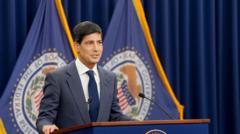
The marble walls of the Marriner S. Eccles Federal Reserve Building in Washington, D.C., are engineered to filter out the noise of the street. Inside the boardroom, the air is thick with a specific kind of quiet—the heavy silence of twelve people trying to read the future through a fog.
Jerome Powell sits at the center of the massive mahogany table. On the screens before him, the economic indicators of the United States are flashing amber. Inflation is a stubborn beast, refusing to die but no longer roaring. The labor market is cooling, but slowly. By almost every traditional metric, the playbook says it is time to move. A cut to the benchmark interest rate would breathe oxygen into the housing market, offer relief to credit-card-strapped consumers, and signal that the post-pandemic storm has finally passed.
Yet, the Federal Reserve just voted to do absolutely nothing.
They held the interest rate steady. To the casual observer tracking a stock portfolio, it looks like a pause. A blip. A routine afternoon in central banking.
But behind that frozen number lies an invisible game of geopolitical chicken. The Fed did not lock rates in place because of American consumer spending or domestic manufacturing output. They stopped because of a shadow hanging over a coastline thousands of miles away, and a volatile piece of foreign policy that could detonate the global energy market overnight.
The Kitchen Table in Ohio
To understand why a boardroom in Washington freezes, you have to leave the capital. Drive three hundred miles northwest to a suburban kitchen in Toledo, Ohio.
Let us call the man sitting at that kitchen table Arthur. He is fifty-four years old, owns a small logistics firm with six box trucks, and is currently staring at a line item on his balance sheet: diesel fuel.
Arthur does not read the Federal Open Market Committee minutes. He does not track the intricacies of international diplomacy. What he knows is that three years ago, filling his fleet cost him a fraction of what it does today. He knows that every time the price of oil ticks up by five dollars a barrel, his profit margin thins to the width of a razor blade. He wants to expand his business. He wants to buy two more trucks and hire two local drivers. But the local bank is asking for an eight percent interest rate on the loan.
"We wait," Arthur tells his wife. "If the Fed cuts rates next month, the loan gets cheaper. We buy the trucks."
Arthur is waiting on Powell. Powell is waiting on inflation. And inflation is currently hostage to the White House and the Strait of Hormuz.
The core reality confronting the American economy right now is not a lack of demand or a failure of corporate earnings. It is uncertainty surrounding the Trump administration’s impending decision on the Iran nuclear deal.
The mechanics are brutal in their simplicity. If the administration completely tears up the remaining fragments of the accord and reimposes maximum-pressure sanctions, Iranian oil exports could drop by over one million barrels a day. In a tight global market, that is not a ripple; it is a tidal wave.
If those barrels vanish, the price of crude oil jumps. When crude jumps, the price of diesel at a pump in Toledo spikes. When diesel spikes, the cost of moving groceries, timber, and microchips across the American continent climbs.
That is cost-push inflation. It is the central banker's worst nightmare because no amount of interest rate hikes can pull more oil out of the ground.
The Illusion of Control
We like to think of the economy as a highly sophisticated machine. We imagine the Federal Reserve as an engineer with a row of precise dials. Turn this knob, unemployment drops. Push this lever, inflation cools.
It is a comforting illusion. In truth, central banking is closer to steering a massive wooden ship through a shifting reef in the middle of a gale. Your rudder only works if the water behaves.
Consider what happens next if the Fed cuts rates right now to help people like Arthur buy their trucks. Money becomes cheaper. Businesses borrow, consumers spend, and the economy accelerates. But if that rate cut occurs at the exact moment a geopolitical shock sends energy prices through the roof, you get the toxic cocktail of the late 1970s: stagflation. Rising prices paired with a stalling economy.
So, the Fed chooses the only weapon it has left when the future is unreadable: inertia.
It is a terrifying position for an institution that prides itself on mathematical certainty. The economists at the Fed have doctorates from Princeton and MIT. They possess models that can simulate thousands of economic variables across decades of historical data. They can calculate the exact velocity of money through the banking system.
But their models cannot calculate the exact temperament of a president at a midnight signing ceremony, nor can they predict how a regime in Tehran will respond when its economic lifeline is constricted.
This is where expertise meets its limit. The Fed is standing still not because they lack data, but because they have just enough data to know how much they do not know.
The Cost of a Safe Bet
Doing nothing feels safe. It sounds prudent, conservative, and responsible.
But standing still carries its own quiet, devastating toll.
While the Fed waits for clarity on the Iran deal, the high-interest-rate environment continues to grind away at the foundations of ordinary life. The young couple in Phoenix who want to buy their first home are priced out by a seven percent mortgage rate, forced to watch their savings erode against rising rent. The tech startup in Austin lays off ten engineers because venture capital has dried up, choosing instead to park its cash in risk-free government bonds yielding five percent.
Arthur’s two box trucks sit on a dealer lot in Ohio, unbought. The two drivers he would have hired remain on unemployment or stuck in part-time gig work.
The economy is full of these ghosts—the businesses not started, the houses not built, the jobs not created, all because capital is locked down, waiting for the all-clear signal.
The real danger is that the all-clear signal may never arrive. Modern geopolitics does not resolve into neat, predictable conclusions. If the Iran deal falls apart, the uncertainty does not end; it merely changes shape. Will the conflict escalate? Will shipping lanes in the Persian Gulf be disrupted? Will alternative suppliers step in to fill the void?
To wait for absolute certainty in the global economy is to wait for a train that is not coming.
The Hidden Room
There is a psychological weight to this moment that rarely makes it into the financial press. We read headlines about "hawkish pauses" and "data-dependent strategies," terms designed to project an aura of calm, clinical detachment. They make the financial system sound like a laboratory.
It is not a laboratory. It is a theater of human anxiety.
Every percentage point shift in the interest rate changes the global flow of billions of dollars, altering human behavior on a massive scale. When the Fed signals that it is frozen by foreign policy fears, it sends a tremor of caution through boardrooms from Tokyo to Frankfurt. Corporate leaders look at the Fed’s hesitation and think: If they are scared, we should be terrified.
They pull back on investments. They hoard cash. The caution becomes a self-fulfilling prophecy, slowing down global growth before a single oil tanker has even changed course.
The Fed is trapped in a room of mirrors. They are trying to react to the world, but the world is reacting to their reactions.
The afternoon sun begins to dip below the Potomac River, casting long shadows across the Eccles Building boardroom. The meeting is adjourned. The statement has been released to the wires. The algorithms have processed the text, the stock market has dipped a fraction of a percent in a collective shrug, and the reporters are packing up their laptops.
The numbers remain exactly where they were yesterday. The interest rate is unchanged.
In Toledo, Arthur closes his laptop, rubs his eyes, and walks away from the kitchen table. He will check the oil futures again tomorrow morning at five. He will look at the news out of Washington and the Middle East, searching for some hint of what his life will look like three months from now.
The machinery of the wealthiest nation on earth remains locked in place, held hostage by an unwritten chapter of history, waiting for someone to make a move.