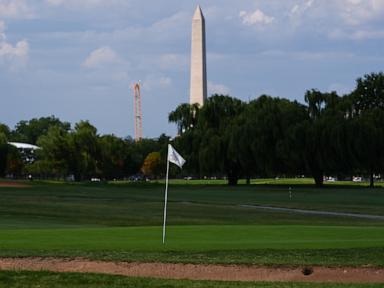
Federal asset conversions rarely fail at the ribbon-cutting; they stall or succeed in the pre-solicitation phase of the Federal Acquisition Regulation (FAR). When the National Park Service (NPS) obligated $389,355 to Vanasse Hangen Brustlin, Inc. (VHB) in September 2026 while simultaneously forecasting a $49 million construction solicitation for January 31, 2027, the transaction signaled a specific capital allocation sequence rather than a mere municipal groundskeeping upgrade. Standard news coverage frames the redevelopment of East Potomac Golf Links as a binary political dispute between executive ambition and congressional oversight. That framing misses the operational reality: the administration is executing a multi-stage federal procurement and land-use reclassification strategy constrained by statutory park mandates, environmental review timelines, and capital expenditure limits.
To understand the trajectory of the East Potomac Park overhaul, analysts must separate political rhetoric from binding legal and financial instruments. The gap between a $389,355 compliance contract and a $49 million construction forecast represents the critical friction zone where federal infrastructure projects are either validated or enjoined. Also making headlines recently: Why Jeffrey Gundlach is Dead Wrong About the Fed and Inflation.
The Three-Stage Federal Capital Deployment Model
Large-scale modifications to federally managed recreational land do not occur through single lump-sum appropriations. Instead, agencies deploy capital through a gated sequence designed to satisfy statutory prerequisites before committing heavy construction funds. At East Potomac Park, this sequence operates across three distinct tiers:
- Conceptual Design and Master Planning: Prior to public solicitation, the administration engaged Fazio Golf Design to draft architectural plans aimed at converting the existing municipal layout into an 18-hole championship venue. In federal contracting, architectural visioning establishes the scope of work (SOW) required to estimate downstream engineering costs, even when formal construction drawings remain incomplete.
- Statutory Compliance and Pre-Construction Engineering: The $389,355 award to VHB covers environmental and historic preservation compliance. Under federal law, an agency cannot legally execute major physical alterations to historic parkland without clearing the National Environmental Policy Act (NEPA) and Section 106 of the National Historic Preservation Act (NHPA). This tier acts as the regulatory gatekeeper; the size of the contract reflects administrative and engineering assessment rather than physical earthmoving.
- Forecasted Capital Construction: The Acquisition Gateway notice projecting up to $49 million in construction spending—slated for solicitation on January 31, 2027—represents an advance market signal rather than an obligated liability. Under FAR Part 10, agencies issue pre-solicitation forecasts to gauge contractor capacity and establish budgetary ceilings before final designs are locked.
The cause-and-effect relationship between Tier 2 and Tier 3 dictates the project's timeline. If VHB’s compliance assessments trigger an Environmental Impact Statement (EIS) rather than a shorter Environmental Assessment (EA) or Categorical Exclusion (CE), the January 2027 solicitation date faces immediate slippage. Conversely, isolating compliance spending from construction forecasts allows the agency to advance administrative groundwork while deferring the primary fiscal commitment. More details on this are covered by The Economist.
Statutory Constraints and the Public Trust Doctrine
The central legal vulnerability of the East Potomac conversion lies in the tension between executive management authority and legislative enabling acts. Congress established East Potomac Park in 1897 explicitly for public recreation and pleasure, with the golf course opening in 1919. Over the ensuing century, the facility functioned as an accessible municipal asset operated under concession and lease agreements—most recently involving the National Links Trust—that prioritized high-volume, low-fee public access.
Transforming a high-throughput municipal facility into a tournament-grade championship course alters the underlying economic model of the land. In public economics, municipal golf courses operate near marginal cost to maximize consumer surplus across diverse income brackets. Championship venues, by contrast, require significantly higher maintenance capital per acre—driven by specialized turfgrass management, expanded drainage infrastructure, and perimeter security—which creates structural pressure to raise greens fees or restrict tee-time availability.
This operational shift forms the basis of ongoing federal litigation, such as DC Preservation League et al. v. Department of the Interior. Plaintiffs challenge whether reconfiguring the site—including proposals that expand golf operations across roughly 50 acres of broader recreational parkland—violates the 1897 congressional mandate. Furthermore, ancillary infrastructure projects, including Phase III of the Potomac seawall fortification and disputes over the staging of demolition debris from the White House East Wing, introduce parallel regulatory review tracks. When multiple federal actions occur simultaneously on contiguous parcels, courts routinely evaluate them for improper "segmentation"—the practice of dividing a single major federal action into smaller components to evade comprehensive environmental review under NEPA.
Procurement Visibility and the Oversight Friction Zone
A recurring point of contention raised by members of the House Natural Resources Committee—including Ranking Member Jared Huffman and regional representatives—centers on the timing and visibility of the initial contract awards. Awarding a sub-$400,000 compliance contract during a congressional recess illustrates how federal procurement thresholds interact with legislative oversight mechanisms.
Under federal acquisition rules, contracts below simplified acquisition thresholds or structured as task orders under existing indefinite-delivery, indefinite-quantity (IDIQ) vehicles do not require the same congressional notification protocols as major line-item appropriations. This creates an information asymmetry:
- Executive Advantage: Agencies can utilize existing operational budgets to fund preliminary architectural and environmental studies without triggering immediate floor votes or committee markups.
- Legislative Countermeasure: When congressional committees lack direct pre-award veto power over sub-million-dollar task orders, oversight shifts to post-award document demands—such as the September 16, 2026 congressional inquiries directed to Interior Secretary Doug Burgum and Acting NPS Director Jessica Bowron—and appropriations riders designed to block future obligation of the $49 million construction tranche.
Simultaneously, the judicial branch acts as an external audit mechanism. When executive announcements regarding facility closures—such as stated plans to close the course in mid-November 2026—diverge from representations made by Department of Justice litigators regarding the finality of redevelopment plans, federal judges gain grounds to appoint independent investigators or issue preliminary injunctions. Operational execution outpacing legal compliance creates acute litigation risk.
Evaluating the Financial and Operational Trade-Offs
Any rigorous assessment of the East Potomac redevelopment must weigh the stated capital objectives against structural execution risks. Proponents of the overhaul argue that upgrading a prominent federal asset near the National Mall elevates Washington, D.C.’s capacity to host premier professional tournaments, potentially generating tourism revenue and modernizing aging drainage and seawall infrastructure.
However, three operational limitations constrain this thesis:
- Cost Escalation Variance: Federal historic renovation and civil engineering projects in the District of Columbia routinely exceed initial pre-solicitation forecasts. Because the $49 million figure is a preliminary ceiling established prior to finalized architectural blueprints, unforeseen subsurface conditions along the Potomac floodplain—combined with specialized agronomic specifications—create high upward variance in final construction costs.
- The Revenue-Access Paradox: A championship-caliber facility cannot sustain tournament conditioning under the foot-traffic volume of a traditional municipal course. Reducing annual rounds played to preserve turf integrity inevitably lowers aggregate volume, forcing management either to subsidize operating deficits with taxpayer funds or to institute pricing tiers that exclude the local demographic the 1897 statute was written to serve.
- Schedule Compression Risk: Attempting to execute major earthmoving, tree removal, and turf establishment on a compressed political timeline conflicts with biological growing seasons and mandatory federal comment periods. Accelerating physical site prep prior to the resolution of NHPA Section 106 consultations risks work-stoppage orders that compound contractor standby costs.
Strategic Positioning for Stakeholders
The trajectory of the East Potomac Golf Links project will be decided between November 2026 and the projected January 31, 2027 solicitation window. Stakeholders monitoring or operating within this environment should execute specific, targeted actions based on institutional role:
- For Congressional Oversight Staff and Policy Analysts: Focus legislative tracking on the System for Award Management (SAM.gov) and the Federal Procurement Data System (FPDS) rather than public press releases. Audit the exact funding codes (Treasury Account Symbols) used for the $389,355 VHB award and the Potomac seawall fortification to determine whether funds were reprogrammed from deferred maintenance accounts without committee notification, and draft targeted appropriations language restricting FY2027 capital obligations pending full NEPA EIS completion.
- For Civil Engineering and Construction Contractors: Treat the January 31, 2027 $49 million solicitation forecast as a high-risk bid opportunity. Before committing bid-and-proposal (B&P) capital, require clarity on indemnification clauses regarding project delays caused by federal court injunctions, historic preservation stop-work orders, and floodplain permitting bottlenecks.
- For Legal and Preservation Challengers: Anchor motions for injunctive relief strictly in administrative procedure rather than political intent. Document any physical site alterations—including perimeter fencing, tree clearing, or debris staging—that occur prior to the formal publication of VHB’s NEPA and NHPA findings, as pre-decisional irreversible commitment of resources constitutes the clearest statutory violation under the Administrative Procedure Act.