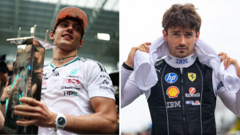
The valuation of a Formula 1 driver’s weekend relies on a binary distinction between raw potential and execution under high-stress variables. While surface-level analysis focuses on lap times or "flair," a rigorous assessment must deconstruct performance into three distinct vectors: Technical Adaptation, Risk-Weighted Aggression, and Strategic Resource Management. The Italian Grand Prix provided a unique case study in these variables, specifically contrasting the high-velocity arrival of Kimi Antonelli against the tactical endurance of Charles Leclerc.
The Antonelli Volatility Curve
The debut of Kimi Antonelli during Free Practice 1 (FP1) represents a classic study in the Asymmetry of Expectation. For a developmental driver, the primary objective is the accumulation of mileage to calibrate the vehicle’s aero-map and tire degradation models. Antonelli’s session followed a non-linear progression that highlighted a specific technical bottleneck: the gap between simulator-derived muscle memory and the physical reality of high-load lateral G-forces at the Parabolica.
The Mechanism of the Incident
Antonelli’s crash was not a failure of talent, but a failure of Closed-Loop Feedback Systems. In high-speed cornering, a driver operates within a "limit-handling" window.
- Entry Velocity Over-Optimization: Antonelli entered the corner with a speed profile derived from lower-category machinery (Formula 2), where the aerodynamic "snap" is less pronounced.
- Aero-Elasticity Variables: As the floor of the Mercedes W15 lost seal due to a slight mid-corner oscillation, the downforce dropped precipitously.
- Correction Lag: At 18 years old, the neural pathways for "saving" a modern ground-effect car are still being programmed. The crash serves as a data point on his current Operational Ceiling—it is exceptionally high, but currently lacks the fail-safes required for consistent race-trim reliability.
The "stupendous" speed noted by observers is merely the raw input; the output, in professional terms, was a net loss in development time. A strategy consultant would categorize this as a High-Variance Asset—one that can provide a massive competitive advantage but currently carries a high risk of capital (chassis) destruction.
Leclerc and the Optimization of Lairy Dynamics
Charles Leclerc’s "lairy" final lap to secure a high grid position or maintain a gap is often misinterpreted as erratic driving. In a data-driven framework, this is identified as Controlled Instability. Leclerc utilizes a specific driving style known as "Rotation via Oversteer," where the car is intentionally unsettled at the entry point to reduce the time spent in the mid-corner phase.
The Calculus of the "Lairy" Lap
When a driver is described as being "on the edge," they are managing a Diminishing Returns Function regarding tire surface temperature.
- Thermal Scuffing: By sliding the rear slightly, Leclerc generates surface heat that provides a momentary spike in grip for the subsequent high-speed exit.
- Angle of Attack: By rotating the car earlier than the traditional racing line dictates, he can apply full throttle 0.1 to 0.15 seconds sooner.
- Risk Premium: The "lairy" nature of the lap is the visual manifestation of the driver operating at 102% of the car's theoretical limit. The 2% represents the "Risk Premium"—the extra performance extracted by the driver's willingness to accept a potential spin in exchange for a front-row start.
Leclerc’s ability to sustain this for an entire race distance, particularly during the Ferrari home race at Monza, indicates a high level of Cognitive Load Management. He can process the telemetry of the car in real-time while simultaneously adjusting brake bias and engine modes, a feat that separates "fast" drivers from "championship-caliber" assets.
The Three Pillars of Driver Rating Calibration
To move beyond the subjectivity of standard "1 to 10" ratings, we must apply a weighted matrix. A driver's performance is the sum of their ability to navigate these specific constraints:
1. Mechanical Sympathy and Energy Recovery (ERS)
Modern F1 is an energy management game. A driver who finishes a lap with 0% battery deployment (SOC - State of Charge) but is 0.5s faster is often less valuable than one who is 0.2s slower but retains 20% SOC for overtaking or defending on the following straight.
- The Bottleneck: Drivers who over-use the battery in Sector 1 often become vulnerable in Sector 3.
- The Mastery: Observing how veterans like Lewis Hamilton or Fernando Alonso harvest energy through lift-and-coast maneuvers while maintaining a competitive delta.
2. Micro-Sector Consistency
Consistency is the primary metric for race engineers. A driver who can hit a specific apex within a 5cm margin for 50 consecutive laps allows the strategy team to run highly accurate simulations.
- Quantifying Antonelli: His micro-sectors showed flashes of purple (fastest), but his standard deviation across a five-lap stint is currently too high for a lead-driver profile.
- Quantifying Leclerc: Despite the "lairy" appearance, his telemetry often shows remarkable consistency in throttle application points, suggesting the "instability" is a deliberate, repeatable choice.
3. Psychological Resilience and Environmental Pressure
The "Monza Factor" places a unique stressor on Ferrari drivers. This is a Systemic Pressure Variable.
- Cognitive Narrowing: Under extreme stress, most humans suffer from "tunnel vision." In racing, this leads to missed flags, poor tire management, and late defensive moves.
- Resilience Metric: Leclerc’s ability to ignore the "noise" of the Tifosi and execute a one-stop strategy—if that were the optimal path—requires a level of detachment that is rarely quantified but essential for high-stakes decision-making.
Structural Deficiencies in Current Analysis
Most media outlets fail to account for the Hardware Latency between teams. When comparing Antonelli’s FP1 times to the rest of the field, the analysis must be normalized against the Mercedes development path for that specific weekend.
- Fuel Weight Bias: We do not know if Antonelli was running a 10kg "glory run" fuel load or a 40kg "baseline" load. Without this data, a "rating" is a speculative guess rather than an analysis.
- Engine Mapping: Teams often detune engines for FP1 to preserve mileage. If Antonelli was on a conservative map and still produced competitive times, his performance is exponentially more impressive than the raw numbers suggest.
Conversely, Leclerc’s performance must be viewed through the lens of the SF-24’s aerodynamic update package. If the car was fundamentally more stable, his "lairy" lap was actually safer than it looked. If the car was inherently "nervous," his performance was a masterclass in Crisis Management.
The Cost Function of Technical Errors
The financial implications of a driver’s performance are now dictated by the FIA Cost Cap. This creates a new metric: Pace-to-Damage Ratio.
- Antonelli’s Net Value: While his speed confirms his status as a "generational talent," the cost of the carbon fiber repair and the lost data from a truncated FP1 session creates a negative short-term ROI (Return on Investment). For Mercedes, this is an acceptable "Customer Acquisition Cost" for a future star.
- The Veteran Stability: In contrast, drivers who provide "7/10" pace but bring the car back in one piece every weekend are the "Blue Chip Stocks" of the paddock. They provide the stable platform necessary for engineering development.
Strategic Forecast: The Transition from Raw to Refined
The evolution of Kimi Antonelli will be determined by his ability to transition from Reactive Driving to Proactive System Management.
The Strategic Play:
- Simulation Saturation: Antonelli requires an additional 2,000km of private testing in 2022-spec cars to internalize the aero-limitations of ground-effect floors.
- Telemetry Deconstruction: His team must focus on "smoothing" his steering inputs. The goal is to retain the entry speed while reducing the mid-corner oscillation that led to the Monza crash.
- Leclerc’s Path to the Title: For Leclerc, the goal is not "more speed," but a more influential role in the Ferrari strategy pit. He has mastered the car; he must now master the race-environment variables that often derail Ferrari's technical advantages.
The gap between a "lairy" lap and a "stupendous" debut is smaller than it appears. Both represent a driver attempting to find the limit of a complex, multi-variable system. The winner will be the one who can find that limit and stay there, lap after lap, without crossing the threshold into systemic failure.