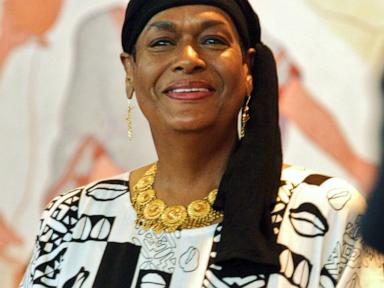
The death of Khadijah Farrakhan at age 90 marks the end of an era for one of the most insular and influential religious movements in modern American history. While her husband, Louis Farrakhan, commanded microphones and filled arenas with fiery rhetoric, Khadijah operated as the organizational anchor of the Nation of Islam. Her passing removes the final direct link to the mid-century rebuilding era of the movement, leaving a profound vacuum in the hierarchy of an organization facing an impending leadership transition. Understanding her role requires looking past the title of "first lady" to examine how she managed the internal machinery that kept the movement solvent and structured for decades.
She was not merely a supportive spouse. She was a operational pillar.
Rebuilding from the Ashes of Dissolution
To understand her impact, one must look at the critical juncture of 1977. Following the death of Elijah Muhammad in 1975, his son Warith Deen Mohammed dismantled the original Nation of Islam, moving the membership toward mainstream Sunni Islam. The temples were sold, the strict dress codes abandoned, and the old hierarchy dissolved.
When Louis Farrakhan decided to break away and resurrect the original teachings of Elijah Muhammad, he did so with virtually no institutional backing. He had the voice, but he lacked the infrastructure.
This is where Khadijah Farrakhan stepped into the operational vacuum. She did not just offer moral support; she physically helped rebuild the administrative backbone of the new Nation of Islam. Operating out of their Chicago home, she managed the initial correspondence, organized the early meetings, and oversaw the distribution of the newly minted Final Call newspaper.
Historical records of the movement show that during the lean years of the late 1970s and early 1980s, the financial management of the fledgling organization rested largely in her hands. She established the protocol for the Vanguard—the women's division of the Fruit of Islam—ensuring that the strict disciplinary codes and self-reliance principles of the original movement were replicated precisely.
The Power Dynamics Behind the Scenes
The public perception of women within the Nation of Islam often clashes with the reality of how power was exercised in the Farrakhan household. The doctrine mandates strict traditional gender roles, emphasizing domesticity and modesty. Khadijah wore the traditional white garments and head coverings, embodying the idealized image of Muslim womanhood promoted by the group.
Behind closed doors, her influence over policy and personnel was substantial. Insiders from the Chicago headquarters, known as Mosque Maryam, frequently noted that access to Louis Farrakhan was effectively mediated by his wife. She acted as a buffer against internal rivalries and financial mismanagement.
Her role was akin to a chief operating officer. While the minister traveled the world meeting with foreign heads of state and delivering multi-hour sermons, she maintained the stability of the Chicago base. This division of labor allowed the organization to survive controversies that would have destroyed other fringe religious movements.
The Unresolved Succession Crisis
The passing of Khadijah Farrakhan intensifies the scrutiny on the future of the Nation of Islam. Louis Farrakhan is 93 years old and has faced severe health challenges over the past decade. The organization has never successfully navigated a peaceful, democratic transition of power.
The first lady was a unifying figure who commanded respect across various factions within the mosque hierarchy. Her presence muted public infighting among potential successors, including national international representatives and regional ministers.
Without her stabilizing presence, the internal jockeying for position is expected to accelerate. The Nation of Islam holds significant real estate assets, commercial enterprises, and cultural capital within urban America. The battle for control of these assets will likely expose deep ideological rifts between the older guard, who favor maintaining the strict, controversial doctrines of the past, and younger members who seek a more modernized approach.
A Legacy Wrapped in Controversy
Evaluating the life of Khadijah Farrakhan requires acknowledging the stark polarization surrounding the organization she helped build. To its supporters, the Nation of Islam provided a lifeline of discipline, economic self-reliance, and racial pride in neglected urban communities. The clean-cut men in bow ties and the disciplined women in white represented safety and order.
To critics, civil rights organizations, and hate-group monitors, the Nation of Islam remained a source of antisemitism, homophobia, and racial separatism. Khadijah was never a public source of these rhetoric pieces, but she was deeply embedded in the system that propagated them. She chose a path of public silence on these issues, focusing instead on internal charity work, disaster relief efforts, and community cleanup initiatives.
This duality defines her legacy. She was a philanthropist within her community, funding schools and supporting families in distress, while simultaneously anchoring an organization that remained radioactive to mainstream society.
The Shift in Urban Influence
The world Khadijah Farrakhan helped shape is radically different from the contemporary landscape of urban activism. In the 1980s and 1990s, the Nation of Islam could mobilize tens of thousands of men for events like the Million Man March. Today, Black activism has largely decentralized, moving toward secular, leaderless movements utilizing digital organizing tools rather than top-down religious hierarchies.
The strict discipline that Khadijah championed faces declining appeal among younger generations. The mosque membership is aging, and the economic model of selling physical newspapers and door-to-door goods has been rendered largely obsolete by modern commerce.
Her death is the penultimate chapter in the story of 20th-century American Black nationalist movements. The infrastructure she built and maintained for nearly fifty years faces its greatest test now that its primary caretaker is gone. The institutions she managed must adapt to a world that no longer operates on the principles of deference and absolute authority that defined her era.