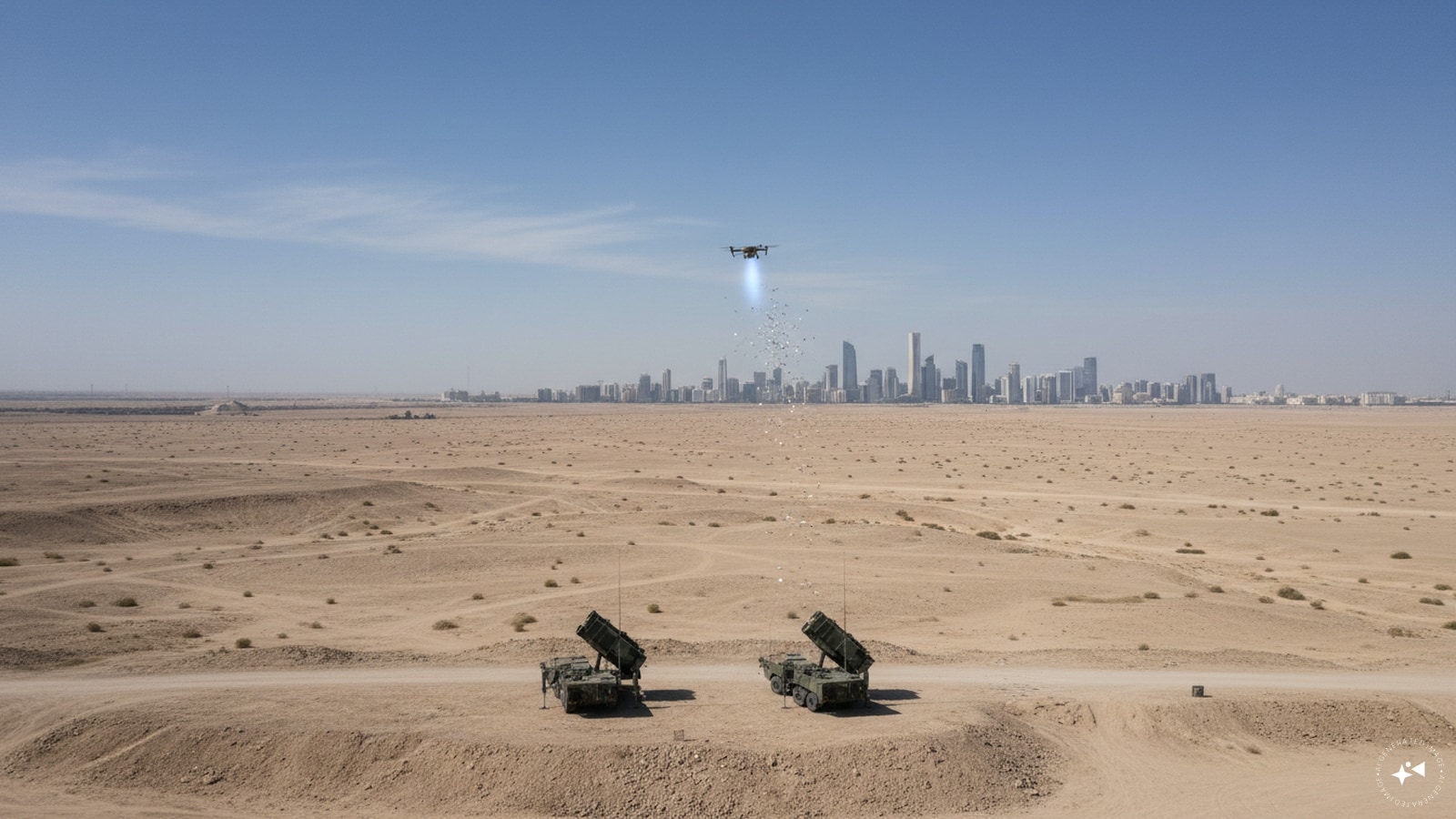
Two in the morning in Riyadh feels like a velvet blanket thrown over a sprawling, neon-lit desert. The daytime heat, which regularly climbs past forty degrees Celsius during the summer months, finally retreats, leaving behind a cool, dry stillness that settles over the limestone facades and glass towers of Saudi Arabia’s capital. Down on King Fahd Road, a few late-night delivery scooters zip past empty plazas, their taillights leaving brief red smears in the dark. Inside millions of bedrooms, air conditioners hum at a steady, hypnotic frequency, masking the outside world.
Then, high above the city’s outer perimeter, a different kind of sound cuts through the upper atmosphere. For another look, consider: this related article.
It is not the thunderous roar of a commercial airliner descending toward King Khalid International Airport. It is smaller, higher-pitched, and relentlessly purposeful—the mechanical buzz of an unmanned aerial vehicle pushing through the night sky. Minutes later, a sharp, distant concussion ripples across the horizon. A flash of light blooms briefly against the dark clouds, followed by the fading trail of falling debris. By breakfast, the event will be reduced to a three-sentence wire report stating that Saudi air defenses intercepted and destroyed a hostile drone in the Riyadh region.
For anyone reading that headline over coffee thousands of miles away, the news registers as little more than a routine geopolitical footnote. Intercepted. Destroyed. Nobody hurt. Next story. Further analysis on this trend has been shared by Associated Press.
Yet for the people living beneath that sky, a successful interception is never just a sterile military statistic. It is a visceral reminder of an invisible, high-stakes war being fought miles above their roofs while they sleep.
The Anatomy Of A Midnight Alarm
To understand what a single line of newsprint actually means on the ground, consider a hypothetical scenario rooted in the lived reality of thousands of expatriates and Saudi families in the capital. Picture Tariq, a thirty-eight-year-old civil engineer living in a fourth-floor apartment in northern Riyadh, and his seven-year-old daughter, Layla.
On the night an interception occurs, Tariq is usually awake, finishing drawings for a new transit hub while the rest of his household sleeps. When the Patriot or THAAD radar batteries stationed miles away lock onto an incoming target, there is no Hollywood siren wailing across the city blocks. Modern air defense operates at speeds that make public alarms obsolete before the sound waves could even reach a bedroom window. Instead, the first sign of trouble is a low, vibrating thud that rattles the sliding glass doors leading to the balcony.
Tariq freezes, his pen hovering over his tablet. Experience has taught him to count the seconds between the flash on the horizon and the pressure wave hitting his windows—a childhood habit repurposed for adulthood in a region where asymmetric warfare has reshaped daily life.
One. Two. Three. Four.
The glass trembles again, softer this time, as secondary fragments burn up in the upper air. Down the hallway, Layla stirs, calling out softly for water, completely unaware that an automated mathematical calculation just prevented a hundred-kilogram warhead from reaching the city’s outskirts. Tariq walks to her room, checks the lock on the window, and hands her a glass. If he tells her the truth, she will not sleep for a week. So he tells her it was just thunder—a rare desert storm passing overhead—and watches her close her eyes.
That quiet lie is the real human cost of modern drone warfare. Even when the shield holds, the psychological weight settles onto the shoulders of parents, night-shift nurses, and air traffic controllers who know exactly what that distant rumble represents.
Why A Cheap Plastic Frame Threatens A Billion-Dollar Skyline
For decades, military dominance belonged exclusively to nations capable of building multi-million-dollar fighter jets, massive naval fleets, and sprawling satellite networks. If an adversary wanted to strike a capital city situated hundreds of kilometers from a border, they needed an air force or a sophisticated ballistic missile program. Both left massive footprints that intelligence agencies could spot months in advance.
Unmanned aerial systems shattered that monopoly overnight.
Think of traditional air warfare like a chess match played with heavy marble pieces; every move is visible, expensive, and deliberate. Modern drone warfare, by contrast, is like someone tossing a handful of gravel at a stained-glass window from behind a wall. Individual drones—often assembled using commercially available components, lightweight carbon-fiber composites, and simple lawnmower-style two-stroke engines—can cost as little as ten thousand to twenty thousand dollars to produce. Yet a single one of these machines, packed with high explosives and guided by basic GPS coordinates, carries enough kinetic and destructive power to cripple a power substation, ignite an oil refinery, or shut down an international airport.
When Saudi authorities announce the interception of a hostile drone in the Riyadh region, they are describing the final seconds of a cat-and-mouse game that spans vast stretches of desert. Riyadh sits roughly eight hundred kilometers north of the Yemeni border, where Houthi militants have repeatedly launched long-range unmanned aircraft toward the kingdom over the past decade, and hundreds of kilometers west of the Persian Gulf. Covering that distance requires a drone to fly low, hugging the terrain to slip beneath traditional radar horizons.
Imagine trying to spot a dark-colored bird flying just fifty meters above a moonless ocean while standing on a lighthouse tower ten miles away. That is the exact technical challenge facing air defense operators every single night.
Inside The Digital Nervous System
If spotting a low-flying drone is nearly impossible for the human eye, stopping it requires a network of sensors and interceptors operating faster than human reflexes allow.
Across Saudi Arabia, defense planners have spent billions of dollars constructing one of the most dense, multi-layered air defense architectures on the planet. It works much like a series of concentric nets, each designed to catch a different kind of threat at a different altitude and distance.
At the outer edge sit long-range early warning radars and airborne surveillance aircraft—flying command centers equipped with massive rotating radar domes that look down from high altitude, eliminating the blind spots created by hills and valleys. When these sensors detect an anomalous heat signature or a slow-moving radar return where no commercial flight path exists, the data is transmitted instantaneously to regional command centers.
Inside those dimly lit rooms, operators watch luminous screens where every civilian airliner, cargo plane, and weather balloon is tagged and accounted for. An unidentified track appears as an amber symbol creeping across the desert floor. Within seconds, algorithms calculate its trajectory, speed, and projected impact zone. If the path points toward a populated area like Riyadh or critical infrastructure, the system hands off tracking duties to shorter-range batteries—such as the Raytheon Patriot system, the Terminal High Altitude Area Defense (THAAD) network, or specialized close-in weapons systems designed specifically for low-altitude threats.
Then comes the hardest decision in modern defense economics.
To destroy a drone that costs roughly the price of a used sedan, defenders frequently have to fire an interceptor missile that costs anywhere from one million to four million dollars. Critics often point to this glaring financial imbalance as a fatal flaw in modern air defense. Why spend millions to swat down pennies?
The answer becomes obvious the moment you look down at the streets of Riyadh. You do not price an interceptor missile against the cost of the drone that launched it; you price it against the value of the hospital, the desalination plant, or the apartment building sitting at the end of that drone’s flight path. When a single strike on Abqaiq and Khurais in September 2019 temporarily knocked out half of Saudi Arabia’s crude oil production—roughly five percent of the entire world’s daily oil supply—the global economy felt the shockwaves within hours. Against that scale of disruption, a three-million-dollar interceptor looks less like an extravagance and more like an insurance policy paid in full.
The Invisible Debris Nobody Talks About
Even a textbook interception carries hidden risks that rarely make it into official press releases.
Physics dictates that matter cannot simply vanish into thin air. When an interceptor missile collides with a hostile drone ten kilometers above the desert, the explosion shreds both vehicles into thousands of jagged metal fragments. Most of the smaller pieces burn up from friction as they plunge downward, creating the brief shooting-star streaks that residents occasionally capture on smartphone cameras.
Heavier components—such as engine blocks, battery packs, or unexploded warhead casings—survive the fall.
In January 2021, when Saudi air defenses intercepted an aerial target over Riyadh, falling debris damaged residential homes in the capital, shattering windows and punching holes through roofs, though miraculously causing no fatalities. That incident forced civil defense authorities to issue urgent public guidelines reminding residents not to rush outside to film explosions in the sky. Staying away from windows, moving to interior hallways, and waiting at least fifteen minutes after an impact sound before stepping outside became essential urban survival habits.
I remember speaking with an aviation safety consultant in the Gulf who described the aftermath of an interception like a sudden, localized hailstorm made of twisted aluminum. You can engineer a radar system to hit a target the size of a suitcase moving at two hundred kilometers an hour, he told me, but once that collision happens, gravity takes over, and gravity does not discriminate between an empty desert dune and a backyard patio.
The Shift Toward Lasers And Silent Interceptors
Because firing multi-million-dollar missiles at cheap drones is unsustainable over a multi-year conflict, the race is now on to rewrite the rules of interception entirely.
Across defense laboratories in Riyadh, Washington, and beyond, engineers are rapidly deploying a new generation of counter-drone technologies that rely on directed energy rather than explosives. High-energy laser systems—such as the SkyShield and Silent Hunter platforms already tested in the region—use concentrated beams of light to heat a drone’s airframe or optical sensors until the aircraft melts, loses control, and crashes harmlessly miles away from populated areas.
The economics of a laser shot flip the equation completely. Instead of burning through finite stockpiles of expensive missiles, a directed-energy weapon costs roughly the price of a gallon of diesel fuel per engagement, limited only by the electrical power available to its generators.
Alongside lasers, electronic warfare units now blanket sensitive zones with invisible walls of radio-frequency jamming. Since most long-range drones rely on satellite navigation to stay on course over featureless desert terrain, jamming or spoofing those signals can trick a drone into thinking it is flying north when it is actually turning south, causing it to run out of fuel harmlessly over empty sand.
Yet technology alone never provides absolute certainty. Every new jamming frequency prompts adversaries to build drones with inertial navigation systems that do not need satellites at all. Every laser system struggles when thick desert dust storms scatter the beam of light. Anyone who claims a defense network is impenetrable is either selling hardware or ignoring history. There is always a margin of vulnerability, a thin sliver of risk that keeps commanders awake at night watching green lines sweep across dark monitors.
Morning Light Over King Fahd Road
By six in the morning in Riyadh, the night shift at the air defense batteries hands over control to the morning crew. The official statement from the Ministry of Defense has already crossed the wires, confirming that a hostile drone was detected, tracked, and destroyed before reaching its target, with no casualties reported.
Down in northern Riyadh, Tariq wakes up to the smell of cardamom coffee drifting from the kitchen. Layla is already dressed in her school uniform, chattering excitedly about an art project while she eats her breakfast, completely untouched by the events of four hours earlier. Outside, the city roars back to life. Construction cranes swing steel beams into place against a pale blue sky, commuters merge onto the highways, and the glass towers reflect the rising desert sun as if nothing could ever disturb their stillness.
Tariq steps onto the balcony for a moment, wrapping his hands around his warm mug, and looks up into the empty, cloudless expanse above the rooftops. Nothing is visible—no smoke trails, no radar waves, no trace of the machinery that stood guard while the city slept—only the quiet, unbroken blue of another ordinary morning.