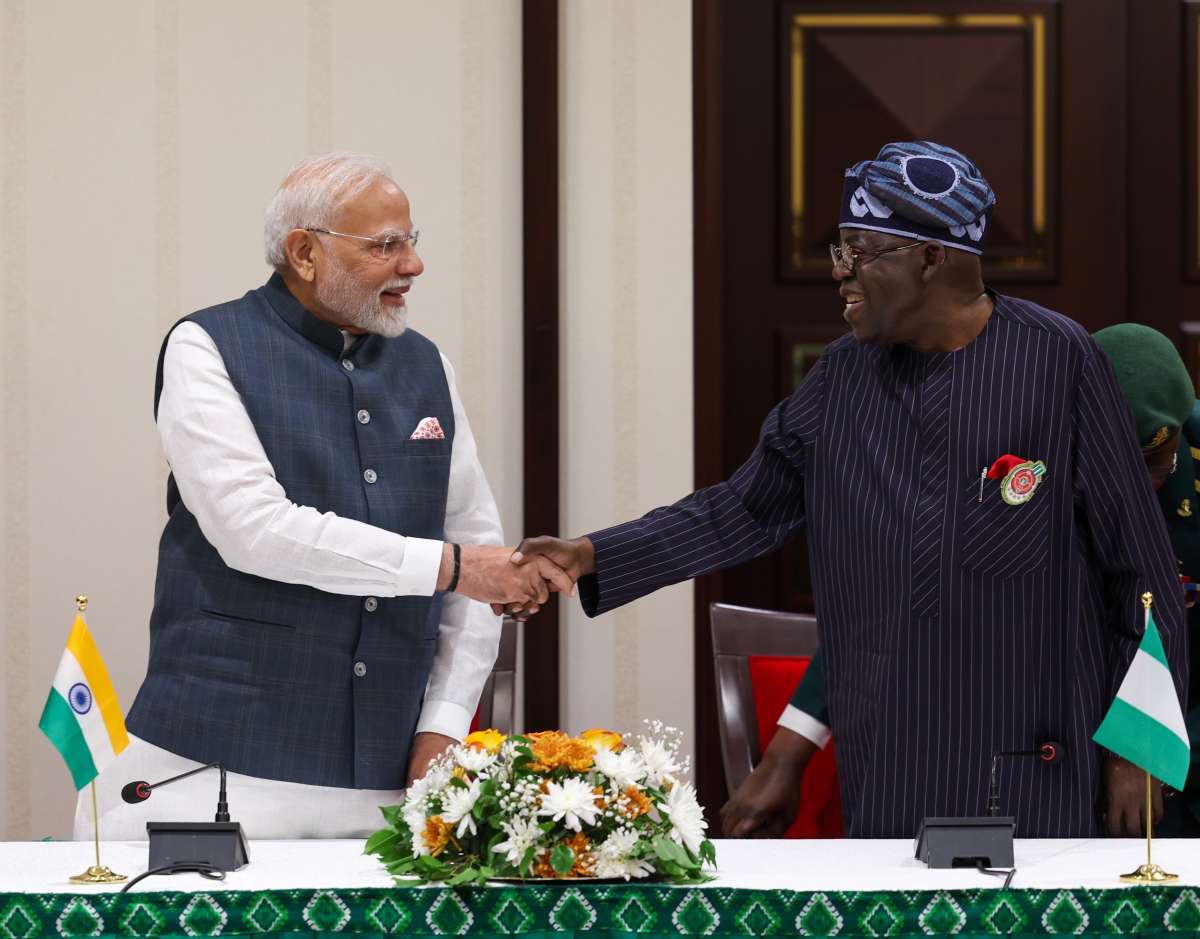
The morning air in Keralam carried the familiar, rich scent of damp earth and crushed cardamom leaves. Monsoon clouds heavy with moisture drifted lazily across the horizon, brushing against the emerald canopy of coconut palms. In a quiet, sequestered corner far removed from the glaring lights of bureaucratic press conferences, two men sat down across from one another.
One wore the sharp, unmistakable authority of statecraft. Malaysian Prime Minister Anwar Ibrahim. A man whose life has been etched by decades of prison walls, fiery rhetoric, and a hard-fought ascent to the highest office of his nation. The other wore the quiet, timeless grace of spiritual stewardship. Grand Mufti Kanthapuram AP Aboobacker Musliyar. A scholar whose hands have blessed millions, whose voice carries the weight of a traditional seminary, and whose influence bridges continents without ever needing a microphone.
History is rarely written in the grand chambers where treaties are signed with silver-nibbed pens. More often, it is forged in these hushed encounters. Two distinct worlds—the secular halls of Southeast Asian governance and the deep, spiritual roots of South Asian Islamic scholarship—converging in a single room.
Consider what happens when political power meets moral authority.
Usually, we expect friction. We expect staged handshakes for the evening news, polite platitudes about economic cooperation, and an immediate retreat to separate corners. But this was different. When Anwar Ibrahim stepped into Keralam to meet the Grand Mufti, he was not merely executing a diplomatic formality. He was seeking counsel. He was looking into the eyes of a spiritual leader who understands the human cost of division, and listening.
To understand why this matters, you have to step away from the headlines and look at the map not as a collection of borders, but as a web of human pulses.
Malaysia is a modern, multicultural powerhouse, navigating the delicate tightrope of pluralism in a rapidly modernizing world. Anwar Ibrahim has spent his tenure preaching a philosophy he calls Madani—an ideology centered on sustainability, prosperity, innovation, respect, trust, and compassion. It is a lofty vision. But visions mean nothing if they cannot touch the soil where ordinary people live, pray, and try to feed their children.
Keralam, on the other hand, is an ancient crossroads. For centuries, Arab traders, Sufi saints, and maritime merchants brought more than spices to these Malabar shores; they brought faith, philosophy, and a tradition of syncretic living. Long before modern nation-states drew lines on parchment, Keralam was a place where different communities did not merely tolerate one another—they wove their daily lives together.
When the Prime Minister of Malaysia sits knee-to-knee with the Grand Mufti, they are channeling that ancient lineage. They are discussing education, the upliftment of marginalized communities, and the urgent need to reclaim a faith that is too often hijacked by extremists or reduced to political weaponization.
Listen closely to the silence in that room. It is heavy with responsibility.
What does a statesman say to a scholar when the world is burning at the edges? When sectarian tensions flare across the globe, and the language of division threatens to drown out the voice of reason?
You do not offer soundbites. You talk about the children sitting in classrooms in Kuala Lumpur and Kozhikode. You talk about the necessity of moral education that teaches empathy before dogmatism. You talk about the profound, undeniable truth that humanity is meant to know one another, not to fear one another.
We live in an era obsessed with noise. Every screen shouts at us. Every notification demands outrage. We are fed a steady diet of conflict, as if human beings were only capable of tearing down what previous generations built.
Yet, in Keralam, the noise faded.
The meeting between Anwar Ibrahim and Kanthapuram AP Aboobacker Musliyar serves as a quiet rebuke to the cynics. It reminds us that leadership is not just about GDP growth rates or military posture. True leadership requires a moral compass. It requires the humility to travel thousands of miles just to sit with a wise elder and listen.
Think about the invisible stakes of diplomacy like this. A policy can be written in a sleek government office, but it only breathes when the cultural immune system of a society accepts it. If political leaders ignore the moral and spiritual architects of their communities, policies become sterile mandates. If spiritual leaders ignore the practical realities of governance, they become relics of the past.
This encounter bridged that chasm.
When Anwar Ibrahim left Keralam, he took more than memories of humid breezes and green vistas. He carried a renewed perspective on how faith can be a wellspring of healing rather than a tool for fracture. The Grand Mufti, in turn, reinforced a message that has echoed through the corridors of Islamic scholarship for centuries: true authority serves the people, honors diversity, and guards the vulnerable.
The monsoon rain continued to tap gently against the windows as they parted ways. Outside, the ordinary life of Keralam rushed on—rickshaws chiming their bells, fishermen hauling nets, children laughing under umbrellas. None of them knew the exact words spoken in that room. None of them needed to.
They only needed to feel the resonance.
Because sometimes, a single conversation between two men of substance can bend the arc of a troubled world just a fraction of an inch closer to peace. And in these times, an inch is everything.