Winter in Tallinn smells like burning birch and wet stone. If you walk down the narrow, cobblestone alleys of the Old Town just as the blue hour bleeds into night, the streetlamps cast long, shivering shadows against medieval walls that have seen empires rise, fracture, and vanish. In these moments, Estonia feels like a secret kept by the Baltic Sea. It is a place of quiet dignity, where people speak in low registers and measure their words the way a master carpenter measures timber.
Yet, beneath that calm surface runs a deep, ancestral current of vigilance.
I remember standing in a Tallinn cafe a few years ago, watching an elderly man read a newspaper headline while sipping his black coffee. His expression did not change. There was no gasp, no sudden shift in posture. Just a slight tightening of the jaw. That reaction is the national reflex. When your neighbor is a giant with a history of rewriting borders, you learn not to panic. You learn to organize. You learn to endure.
And then, you choose a president.
To understand why Estonia’s choice of a head of state matters far beyond the borders of a country smaller than Denmark, you have to look past the dry diplomatic cables. You have to look at the invisible architecture of fear and resilience that defines the Baltic states.
Consider what happens next when a small nation stands on a geopolitical fault line. Every election is a stress test. Every political maneuver is watched from across the eastern border with hungry eyes. When the political machinery in Tallinn ground into gear to find a successor for the presidency, the temptation was high for factions to clash, to pull the nation toward ideological extremes, to fracture the fragile consensus that keeps a front-line democracy stable.
Instead, they did the remarkable. They chose calm.
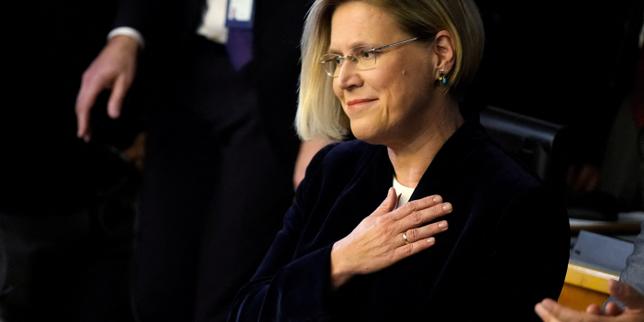
Kersti Kaljulaid, and the consensus-driven political culture she came to embody during her tenure, represents a specific kind of power. It is not the loud, chest-thumping authority of autocrats. It is the unyielding strength of a reinforced concrete beam hidden inside a minimalist wall.
Imagine a bridge built over a roaring, freezing river. The wind howls down the gorge. Ice floes slam against the concrete piers. If the bridge is rigid, it cracks. If it is too flexible, it collapses. It survives only because every stone is locked in precise, quiet tension with the next.
That is Estonia's political reality.
For decades, the shadow of Kremlin destabilization attempts has loomed over the Baltic states. This is not abstract theory. It is cyberattacks that paralyze banking systems. It is disinformation campaigns designed to pit Russian-speaking minorities against ethnic Estonians. It is the constant, low-humming psychological warfare intended to exhaust a population into submission.
When a nation faces that kind of persistent pressure, division is the ultimate vulnerability. If Moscow can make Estonians distrust their own parliament, distrust their neighbors, and distrust the integrity of their institutions, the battle is half-won without a single soldier crossing the border.
So, when the political class maneuvered past petty squabbles to agree on a unifying figure, it was more than an administrative victory. It was a collective act of defiance.
It said: You can try to break our unity, but we will forge it ourselves.
To grasp the human element here, look at the people who live this reality every day. Picture Kadri, a thirty-something cybersecurity specialist working in a sleek glass office building in downtown Tallinn. She spends her workdays neutralizing foreign malware attempts, tracing digital footprints back to dark server rooms across the border. Her job is invisible. If she succeeds, nothing happens. No systems crash. No headlines are written.
Kadri lives in a state of hyper-awareness. She knows that her digital defense is only as strong as the political will of the country standing behind her. When politicians bicker, cracks form in the wall. When politicians unite, her firewall holds.
For Kadri, a consensus president is not a political abstraction. It is the baseline security that allows her to sleep for five hours before heading back to the screen.
History teaches us that small nations do not survive by accident. They survive by discipline. Estonia has mastered the art of digital governance, transforming itself from a Soviet-occupied territory into a gleaming, paperless society where you can vote, start a business, and file taxes online in minutes. But technology without trust is just a fragile web of wires waiting to be cut.
Trust is political. Trust is cultural.
When the electoral college reached its consensus, choosing a leader who could speak to all factions, the message beamed straight to Moscow was unambiguous. You cannot wedge a crowbar into a door that has no gaps.
We often romanticize dramatic political revolutions—the barricades, the shouting crowds, the sudden overthrow of tyrants. But the harder, rarer, and far more vital form of courage is the daily maintenance of democracy. It is the willingness of politicians to swallow their egos, set aside partisan ambitions, and choose a leader who embodies stability rather than spectacle.
It is boring. It is unglamorous.
And it is entirely bulletproof.
As the evening mist rolls off the Baltic Sea and blankets the red rooftops of Tallinn, the lights in the presidential palace stay on. Inside, the work continues. Not the loud, theatrical work of empires, but the quiet, meticulous craftsmanship of a free people refusing to be rattled.
The wind will blow from the east. The algorithms will probe for weakness. The pressure will not let up.
Yet the bridge still stands. Stone by stone. Quietly holding the weight of a nation that refuses to fall.