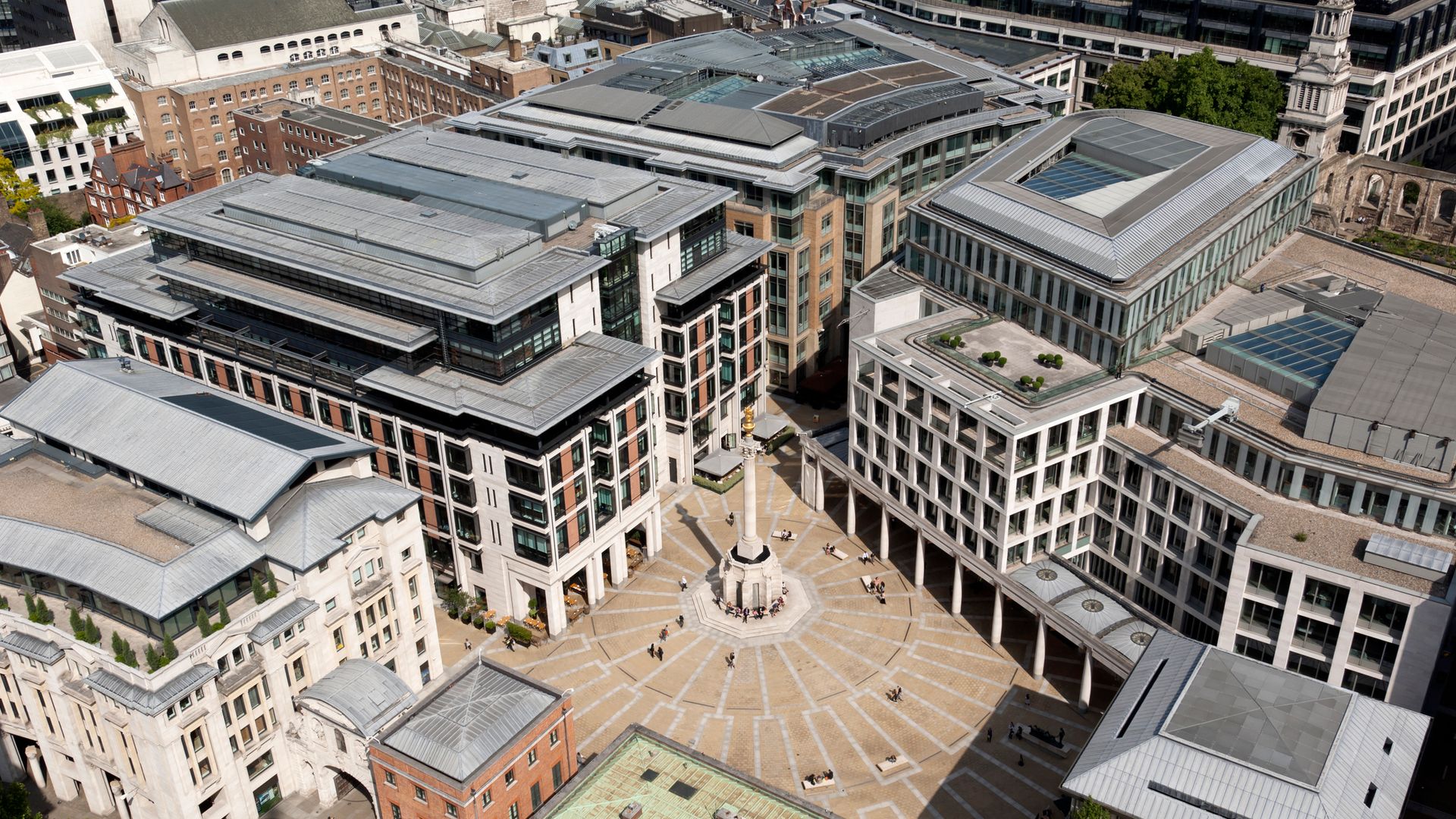
Seven o'clock on a Tuesday morning in the City of London smells like wet wool, roasted espresso, and a very specific kind of quiet panic.
You can see it on the faces pouring out of Bank station. Men and women in tailored navy coats clutch paper cups like lifelines, their eyes already glued to glowing phone screens before they even reach the pavement. For years, I stood in that exact crowd. I spent a decade working as an analyst just two streets away from Paternoster Square, watching the numbers tick across glass walls while the rain streaked the windows. Back then, the London Stock Exchange felt like the beating, indisputable heart of global finance. It was loud. It was confident. It was where the world came to raise money and build empires. Discover more on a connected issue: this related article.
Today, the square feels different. Quieter.
And inside the sleek headquarters of the London Stock Exchange Group—the parent company known simply as LSEG—a proposal has been quietly circulating among board members and major institutional investors. It is a plan to hand chief executive David Schwimmer a multimillion-pound pay hike, potentially doubling his total compensation package from roughly £6.25 million to more than £13 million a year. More reporting by MarketWatch highlights similar perspectives on this issue.
On paper, this looks like just another headline about corporate excess. You read the numbers, you roll your eyes, and you move on with your breakfast.
Stop. Look closer at what that paycheck actually represents.
Because this isn't really a story about one man's bank account. It is a story about a three-hundred-year-old financial institution fighting for its survival in a world that has quietly moved on without it. It is about what happens when the premier marketplace of a proud nation realizes it can no longer compete on prestige alone—and decides to pay American prices to keep its American architect from walking out the door.
The Gravity of New York
To understand why the board of the London Stock Exchange Group is preparing to open its vault, you have to picture a hypothetical scene playing out in a glass-walled boardroom overlooking the Thames.
Let's call our fictional character Arthur. Arthur sits on a pension fund committee in Leeds. He manages the retirement savings of forty thousand former teachers, nurses, and council workers. Every quarter, Arthur looks at spreadsheets showing where their money is invested. Twenty years ago, half of that portfolio sat comfortably in London-listed companies. Today, Arthur is shifting more and more of those funds across the Atlantic to New York.
Why? Because that is where the growth went.
Over the past few years, London has suffered a slow, agonizing bleed of talent and capital. Tech giants like Arm Holdings—born and bred in Cambridge—chose the Nasdaq in New York for their blockbuster flotation instead of coming home to the Thames. Building materials behemoth CRH packed its primary listing and moved stateside. Flutter Entertainment, the owner of Paddy Power and Betfair, did the exact same thing. Even fast-fashion giant Shein, once viewed as a potential savior for London's IPO market, found itself tangled in regulatory scrutiny and political pushback, leaving bankers wondering where the next big listing would ever come from.
Think of a stock exchange like a massive, bustling night market. For the market to thrive, you need two things: vendors with exciting goods to sell, and crowds of hungry buyers willing to pay top dollar. When the most exciting vendors start setting up their stalls across the ocean because the foot traffic is heavier and the buyers have deeper pockets, the old market starts to empty out. The lights stay on, the stalls are still swept every morning, yet the energy is gone.
David Schwimmer saw this coming long before most people in the Square Mile were willing to admit it out loud.
When the former Goldman Sachs banker took the helm of LSEG in 2018, he inherited an exchange that was still largely defined by its history. Within three years, he executed a daring, $27 billion gamble: he bought Refinitiv, a sprawling financial data and analytics giant. Overnight, he transformed the London Stock Exchange Group from a traditional venue for buying and selling shares into a global data powerhouse. Today, trading equities accounts for only a tiny sliver of LSEG's actual revenue. The real money—the steady, recurring, bulletproof cash flow—comes from selling real-time financial data, risk intelligence, and market infrastructure to banks and governments around the world.
Schwimmer saved the company by changing what the company actually is.
The Pay Gap Across the Ocean
Now, consider what happens next when a board of directors looks at a chief executive who has doubled the company's market value and steered it away from an existential cliff.
They look across the Atlantic. And what they see makes them break out into a cold sweat.
In New York, the chiefs of rival data and exchange operators—companies like Intercontinental Exchange, Nasdaq, and S&P Global—regularly pull down compensation packages worth $15 million, $20 million, or even $25 million a year. Meanwhile, Schwimmer, running a business of comparable scale and global complexity, was earning roughly half of what his American peers took home.
For years, the United Kingdom maintained an unspoken cultural ceiling on executive pay. Unlike Wall Street, where astronomical bonuses are treated as badges of honor, Britain has always viewed massive CEO salaries with deep skepticism. Shareholders push back. Politicians give speeches about inequality. Tabloids print the numbers next to pictures of struggling high streets.
I remember sitting in shareholder meetings in London during the late 2010s, listening to fund managers grill remuneration committees over every hundred-thousand-pound bump in base salary. There was a fierce, almost puritanical pride in keeping British executive pay restrained compared to the excesses of Manhattan.
That pride is colliding head-on with brutal market reality.
If you are the board of LSEG, you face a terrifyingly simple equation. You have an American CEO who successfully transformed your business into a global data titan. Headhunters in New York and Chicago have his number on speed dial. If you refuse to pay him closer to the global market rate for his talent, someone else will. And if he leaves, who steps into those shoes? Will a world-class leader from New York or Zurich uproot their life to run a complex global enterprise in London for fifty cents on the dollar?
Probably not.
The Invisible Stakes for Everyone Else
It is easy to dismiss this as a dispute among billionaires and multi-millionaires—a closed-door negotiation between ultra-wealthy executives and massive institutional asset managers. You might ask yourself why a nurse in Manchester or a small business owner in Bristol should care whether one man makes six million pounds or thirteen million pounds.
Look beneath the surface. The stakes are entirely invisible, yet they touch almost every corner of British economic life.
First, there is your pension. If you have a workplace pension in the UK, there is a high probability that a portion of your retirement savings is invested directly in LSEG or in the funds that track the FTSE 100. When LSEG thrives, its share price rises, its dividends grow, and the quiet machinery compounding your retirement fund ticks upward. If the company stumbles because it loses its strategic leadership, that ripple reaches your statement decades from now.
Second, there is London's identity as a global financial capital. Financial services generate roughly ten percent of the UK's total tax revenue—money that pays for hospitals, schools, trains, and roads. For centuries, Britain punched wildly above its weight because the world trusted London's markets, courts, and institutions. When London fails to retain top-tier global leadership, or when its premier financial institutions look weak and hesitant on the international stage, that trust erodes. Capital flows to where strength lives. Once it leaves, it rarely comes back.
Finally, there is a broader reckoning happening across the entire UK corporate landscape. LSEG is not acting alone. Over the past two years, a quiet rebellion has broken out among Britain's biggest listed companies. AstraZeneca, Smith & Nephew, and several other FTSE 100 giants have all moved to overhaul their pay policies, begging shareholders to let them offer American-style compensation packages so they can compete for global talent.
Even Julia Hoggett, the chief executive of the London Stock Exchange itself—a subsidiary within Schwimmer's broader group—sparked a fierce national debate when she warned that the UK was pricing itself out of the global talent market. Her argument was blunt: Britain cannot expect to build world-leading companies while refusing to pay world-leading wages to the people who run them.
The Flaw in the Argument
Yet, as persuasive as the board's logic sounds inside a warm conference room, something about it still leaves a bitter taste in the mouth.
Let's be honest about the doubts here. Even after years of analyzing balance sheets and executive incentive plans, I still struggle with the sheer scale of these numbers. When a pay package jumps from six million to thirteen million pounds in a single stroke, we are no longer talking about someone struggling to pay their mortgage or afford school fees. We are talking about abstract scorekeeping among the global elite.
And history offers plenty of warnings about what happens when boards panic and throw massive piles of stock options at a CEO.
Pay hikes do not guarantee performance. Across the corporate world, history is littered with examples of boards approving stratospheric compensation plans right at the peak of a company's cycle, only to watch the share price stagnate while the executive walks away rich regardless. Critics of the LSEG proposal point out a crucial flaw in the "American pay" argument: Wall Street executives earn massive rewards when things go well, yes, but they also face ruthless, unforgiving accountability when things go wrong. In Britain, critics argue, companies often try to import the upside of American pay without importing the brutal downside risk.
There is also the undeniable optics of timing. Millions of households across Britain are still grappling with stubbornly high living costs, elevated mortgage rates, and squeezed public services. Against that backdrop, doubling the pay of the man who runs the nation's flagship financial institution feels jarring. It widens the psychological chasm between the people who manage capital and the people who actually work for a living.
You can understand the board's fear of losing Schwimmer. You can follow every logical step of their math. And at the exact same time, you can feel a deep unease about what it says when a nation's financial crown jewel has to essentially bribe its own leadership to stay competitive.
The Architecture of a Modern Payday
How does a pay package actually double without simply handing someone a briefcase full of cash?
If you imagine David Schwimmer receiving a larger monthly direct deposit, you have the mechanism entirely backward. Modern executive pay is an intricate piece of financial engineering, designed to look sensible to regulators while delivering enormous upside if the stock performs.
Under the proposed structure, Schwimmer's base salary—the fixed cash he gets paid just for showing up to work—barely moves. It stays anchored around £1.38 million. To a board of directors, keeping base pay flat is a vital talking point. It allows them to tell skeptical shareholders, "Look, we aren't giving him guaranteed money."
The real explosion happens in the long-term incentive plans—the performance shares that vest three to five years down the road.
Think of it like a high-stakes bet placed on the company's future. The board sets a series of hurdles: revenue growth targets, earnings per share milestones, and relative shareholder returns compared to global peers. If LSEG's stock price climbs and those financial targets are met, those paper promises convert into millions of pounds' worth of actual shares. Under the revised policy, Schwimmer's maximum annual bonus opportunity jumps from 225 percent of his salary to 300 percent, while his long-term share award potential surges from 550 percent to a staggering 650 percent.
If everything hits, the total package crests north of £13 million.
Institutional investors—the massive pension funds and asset managers who actually own LSEG's shares—have largely nodded along during private consultations. Why? Because from their perspective, if Schwimmer hits those targets, their own portfolios will be worth billions of pounds more. To a fund manager overseeing five hundred billion dollars, paying an extra seven million pounds to the architect of that growth looks like a rounding error.
What Happens When the Lights Dim
Step back out onto the wet cobblestones of Paternoster Square as evening falls.
The traders and analysts are filing back toward the Underground stations, their umbrellas blooming like black mushrooms against the drizzle. Above them, the illuminated ticker boards inside the exchange headquarters cast a soft blue glow onto the damp stone.
For three centuries, this tiny patch of real estate helped finance the Industrial Revolution, built railways across continents, and funded empires. It operated on an unwritten social contract: London offered stability, fairness, and global reach, and in return, the world brought its business here.
That contract is being rewritten in real time.
Whether David Schwimmer pockets six million pounds or thirteen million pounds next year will not change the price of a loaf of bread in Birmingham or fix a pothole in Edinburgh. Yet the decision sitting before LSEG's shareholders is a quiet, unmistakable signal of where Britain stands in the global pecking order. It is an admission that London is no longer setting the rules of global finance—it is desperately trying to keep up with them.
A market is only as strong as the faith people place in it, and right now, the keepers of Britain's oldest marketplace are betting thirteen million pounds that they can buy back their relevance.