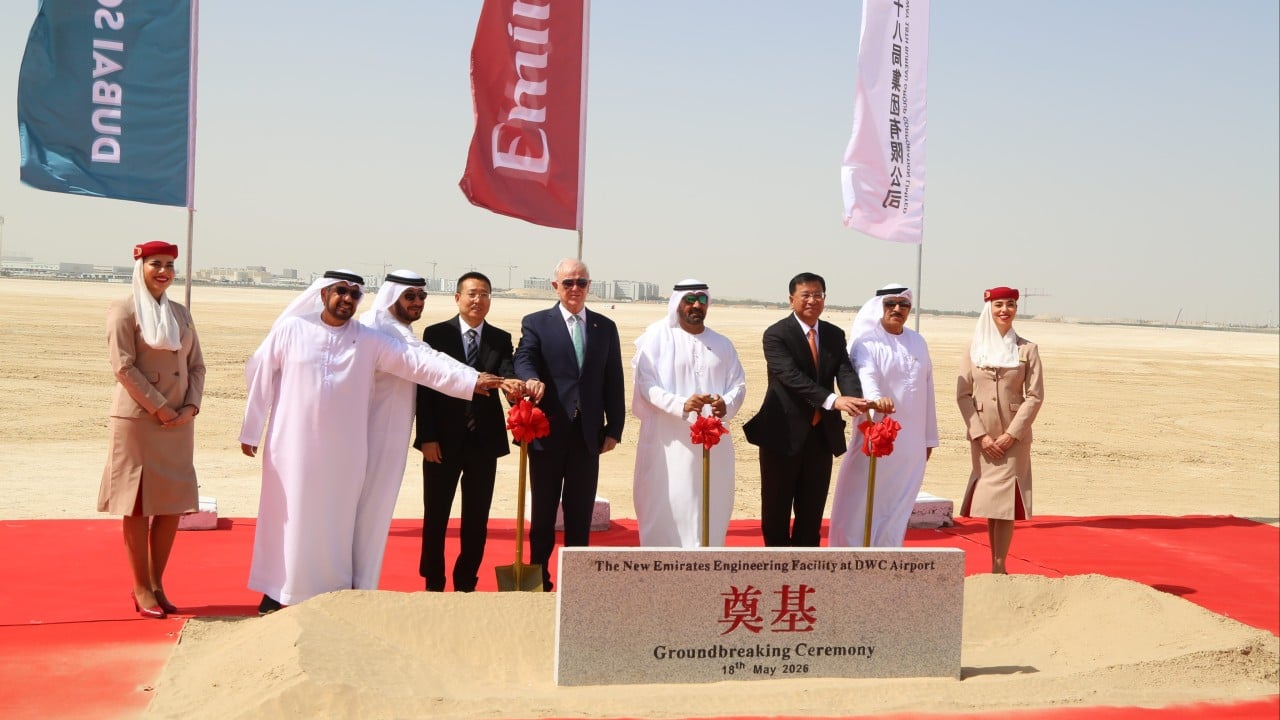
China Railway Construction Corporation just broke ground on a massive $5.1 billion aviation engineering and maintenance complex in Dubai South, ignoring the fires burning across the Middle East. The sheer scale is staggering. Spanning 1.1 million square meters, the facility will hold up to 28 wide-body aircraft simultaneously and feature the world’s largest free-span hangar.
While conventional analysis views this strictly as a commercial win for Emirates Airline or a standard Belt and Road initiative, the reality is far more calculated. Beijing is deliberately anchoring its state-backed corporate giants into the critical infrastructure of the United Arab Emirates at a moment of extreme geopolitical volatility, effectively hedging against Western financial dominance and securing an irreplaceable role in global logistics.
The Geopolitical Shield
Building the world’s most advanced maintenance, repair, and overhaul facility next to Al Maktoum International Airport takes years. Completion is slated for mid-2030. This means China and the UAE are making a multi-decade bet on mutual interdependence, completely indifferent to the ongoing shadow wars and airspace closures that recently forced Emirates to reroute its fleet.
Western defense analysts often look at these massive civil engineering projects through a narrow lens, fearing secret military bases or dual-use ports. They miss the real play. By embedding a state-owned enterprise like China Railway Construction Corporation into the literal lifeblood of Dubai’s economic engine, Beijing achieves a form of commercial deterrence.
Bilateral Trade (China-UAE, 2025): $108 Billion
Year-on-Year Increase: 6%
Projected Facility Capacity: 28 Wide-body Aircraft Simultaneously
Consider how this alters regional dynamics. If a major conflict threatens the Gulf, any kinetic action that disrupts a trillion-dollar global trade hub also disrupts trillions of yuan in state-backed investments. China is not just building a hangar; it is installing a massive financial tripwire.
Moving Beyond Simple Infrastructure
The technical specifications of the project explain why Western contractors were left on the sidelines. The complex requires a 285-meter-wide free-span hangar, structural engineering that will stand as the largest steel structure in the Gulf Cooperation Council.
Vertical integration is the phrase used by Emirates Chairman Sheikh Ahmed bin Saeed Al Maktoum, but for China, the project is about exporting high-end industrial capacity. It represents a massive shift from pouring concrete for highways to installing advanced automated landing gear workshops and specialized aircraft paint hangars.
This is the evolution of the Belt and Road strategy. The early days of building underutilized ports in developing nations have given way to sophisticated partnerships with cash-rich, highly developed hubs. China is supplying the elite engineering talent while the UAE provides the strategic geography and capital.
The Soft Power Overhaul
While Washington pressures Gulf nations to restrict their use of Chinese technology, local governments are looking at the math. Bilateral trade between China and the UAE reached $108 billion in 2025. This momentum cannot be halted by diplomatic warnings alone.
French consultancy Artelia is overseeing the project management, providing a thin veneer of European oversight to a project that is entirely powered by Chinese industrial muscle. This setup makes it incredibly difficult for Western regulators to claim the facility poses an existential security threat, yet the underlying dependency remains unchanged.
The infrastructure will be built to achieve LEED Platinum environmental certification, complete with massive rooftop solar arrays. Beijing is proving it can deliver green, technologically superior megaprojects faster and cheaper than Western rivals bogged down by supply chain friction and domestic labor shortages.
Structural Interdependence
The global aviation industry is facing a massive shortage of maintenance capacity. Major carriers are currently waiting months for heavy maintenance slots, stalling fleet renewals and grounding profitable routes.
By controlling the physical space where these fleets are serviced, China gains significant leverage over global supply chains. A hypothetical example illustrates the risk: if global trade tensions escalate, a state-backed contractor could easily slow down maintenance operations under the guise of technical delays or parts shortages, crippling international airlines without firing a single shot.
This is not about an immediate threat. It is about twenty years of structural influence. When the facility opens its doors in 2030, the mechanics, the logistics software, and the physical architecture will all bear the stamp of Chinese industrial design.
The West continues to view the Middle East through the lens of security pacts and arms sales. Beijing is playing a different game entirely, winning the peace by making itself completely indispensable to the region's economic survival.