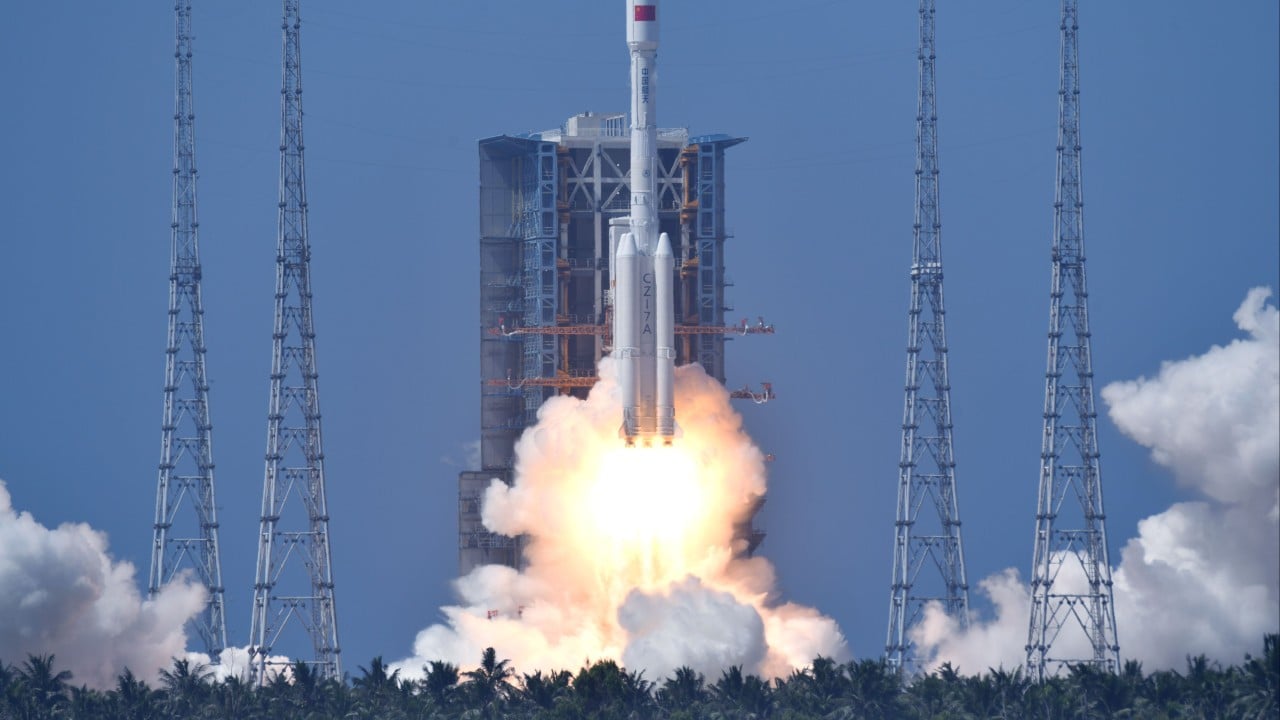
Beijing wants the world to believe its grip on the global technology supply chain is unbreakable. On paper, the strategy appears flawless. China controls the raw inputs for the world’s advanced electronics and has recently demonstrated a spectacular orbital rocket recovery using a maritime net system. However, this narrative of inevitable dominance obscures a deeper structural decay. China remains fundamentally dependent on Western intellectual property for high-value manufacturing, and its state-directed aerospace sector is burning billions of dollars to replicate technological milestones that Western commercial entities passed a decade ago.
The primary vulnerability in China’s industrial strategy lies in its inability to convert raw dominance into high-value technological ownership. While Beijing controls the physical extraction and basic refining of rare earth elements, it relies on American and Japanese patents to turn those minerals into the functional components required for modern defense, computing, and clean energy. At the same time, its rapid-fire breakthroughs in reusable rocketry are less about leapfrogging the United States and more about a desperate, capital-intensive effort to prevent SpaceX from establishing a permanent monopoly over low Earth orbit.
The Raw Material Mirage
For years, Western policy analysts have warned that China could bring global manufacturing to a halt by shutting off its supply of rare earth elements. This fear is rooted in raw numbers. China currently accounts for roughly 70 percent of global rare earth mining and an astonishing 90 percent of processing capacity. It is an industrial chokehold that Beijing has repeatedly threatened to tighten, imposing export restrictions on key minerals to retaliate against Western trade policies.
But a landmark study examining the global distribution of patents reveals that this raw dominance is an illusion. China owns the mud, but Tokyo and Washington own the science.
The study, which analyzed intellectual property filings rather than physical reserves, concluded that China does not hold a leading position in mastering the key technologies required to make advanced rare earth functional materials. Instead, the most commercially valuable applications—which make up more than 80 percent of all rare earth-related patents globally—are overwhelmingly controlled by foreign competitors.
- Permanent Magnets: Crucial for electric vehicle motors and wind turbines, this sector remains under the strict technological control of Japanese firms, which retain the foundational patents for high-performance neodymium-iron-boron magnets.
- Catalytic Materials: The United States holds the lion’s share of patents governing the chemical catalysts used in automotive emission control and industrial refining.
- Luminescent and Polishing Materials: American companies dominate the chemical formulations that allow rare earths to be used in precision optics, flat-panel displays, and silicon wafer manufacturing.
This division of labor reveals a profound asymmetry. China has borne the heavy environmental and energy costs of mining and basic chemical processing, yet it remains dependent on importing the highly refined, IP-protected end products that its own domestic industries require. When Beijing restricts rare earth exports, it does not just starve Western defense contractors; it actively forces those contractors and foreign governments to fund alternative mining and processing operations in places like Australia, Africa, and North America. In doing so, China is slowly destroying its own monopoly while remaining entirely exposed to foreign intellectual property blocks.
The Sea Based Rope Trick
If China's mineral dominance is hollower than it looks, its highly publicized push into commercial spaceflight is an attempt to build a completely different kind of leverage. The world watched on July 10, 2026, when China’s Long March 10B booster completed its maiden flight from Hainan. Six minutes after liftoff, the kerosene-and-liquid-oxygen first stage separated and began its descent toward a recovery vessel named the Linghangzhe.
Instead of landing on legs like a SpaceX Falcon 9, the Chinese booster was caught mid-air by a sophisticated cable-and-net system mounted on the deck of the ship.
This was a genuine engineering feat. No other space program has successfully recovered an orbital-class booster using a sea-based net. It was immediately hailed by state media as a historic leap that puts China on equal footing with American private aerospace.
But behind the spectacle lies a series of severe engineering and operational compromises.
By utilizing a net system, Chinese designers avoided adding heavy landing legs and deployable grid fins to the booster itself. This reduces the dry mass of the rocket, theoretically allowing it to carry more payload to orbit. But it merely shifts the engineering burden from the rocket to the recovery vessel. Capturing a multi-ton, falling cylinder with high-tension cables on a rolling ocean surface requires hyper-precise positioning, real-time wind compensation, and incredibly complex mechanical dampening systems.
A net-based capture system is highly sensitive to maritime weather. While a Falcon 9 can land on a relatively stable barge in moderate seas, the precise alignment required for a net catch becomes exponentially more hazardous in the rough waters of the South China Sea. If the recovery ship rolls even slightly out of alignment during the final seconds of descent, the booster will strike the support structure, resulting in a catastrophic loss of both the rocket and the recovery vessel.
Furthermore, the Long March 10B is a medium-lift vehicle capable of carrying roughly 16 metric tons to low Earth orbit. That places it below the capacity of a standard Falcon 9, a workhorse that has been flying and landing reliably for over a decade. China is celebrating its ability to catch a medium-capacity booster in a net, while SpaceX has moved on to catching the largest rocket ever built, Starship, using mechanical arms back at its launch site. The "rope trick" is a creative engineering workaround, but it is fundamentally a late entry into a race where the leader has already finished several laps.
The Financial Hemorrhage of State Commercialism
The technical gap is only half the problem. The financial engine driving China’s space race is showing signs of extreme strain.
Under direct orders from Beijing, which views SpaceX’s Starlink constellation as a major national security threat, China is trying to build its own megaconstellations, including the 14,000-satellite Qianfan network. To do this, the state has opened its defense research facilities to commercial entities and loosened listing rules to funnel private capital into rocket startups.
The result is a wave of heavily subsidized, unprofitable entities rushing to the public markets to stay afloat.
| Company | Key Project | Financial Health / Status |
|---|---|---|
| CAS Space | Kinetica-2 reusable launcher | Filed for $607 million Shanghai IPO; over 2.5 billion yuan in accumulated losses |
| LandSpace | Zhuque-3 methane-fueled rocket | Seeking to raise $1 billion on the STAR Market to fund reusability research |
| CASC (State-owned) | Long March 10B & Long March 9 | Funded directly by national defense and civil space budgets |
The financial filings of these companies paint a bleak picture of the "commercial" Chinese space sector. CAS Space, a spin-off of the state-run Chinese Academy of Sciences, has accumulated losses that dwarf its actual revenues, driven by the massive capital expenditure required to build and test high-performance rocket engines.
This is not the self-sustaining commercial model pioneered by Western firms. It is state-directed industrial policy dressed up in the language of venture capital.
In the United States, SpaceX achieved profitability by securing highly lucrative commercial launch contracts, servicing NASA resupply and crew missions, and deploying its own revenue-generating internet service. The Chinese startups, by contrast, are entirely dependent on domestic government procurement or state-directed investment. There is no global commercial market for Chinese rocket launches. Western satellite operators are prohibited by defense export regulations and geopolitical concerns from launching on Chinese boosters.
This means China’s commercial space sector is operating in a closed loop. The state provides the capital, the state-run institutes provide the basic research, and the state-directed satellite networks are the only customers. This lack of genuine market discipline leads to redundant development programs, where multiple state-backed startups are building highly similar medium-lift rockets, all competing for the same limited pool of domestic state capital.
The Academic Industrial Chokepoint
Why does China struggle to bridge these high-value technological gaps, whether in rare earth engineering or advanced rocket materials? The answer lies in the structure of its innovation system.
In the West, innovation often flows from commercial demand. A company identifies a market need, invests in research, and aggressively protects and commercializes its intellectual property. In China, the system is top-down, driven by state-mandated targets and academic metrics.
While China files a massive number of patents every year, the vast majority are domestic-only filings of relatively low technical value. Academic researchers are incentivized to file patents to secure state funding and academic promotion, rather than to create commercially viable products. This has created a vast disconnect between the laboratory and the factory floor. Chinese universities are highly capable of publishing papers and demonstrating prototype technologies under controlled conditions, but the country lacks the specialized private-sector ecosystem required to refine those breakthroughs into durable, mass-produced advanced materials.
This structural flaw explains why, despite decades of state focus and billions of dollars in subsidies, China still cannot match the high-performance permanent magnets produced by Japanese firms. It is why Chinese rocket manufacturers are forced to rely on complicated, high-risk mechanical workarounds like sea-based nets, rather than the highly optimized, software-driven vertical descent systems mastered by American engineers.
The Chinese model of state-directed industrial mobilization is highly effective at scale and repetition. It can build thousands of miles of high-speed rail, mine millions of tons of ore, and assemble millions of smartphones. But it remains fundamentally unsuited for the erratic, high-risk, trial-and-error process of fundamental scientific discovery and commercial scaling. Until Beijing addresses this structural disconnect, its claims of technological supremacy will remain half-built.