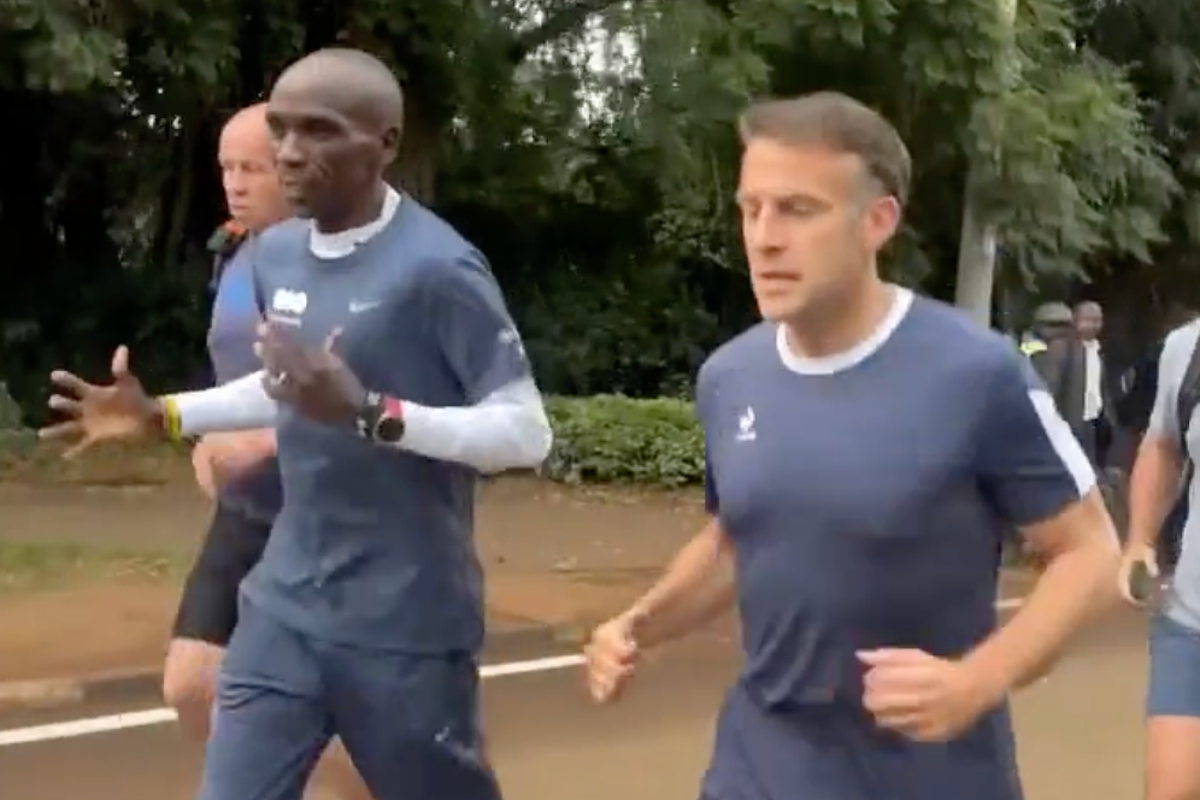
French President Emmanuel Macron started his Monday morning in Kenya by running through the streets of Nairobi alongside Eliud Kipchoge, the two-time Olympic marathon champion. To casual observers and standard news feeds, the sight of a sitting European head of state in black shorts and running shoes jogging past the Bunyala Road roundabout was a lighthearted moment of soft diplomacy before the opening of the Africa Forward Summit. But looking past the standard photo opportunity reveals a far more calculated exercise. This was a deliberately engineered piece of political theater meant to distract from France's declining influence across the African continent and to rebrand French economic ambitions under the guise of athletic partnership.
The strategy of using sports as a geopolitical smoke screen is as old as the Olympics themselves. Macron, whose international trips frequently feature highly publicized workouts, knew exactly what he was doing by alignment with Kipchoge. By running next to a man widely considered the greatest marathoner in history, the French president attempted to absorb some of the universal goodwill that follows the Kenyan icon. The reality underlying the summit, which France co-hosted with Kenya, is far less harmonious than a shared morning jog.
The Strategy Behind the Pavement Diplomacy
France is facing a massive crisis of credibility across Africa. Over the past few years, a wave of anti-French sentiment has forced the withdrawal of French troops and diplomats from several West African nations, severely damaging Paris's traditional sphere of influence. To counter this narrative of retreat, Macron is pivoting toward East Africa, attempting to forge new alliances with economically stable democracies like Kenya.
The Africa Forward Summit was designed to showcase a modern relationship based on trade, climate action, and technology rather than colonial history. Yet, signing bilateral agreements on transport and renewable energy does not capture the public imagination. A 41-year-old Kenyan sports legend running side by side with a European leader does.
Kipchoge used the opportunity to pitch an agenda of his own. He publicly called for France to provide Africa with infrastructure, event-hosting expertise, and sports science resources to help develop the continent's untapped athletic talent. This framing portrays France as a benevolent mentor offering technical gifts to an energetic but under-resourced partner. This transactional view of African talent, however, ignores a critical reality. African distance running does not need European instruction to achieve dominance; African athletes already completely command the sport.
The Myth of the Underdeveloped African Sport
The narrative that African sports communities are a barren landscape waiting for Western infrastructure to become a superpower is fundamentally flawed. Just last month at the London Marathon, Kenya's Sabastian Sawe won the race in an astonishing 1:59:30, ahead of Ethiopia's Yomilf Kejelcha. African runners routinely break records and win major marathons without relying on the specific models of state-sponsored sports science that European nations use.
When Kipchoge speaks about needing French assistance for "athlete development," he is playing into a diplomatic script that satisfies his hosts. The proposal to import sports science and corporate infrastructure from France is less about helping young runners and more about opening new avenues for European sports brands, consultants, and marketing agencies to profit from African excellence.
Consider the apparel worn during the run. Macron was carefully outfitted in a navy blue track shirt made by a French brand, ensuring that even during a casual jog, French manufacturing was on display. The entire event served as a moving billboard for French commerce, wrapped in the wholesome imagery of a schoolyard stop at State House Primary School, where pupils were encouraged to cheer for "Kipchoge and Emmanuel."
The Economic Realities Behind the Footsteps
While the cameras captured Kipchoge's smooth stride and Macron's forced pace, the actual business of the summit involved much harder calculations. Kenya and France signed deals covering digital transformation, agriculture, and education. Kenya is positioning itself as a regional hub for international business, and President William Ruto has been eager to court European investment.
But these partnerships are rarely equal. European investment in African infrastructure frequently comes with strings attached, often requiring the use of European contractors or resulting in long-term debt structures that favor the lender. By focusing media attention on the shared sweat of a morning run, both governments successfully shifted the public focus away from the specific details of these economic deals.
The timing of this athletic display is also highly convenient for Kipchoge. Moving into the twilight of his competitive career—highlighted by a disappointing 17th-place finish at the 2025 New York City Marathon—the former world record holder is transitionally repositioning himself as a statesman and power broker. His Eliud Kipchoge Foundation is deeply involved in environmental and educational advocacy. Aligning himself with a foreign head of state elevates Kipchoge from a retired athlete to a serious geopolitical player capable of negotiating directly with global leaders.
The Limits of Public Relations
Photo opportunities do not change underlying political trends. Jogging through Nairobi might generate positive social media engagement and friendly headlines in Paris, but it does not alter the deep skepticism that many African intellectual and political circles hold toward French foreign policy.
The image of the running president is a temporary distraction from a broader structural shift. African nations are increasingly looking to a diverse group of international partners, including China, India, and Gulf states, for infrastructure and development, bypassing traditional European powers entirely. A morning run with an aging champion cannot stop the decline of a European superpower's influence in a rapidly changing world. Macron's steps on the Nairobi pavement were swift, but they cannot outrun geopolitical reality.