Dozens of French municipalities have canceled their traditional Bastille Day fireworks displays and firefighters' balls this July 14, as a relentless third summer heatwave and explosive wildfires push the country's emergency resources to their absolute limit. With the historic Fontainebleau forest burning just thirty miles south of Paris, regional prefectures have enforced blanket bans on pyrotechnics to prevent catastrophic ignitions in parched woodlands. While the grand military parade marched down the Champs-Élysées, the silence of the night skies reveals a deeper, more systemic crisis gripping France.
The canceling of the pyrotechnics is not merely a temporary atmospheric shift. It is a stark admission of vulnerability by a G7 nation finding itself increasingly unable to manage the basic environmental realities of its summers. Read more on a connected topic: this related article.
The Night the Firecrackers Went Out
For centuries, the night of July 14 has belonged to the sky. From the tiniest communes in the Dordogne to the iconic Eiffel Tower, fireworks are the emotional climax of the Fête Nationale, cementing the founding myth of the French Republic with fire and noise. This year, however, vast swathes of the country fell silent.
In departments like Rhône and across the Île-de-France region surrounding Paris, prefects stepped in with emergency decrees. The reasoning was uncompromisingly simple. A single stray spark drifting into dry undergrowth could instantly trigger a blaze that local fire departments have no spare capacity to fight. Further analysis by The Washington Post delves into similar perspectives on this issue.
For local mayors, the decision is agonizing. Bastille Day is the economic engine of mid-summer, drawing millions of domestic and international tourists who crowd into village squares, patronize local bistros, and book out hotels. When a municipality cancels its fireworks, the economic ripple effect is immediate and painful. Some coastal towns managed to salvage their shows by launching pyrotechnics directly over the ocean, but inland communities had no such luxury. They were forced to offer quiet alternatives like low-impact acoustic concerts or laser light shows. These alternatives, while safe, lack the visceral, unifying power of the traditional display.
The silence of July 14 is the sound of a country adjusting to a volatile, hotter normal.
When the Mediterranean Creeps North
Historically, wildfires were a seasonal hazard reserved for the sun-baked pine forests of the Gironde or the scrublands of the Mediterranean coast. That geography has shattered.
The most alarming development of the summer is the catastrophic blaze that erupted in the Fontainebleau forest. Spanning over 800 hectares, the fire threatened historic châteaux, forced the evacuation of residential areas, and shut down sections of the critical A6 motorway—the primary artery connecting Paris to the south of the country. Fontainebleau is not the dry, resinous maquis of the south. It is a temperate, leafy sanctuary on the very doorstep of the capital.
The physical response to this northern shift has forced unprecedented tactical changes. For the first time, yellow-and-red Canadair water-bombing aircraft, which normally patrol the southern coast, were deployed to the skies over Paris. Residents watched in disbelief as these massive planes skimmed the waters of the Seine River to scoop up moisture before banking sharply to dump it on the smoldering ancient forest.
This is no longer a localized regional problem. It is a national security crisis. European climate agencies indicate that northern and central France are drying out at a rate that mimics the southern climate of thirty years ago. The soil moisture levels in northern forests have fallen to historic lows, turning lush, green recreational woodlands into giant tinderboxes waiting for a spark.
The Hidden Toll on the Frontline
While the cancellation of fireworks grabbed international headlines, a more quiet, culturally devastating casualty of the heatwave was the cancellation of the bals des pompiers—the traditional firefighters' balls.
These balls are not mere parties. They are a beloved cultural institution where fire stations open their doors to local communities for a night of music, dancing, and fundraising. It is the one night of the year where the public directly connects with the municipal workers who keep them safe. In Paris and its immediate suburbs, the decision to cancel these events was made out of sheer, exhausting necessity.
The truth is that France's civil security services are running on fumes. By mid-July, wildfires had already scorched more than twice the amount of land compared to the same period in previous years. Firefighters are working punishing, back-to-back shifts under heatwave conditions exceeding 38°C. To expect these men and women to host community festivals while actively fighting regional infernos is a logistical impossibility.
The structural strain on France's volunteer firefighter model is showing its cracks. More than eighty percent of French firefighters are volunteers. As the fire season expands from a brief two-month window into a grueling four-month marathon, the demands on these volunteers have become unsustainable. Many are forced to choose between their primary employment and increasingly frequent, dangerous emergency deployments. By canceling the balls, the state acknowledged that its most valuable emergency asset—human beings—is close to a breaking point.
The Clash of Geopolitical Theater and Domestic Reality
There is a striking, almost surreal disconnect between the reality on the ground and the image the French state projected on the morning of July 14.
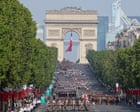
While regional mayors were quietly calling off their local celebrations, President Emmanuel Macron hosted his tenth and final Bastille Day military parade on the Champs-Élysées. It was a massive, highly militarized display featuring a record 6,800 troops. The event was saturated with heavy geopolitical symbolism. Ukrainian President Volodymyr Zelensky stood alongside Macron as Ukrainian soldiers marched down the avenue and Mirage 2000 fighter jets roared overhead. The parade was designed to signal a "strategic rearmament" and show Europe's collective military strength to the world.
Yet, even as the fighter jets flew their tight formations, the smoke from the Fontainebleau forest was visible on the southern horizon of the capital.
This presents an uncomfortable paradox for the French leadership. The state is eager to spend billions of euros expanding its defense budgets and reinforcing its strategic footprint on the global stage. But at home, it struggles to defend its own historic woodlands and civil infrastructure from the escalating shocks of environmental change. A nation cannot easily project power abroad when its domestic transport networks, power grids, and municipal traditions are being systematically disrupted by extreme heat.
During the height of the heatwave, the government was forced to temporarily shut down three of its nuclear power plants because river water temperatures were too high to safely cool the reactors. The grid, much like the fire service, is operating under an emergency margin of safety.
Adapting to a Warmer Republic
The debate in France is shifting from how to fight these summer crises to how the nation must fundamentally reorganize its summer traditions.
The outright cancellation of fireworks has sparked a fierce conversation about the future of the national holiday. Many local leaders are arguing that the traditional July 14 pyrotechnics show is an outdated relic of a cooler era. Relying on open-air explosions during the driest, hottest week of the year is increasingly viewed as an unnecessary gamble.
The transition to drone light shows is one path forward, but it is expensive. Wealthy tourist hubs can afford to commission hundreds of synchronized drones to paint the night sky, but smaller, rural communes simply do not have the budget. Without financial support from the central government, the loss of fireworks threatens to widen the cultural divide between prosperous urban centers and the struggling rural interior.
France is discovering that adapting to climate pressure is not just a matter of purchasing more water-bombing planes or installing smarter irrigation systems. It requires a quiet, systematic dismantling of long-held cultural habits. When the state can no longer guarantee the safety of its national holiday, the very fabric of public life begins to alter. The smoky, quiet July of this year is not a temporary aberration. It is the template for the French summers of the future.