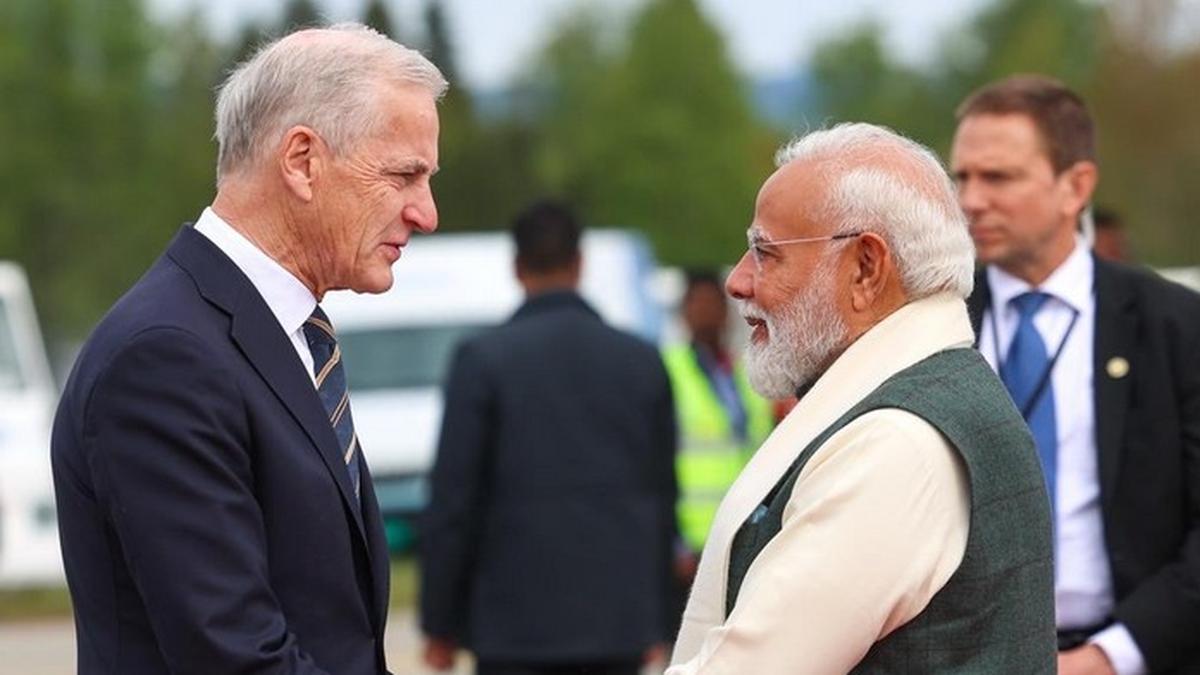
Indian Prime Minister Narendra Modi landed in Oslo on May 18, 2026, marking the first time an Indian head of government has set foot on Norwegian soil in 43 years. While routine state media coverage frames the visit around standard diplomatic talking points like trade and technology, the underlying reality is far more calculated. New Delhi is not throwing its geopolitical weight behind Scandinavia for minor commercial gains. This diplomatic push is a calculated attempt to unlock Norway's $1.4 trillion sovereign wealth fund and secure critical maritime energy infrastructure as India seeks to insulate its economy from compounding global instabilities.
The two-day visit, which includes the 3rd India-Nordic Summit, serves as the real-world stress test for the India-EFTA Trade and Economic Partnership Agreement (TEPA) that went into effect in October 2025.
The Twenty Eight Billion Dollar Prize
To understand why New Delhi has suddenly prioritized Oslo, one must look directly at the asset allocation ledger of the Government Pension Fund Global (GPFG). Norway operates the world's largest sovereign wealth fund. It currently holds roughly $28 billion in the Indian capital market.
For India, that is a baseline, not a ceiling.
The TEPA framework signed with the European Free Trade Association—comprising Norway, Switzerland, Iceland, and Liechtenstein—carries a legally binding target of $100 billion in foreign direct investment into India over the next 15 years. Passing a trade agreement is simple. Materializing institutional capital from a hyper-cautious Scandinavian board of directors is entirely different.
Modi’s presence at the Norway-India Business and Research Summit alongside Norwegian Prime Minister Jonas Gahr Støre is an explicit marketing pitch to institutional giants who remain skeptical of emerging market volatility. India requires massive, predictable capital inflows to fund its infrastructure pipeline. Oslo wants yield, but it demands strict environmental, social, and governance compliance. The friction between those two realities is what this summit is attempting to smooth over.
A Marriage of Convenience in the Blue Economy
The diplomatic rhetoric emphasizes a clean and green future, but the immediate commercial focus centers on shipping corridors and industrial energy supply. Consider the shifting trade balance between the two nations.
| Metric | Value / Status |
|---|---|
| Bilateral Goods Trade (2024-25) | $1.05 Billion |
| India Exports to Norway | $630 Million |
| India Imports from Norway | $420 Million |
| Bilateral Services Trade | ~$1 Billion |
| GPFG Investment in India | $28 Billion |
| TEPA Investment Target (15 Years) | $100 Billion |
The numbers show that traditional merchandise trade is remarkably small for economies of this size. The real meat of the relationship lies in specialized maritime technology and heavy industrial manufacturing.
The Heavy Industry Shift
Indian yards are no longer just breaking down old vessels; they are building Norway's next-generation fleet. Cochin Shipyard and Smart Engineering and Design Solutions have actively transitioned into constructing autonomous, battery-operated coastal cargo ferries and specialized chemical tankers for Norwegian operators like Rederiet Stenersen AS. A recent $220 million contract for six chemical tankers highlights this trend.
The Hydrogen Gamble
Norway possesses the engineering blueprints for deep-water offshore wind and hydrogen carrier vessels. India possesses the raw scale, domestic manufacturing capacity, and an insatiable demand for energy. The newly elevated Green Strategic Partnership announced in Oslo aims to merge these components, though significant infrastructure hurdles remain on the Indian side regarding port readiness for green ammonia and hydrogen fueling.
The Geopolitical Context of the Oslo Summit
The timing of this northern tour is not accidental. The convergence of European and Asian leaders comes at a moment when traditional supply lines are fractured by prolonged conflicts across Eastern Europe and the Middle East.
Norway has quietly become Western Europe’s primary defensive wall for energy security, significantly scaling up its liquefied natural gas exports to replace Russian deficits. Just last week, a major long-term consignment of Norwegian LNG arrived at an Indian port, signaling that New Delhi is looking to diversify its traditional energy reliance away from volatile West Asian corridors.
The 3rd India-Nordic Summit on May 19 forces India to walk a delicate diplomatic tightrope. The five Nordic prime ministers—representing Norway, Sweden, Finland, Denmark, and Iceland—view global security through a specific, unified lens heavily focused on the regional fallout of the Russia-Ukraine war. Modi arrives representing a nation that has historically maintained a strategy of strategic autonomy, choosing to purchase discounted Russian crude while expanding economic ties with the West.
The closed-door meetings in Oslo will test whether economic incentives can override these starkly different geopolitical positions.
Moving Beyond Paper Agreements
The success of this diplomatic push will not be measured by the three government-to-government Memorandums of Understanding signed across space, digital infrastructure, and health sectors. It will be judged by whether the 18 business-to-business agreements can actually navigate the bureaucratic hurdles of the Indian market.
Historically, European mid-sized firms have struggled with India’s complex regulatory environment, uneven state-level policies, and land acquisition delays. While the TEPA agreement provides a tariff-reduction roadmap, it does not automatically eliminate the operational friction of doing business on the ground.
Norway’s decision to officially join India’s Indo-Pacific Oceans Initiative indicates a willingness to engage politically in exchange for commercial access. If New Delhi wants to transform that political goodwill into actual factories, green shipping corridors, and deep-water technology transfers, it must offer more than just a massive consumer market. It must provide the regulatory stability that risk-averse Nordic capital demands. The coming months will reveal whether the commitments made in Oslo are actionable strategies or simply expensive optics.