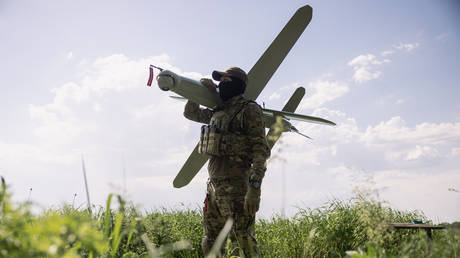
British Prime Minister Keir Starmer is assembling Volodymyr Zelenskyy and dozens of European leaders at Blenheim Palace to hammer out a unified strategy on Ukraine. While official communiqués will frame this summit as a routine display of Western solidarity, the real driver is a quiet panic over shifting American political winds and fracturing European defence budgets. Starmer is moving quickly to position the UK as the continent’s indispensable security hub before the next major geopolitical disruption forces Europe’s hand.
This isn't just about charity or moral duty. It is hard-nosed British statecraft aimed at rewriting the security architecture of the continent.
The Cold Math of a Disappearing American Shield
For decades, European defence has relied on a single, unspoken assumption. The United States will always foot the bill and supply the heavy armor. That assumption is now dead.
White House policy shifts and congressional gridlock have proven that Washington can no longer be viewed as a permanent, predictable guarantor of European borders. European capitals are finally waking up to the reality that they may soon have to manage a hot war on their doorstep entirely on their own.
Starmer’s decision to play host to the European Political Community (EPC) is an aggressive opening gambit. By bringing Zelenskyy into the room alongside EU giants like France and Germany, London is attempting to build a defensive coalition that can survive an American withdrawal.
The strategy is high-risk.
The UK is betting that it can leverage its military intelligence infrastructure and its status as a nuclear power to lead a continent that it formally left during Brexit.
European Defence Spending vs. Real-World Capability
+---------------------+-----------------------+------------------------+
| Country             | GDP Contribution (%)  | Primary Operational    |
|                     | Target                | Bottleneck             |
+---------------------+-----------------------+------------------------+
| United Kingdom      | 2.5% (Projected)      | Procurement Backlogs   |
| Germany             | 2.0%                  | Severe Ammo Deficits   |
| France              | 2.0%                  | Industrial Scale       |
+---------------------+-----------------------+------------------------+
As the table illustrates, hitting spending targets on paper does not automatically translate to battlefield readiness. Germany may have cleared the 2% GDP hurdle, but its depots remain dangerously depleted. France possesses advanced technology but lacks the industrial footprint to manufacture artillery shells at a wartime cadence.
The UK has the opposite problem. It has the operational know-how and the strategic willingness to deploy force, but its own domestic military has been hollowed out by a decade of budget cuts.
Why Diplomacy Alone Cannot Fill the Shell Shortage
Talk is cheap, but 155mm artillery shells are exceptionally expensive and difficult to make.
The battlefield in eastern Ukraine has turned into an industrial war of attrition. It devours munitions faster than the combined factories of the West can produce them. Zelenskyy’s presence at this summit is not for a photo-op. He is there because the Ukrainian front lines are facing a structural deficit in firepower that cannot be solved by political declarations.
European leaders love to announce financial aid packages. They excel at it. Yet, a billion euros in a bank account cannot stop a drone strike if there are no air defence interceptors available for purchase.
The Procurement Trap
The core flaw in Europe's response has been the fragmentation of its defence industry. Every nation wants to protect its own domestic arms manufacturers.
- France prioritizes French-made Rafale jets and Caesar howitzers.
- Germany protects the interests of Rheinmetall and its domestic tank production lines.
- The UK clings to its own sovereign defense primes.
This lack of standardization means that instead of ordering weapons in massive, cost-effective blocks, Europe buys in small, customized batches. It is an absurd way to run a continent's security apparatus during an active conflict.
Starmer wants to use this summit to pitch a centralized approach to procurement. He will argue that the UK can act as a bridge between the European Union’s defense funds and non-EU NATO members.
It sounds logical on paper. In practice, it requires European nations to cede a degree of industrial sovereignty that they have jealously guarded for generations.
The Hidden Fracture Inside the European Coalition
While the public face of the summit will feature leaders standing shoulder-to-shoulder, the private meetings will be fraught with tension. The European coalition supporting Ukraine is nowhere near as unified as the press releases suggest.
There are three distinct factions operating within the room at Blenheim Palace.
The Border States
Poland, the Baltic nations, and Finland view this conflict as an existential fight for survival. They want total victory, a complete restoration of Ukrainian borders, and the permanent containment of Russian power. They are willing to bankrupt themselves to achieve this.
The Western Core
France, Germany, and Italy see the war through a more transactional lens. They want stability returned to the continent. While they publicly support Ukraine's territorial integrity, behind closed doors, their diplomats are constantly looking for the off-ramp—a negotiated settlement that can restore cheap energy flows and normalize trade.
The Disrupters
Countries like Hungary and Slovakia are openly skeptical of the entire enterprise. They act as a diplomatic brake, slowing down sanctions packages and blocking financial aid whenever possible to extract concessions for their own domestic agendas.
[The Border States: Total Victory] <---> [The Western Core: Managed Settlement] <---> [The Disrupters: Strategic Delay]
Starmer’s challenge is to drag the Western Core toward the position of the Border States while neutralizing the Disrupters. He is attempting this from outside the EU, meaning he lacks the institutional levers—such as withholding EU funds—that Brussels usually employs to enforce discipline. He has to rely entirely on security cooperation, intelligence sharing, and the promise of British military backing.
The Gray Zone Vulnerability No One Wants to Discuss
The focus of the talks will inevitably center on tanks, jets, and missiles. This is a mistake that plays directly into the adversary's hands. The most immediate threat facing European capitals right now isn't a conventional armored thrust across a border; it is the escalating campaign of gray-zone warfare.
Over the past year, Europe has seen a mysterious spike in arson attacks on warehouses, GPS jamming affecting civilian airliners over the Baltic Sea, and cyber assaults targeting critical infrastructure. These are not isolated incidents. They are coordinated operations designed to degrade Western resolve and disrupt logistics lines without triggering NATO’s Article 5 mutual defense clause.
                    +--------------------------------+
                    |    Sovereign State Boundaries  |
                    +--------------------------------+
                                    |
          +-------------------------+-------------------------+
          |                                                   |
          v                                                   v
+-----------------------+                           +-----------------------+
|  Conventional War     |                           |  Gray-Zone Warfare    |
|  - Tank Formations    |                           |  - GPS Jamming        |
|  - Missile Strikes    |                           |  - Arson & Sabotage   |
|  - Clear Attributions |                           |  - Cyber Attacks      |
+-----------------------+                           +-----------------------+
          |                                                   |
          v                                                   v
+-----------------------+                           +-----------------------+
| Triggers NATO Art. 5  |                           | Paralyses Decisions   |
+-----------------------+                           +-----------------------+
The British intelligence services are among the best in the world at tracking these asymmetric threats. Starmer intends to offer an enhanced intelligence-sharing pact to European leaders as a sweetener. The message is simple. If you want the data required to stop these sabotage networks before they strike your cities, you need to align with London.
This is a powerful lever. European police and intelligence agencies are chronically underfunded and siloed. By offering a British-led clearinghouse for counter-sabotage intelligence, Starmer is attempting to weave the UK deeply into the daily security operations of continental Europe, making any future attempts to isolate Britain politically impossible.
The Brutal Reality of the British Military Footprint
To lead, you must have the means to back up your words. This is where Starmer’s grand strategy risks colliding with domestic reality. The British Army is currently at its smallest size since the Napoleonic era. Royal Navy ships are frequently stuck in port due to maintenance backlogs and manning shortages. The Royal Air Force lacks the fleet depth required for a prolonged conventional conflict.
Starmer has committed to raising UK defence spending to 2.5% of GDP, but he has refused to set a firm deadline for when that target will be met. This hesitation has not gone unnoticed in Paris and Berlin.
"You cannot claim the mantle of European security leadership while keeping your defense wallet firmly shut at home."
If the UK wants to dictate the terms of Europe's defense evolution, it must fund its own forces to a level that commands respect. Presenting blueprints for industrial cooperation is useless if British factories cannot deliver their own shares of the hardware.
The summit at Blenheim Palace will yield plenty of historic photographs and boilerplate declarations of enduring support. The true measure of its success will not be found in the text of the final communiqué. It will be found in whether European capitals begin placing joint orders for munitions within the next ninety days, and whether they can build a defense apparatus capable of standing alone when the American shadow finally recedes.