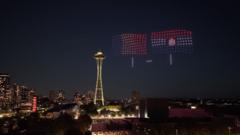
Visit Seattle and Texas-based drone operator Sky Elements launched a fleet of 400 synchronized drones over the Space Needle to display the 1-1 draw between Belgium and Egypt. It marked the debut of the world’s first live drone scoreboard for the FIFA World Cup, a high-tech marketing stunt designed to broadcast match results directly into the clouds. The organization plans to repeat this performance five more times throughout the tournament, illuminating the Pacific Northwest sky with national flags and final scores.
But looking up at a glowing 12-minute aerial animation reveals a much larger corporate calculation than a mere public service. Nobody looks at the sky to see who won a soccer match. We have smartphones for that.
The real objective here is destination branding masquerading as technological utility, an aggressive attempt by a municipal marketing arm to claim the global spotlight during an oversaturated tournament.
The Logistics of a 400 Drone Scoreboard
From a technical standpoint, translating a dynamic soccer score into an aerial light display requires immense operational precision. Sky Elements, the company responsible for recent automated light shows at Lumen Field and T-Mobile Park, uses a localized fleet of quadcopters equipped with high-intensity LED nodes. These units function as floating pixels in a three-dimensional grid, governed by centralized flight-planning software that dictates precise spatial coordinates and color values.
The execution relies on absolute predictability. The drones operate via RTK (Real-Time Kinematic) GPS, a satellite navigation technique that enhances the precision of position data down to the centimeter. This prevents the heavy Pacific Northwest winds from turning a crisp national flag into an unreadable smear of light.
- The Drone Fleet: 400 synchronized quadcopters.
- The Best Vantage Points: Seattle Center, specifically around the International Fountain and Fisher Pavilion.
- Total Run Time: Approximately 12 minutes per performance.
- The Display Window: Between 10:00 PM and 11:30 PM local time, calculated to accommodate late summer sunsets.
The technical constraints, however, expose the fundamental irony of the project. Because of the region's late-summer solstice, twilight lingers well past the final whistle of daytime matches. When Belgium and Egypt kicked off at noon, the match concluded hours before the sky was dark enough to provide sufficient contrast for the LEDs. The drones did not launch until 10:05 PM, a full eight hours after the game ended. The actual scoreboard portion of the show lasted exactly 2 minutes and 45 seconds, with the remaining time dedicated to pre-rendered corporate slogans and civic animations.
The Illusion of Real-Time Utility
Municipal tourism groups love to frame these activations as infrastructure, but they are purely promotional theater. Visit Seattle openly admitted to exploring dozens of public concepts before selecting this specific aerial format. The primary draw was not efficiency, but novelty.
"What made it stand out was its originality: a drone scoreboard tied to live match outcomes," noted Stephanie Byington, Chief Marketing Officer for Visit Seattle.
Yet, "live" is a generous descriptor for a performance that requires hours of post-match programming and waiting for total darkness. A standard stadium scoreboard exists to inform a captive audience during the flow of play. A drone array hovering over the Space Needle hours after the fact serves an entirely different master: the social media algorithm.
The entire performance is optimized for vertical video capture. The 12-minute show is designed to be chopped into ten-second clips, shared across global networks, and repurposed into promotional reels that position the city as a progressive tech hub. The true target audience is not the local pedestrian walking through Seattle Center, but the millions of international viewers scrolling through feeds thousands of miles away.
The True Cost of Atmospheric Ads
While the public enjoys these spectacles for free, the operational overhead is significant. Staging a multi-night drone event involving hundreds of aircraft requires rigorous regulatory clearance, commercial insurance policies, and specialized technical crews. FAA waivers must be secured to operate fleets over populated urban environments, and flight paths must be strictly geofenced to avoid interference with emergency medical helicopters or commercial flight paths.
Cities are increasingly turning to these automated light displays as a cleaner alternative to traditional fireworks, citing reduced chemical runoff and lower noise pollution. But this shift replaces pyrotechnic smoke with visual pollution. As corporate entities realize that the night sky can be leased for high-impact brand activations, the line between civic celebration and unskippable outdoor advertising continues to blur.
The Remaining World Cup Lineup
The drone installation will return to the Seattle skyline five more times as the tournament progresses. Production schedules will adjust dynamically based on match lengths and local cloud cover, though local authorities aim to maintain consistent late-night windows for visibility.
- June 19: United States vs. Australia
- June 24: Bosnia-Herzegovina vs. Qatar
- June 26: Egypt vs. IR Iran
- July 1: Round of 32 (Match 82)
- July 6: Round of 16 (Match 94)
The real test of this operational framework will occur on June 26, when Egypt faces IR Iran in an 8:00 PM evening match. With a late kickoff, the gap between the final whistle and astronomical darkness will shrink significantly, forcing the flight crew to sync their launch sequence directly against a rapidly clearing stadium.
Ultimately, this project highlights how modern sports tourism operates. It is no longer enough to host a historic tournament; a city must engineer a viral visual artifact to prove it was there. The scoreboard in the sky is beautiful, complex, and entirely unnecessary, which is precisely why it works so well as a marketing weapon.