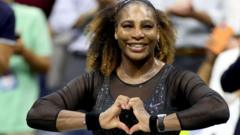
Serena Williams is returning to professional tennis at 44 years old because true sporting icons rarely know how to stay away, and the sport needs her star power just as much as she needs the competition.
Nearly four years after her emotional "evolution" away from the court at the 2022 US Open, Williams confirmed she has accepted a wildcard to play doubles at the Queen's Club Championships in London. She will partner with 19-year-old Canadian Victoria Mboko. The announcement puts an end to months of quiet preparation, including her re-entry into the International Tennis Integrity Agency’s drug-testing pool late last year, a mandatory six-month bureaucratic hurdle required for any former champion plotting a return.
While the tennis world reacts with predictable nostalgia, the underlying mechanics of this comeback reveal a calculated test run rather than a sentimental farewell tour.
The Physical Reality of a Fortysomething Comeback
Tennis at the elite level is brutal on a forty-four-year-old frame. Williams has not played a competitive match since her third-round singles loss to Ajla Tomljanović in September 2022.
Choosing doubles at Queen's Club is a deliberate structural decision. The grass surface reduces joint impact compared to hard courts, and sharing the court cuts her physical coverage requirements exactly in half.
Serena Williams: Career Longevity Context
+-------------------------+-------------------------+
| Milestone               | Age / Detail            |
+-------------------------+-------------------------+
| First Grand Slam Title  | 17 years old (1999)     |
| Last Singles Slam Title | 35 years old (2017)     |
| 2026 Queen's Comeback   | 44 years old            |
+-------------------------+-------------------------+
Modern sports science allows athletes to extend their careers far beyond historical norms. However, doubles requires explosive lateral movement and precise reflex volleys rather than the grueling baseline endurance of singles. By pairing with Mboko, a teenager born seven years after Williams won her first US Open, Williams secures a partner capable of handling the baseline heavy lifting while she commands the net.
The Shadow of the All England Club
Nobody believes a WTA 500 doubles appearance in West Kensington is the ultimate destination. The timing of this return, exactly three weeks before Wimbledon begins on June 29, points toward an assault on the All England Club.
Williams remains marooned on 23 Grand Slam singles titles, one short of Margaret Court’s all-time record of 24. While a singles run seems mathematically and physically improbable given her lack of match play, the pursuit of competitive relevance remains a powerful drug.
The tennis establishment needs this narrative. Broadcasters and tournament directors face a stark reality: the current women's field possesses immense athletic talent but lacks the mainstream, cross-over cultural gravity that the Williams sisters generated for two decades.
The Anti Doping Paper Trail
This comeback was not a sudden impulse. The process began in earnest in October 2025, when Williams quietly submitted her paperwork to re-enter the international drug-testing pool.
Under current anti-doping regulations, a retired player must subject themselves to unannounced, highly intrusive testing for a minimum of six months before stepping onto a competitive court. When online sleuths discovered her name on the registry in December, Williams attempted to kill the rumors on social media, claiming the internet was chasing a wildfire.
That misdirection was essential to protect her commercial partnerships and shield her training camp in Florida from intense media scrutiny. Behind the scenes, she was already log-rolling training sessions with contemporary touring pros, measuring her ball speed and physical recovery times against the demands of the modern tour.
The Marketing Machine Behind the Return
The financial reality of a modern sports icon means that returns are rarely just about the sport. Williams has spent the last four years expanding her venture capital firm, Serena Ventures, and raising her two daughters.
Yet, the commercial valuation of an active legendary athlete dwarfs that of a retired elder statesman. Her announcement arrived alongside a slickly produced social media video featuring her longtime apparel sponsor, immediately monetizing the exact moment of her return.
"Queen's Club feels like the perfect place to begin this next chapter," Williams said in her official statement. "Grass has given me some of the most meaningful moments of my career."
This is pristine corporate choreography. It transforms a high-risk physical gamble into a narrative of unfinished business and historic defiance.
The Complicated Precedent of Late Career Returns
History is unkind to tennis superstars who mount comebacks in their mid-forties. Martina Navratilova managed to win mixed doubles grand slam titles at 49, but her late-career singles attempts were met with sharp realities against younger, harder-hitting opponents.
The game has grown faster since Williams stepped away in 2022. Racquet technology, athletic conditioning, and baseline ball speed have escalated. The teenagers and early-twenties players currently occupying the top 50 do not harbor the same psychological intimidation that Williams weaponized during her decade of absolute dominance. To them, she is a historical figure, not an invincible force.
The risk of a diminished legacy is the standard counter-argument raised by purists. That argument ignores the psychology of the hyper-competitive elite. Athletes like Williams do not view their legacy as a fragile museum piece to be protected; they view it as an active notebook that remains open until they choose to permanently throw away the pen.
The tournament at Queen's Club will quickly expose whether this return is a brief commercial cameo or a functional athletic campaign. If her serve retains its signature velocity and her movement proves sufficient to navigate the low bounce of the London grass, the tennis world will shift its entire focus toward the Wimbledon wildcard lottery.