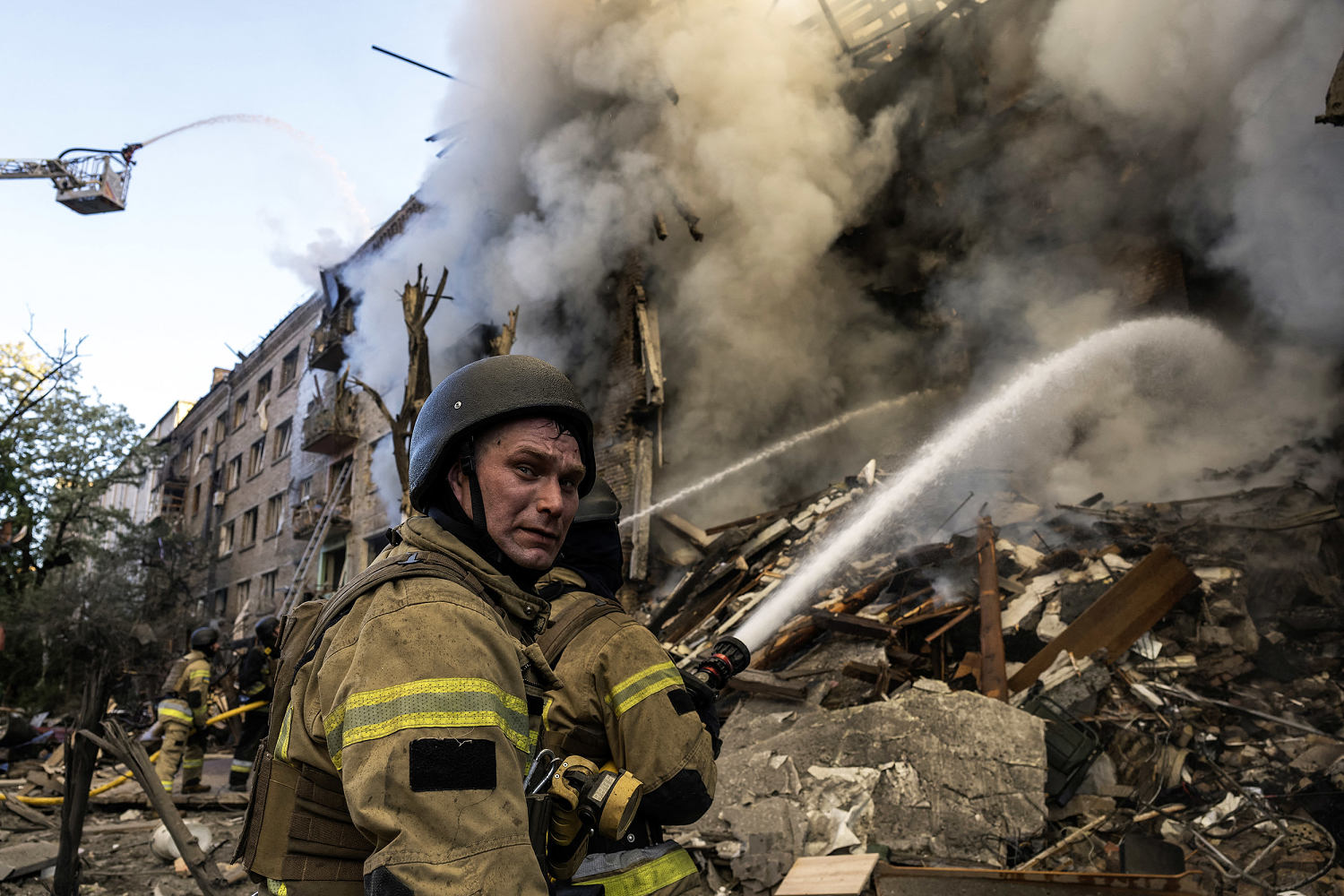
Moscow is escalating its intimidation campaign against Western diplomatic missions and international allies in Kyiv through explicit warnings of systematic air strikes. This strategy aims to forcibly isolate the Ukrainian capital by pressuring foreign governments to evacuate their embassies and pull back their personnel. By threatening the physical safety of international officials, Russia seeks to create a psychological and diplomatic vacuum, severing the direct, on-the-ground lines of communication that have anchored Western support for Ukraine since the conflict began.
The tactical reality of these threats involves an intricate coordination of psychological warfare and calculated military positioning. This is not a sudden shift in doctrine, but rather a deliberate exploitation of Western risk-aversion protocols.
The Calculus of Diplomatic Evacuation
Foreign ministries operate under strict duty-of-care legal obligations. When a nuclear-armed state explicitly declares that specific geographic zones housing diplomatic quarters are targets, it triggers automatic security reviews in Western capitals. Moscow understands this bureaucratic vulnerability. By generating credible, high-intensity threats of systematic strikes, the Kremlin forces Western security chiefs to choose between the political symbolism of staying or the safety of their personnel.
A departure of foreign diplomats yields immediate strategic benefits for Russia.
- Intelligence Deprivation: Embassies serve as critical hubs for real-time information gathering and verification. Removing personnel degrades the West's immediate situational awareness.
- Political Dissuasion: Empty embassies signal a lack of confidence in Ukraine's long-term stability, weakening the collective resolve of the alliance supporting Kyiv.
- Logistical Friction: Direct coordination of aid, financial oversight, and military logistics becomes significantly harder when managed remotely from Poland or Romania.
The immediate reaction from Washington and European capitals has historically been defensive posture adjustments. However, treating these threats purely as a prelude to kinetic strikes misses the broader operational objective. The threat itself is the weapon, designed to achieve encirclement without the necessity of a resource-heavy ground assault on the capital.
Anatomy of the Systematic Strike Threat
The term systematic strikes implies a shift from sporadic, punitive missile barrages to a sustained, methodical targeting of critical infrastructure and decision-making centers. To execute this, the Russian military relies on a specific combination of long-range assets. The primary tools are air-launched cruise missiles fired from strategic bombers operating deep within Russian airspace, sea-launched Kalibr missiles from the Black Sea fleet, and fleets of low-cost loitering munitions designed to overwhelm air defense networks.
+-------------------------------------------------------------+
|               Russian Air Strike Escalation                 |
+-------------------------------------------------------------+
|                                                             |
|  [Strategic Bombers] ----> Cruise Missiles ---\             |
|                                                \            |
|  [Black Sea Fleet]  ----> Kalibr Missiles   ----> [ Kyiv Network ]
|                                                /  (Target)  |
|  [Launch Sites]     ----> Drone Swarms      --/             |
|                                                             |
+-------------------------------------------------------------+
Drone swarms are deployed first. Their primary function is to draw fire and force Ukrainian air defense batteries to deplete their finite stocks of expensive interceptor missiles. Once the defense grid is saturated or temporarily depleted, the faster, more destructive ballistic and cruise missiles are routed through complex flight paths to strike their targets.
This methodology aims to dismantle the foundational infrastructure that keeps Kyiv functioning as a modern metropolis. Power grids, water treatment facilities, and communication nodes are targeted alongside government buildings. The objective is to make the city unlivable for foreign nationals and civilians alike, thereby forcing a de facto evacuation without a single Russian soldier crossing the city limits.
The Air Defense Bottleneck
Kyiv possesses some of the most sophisticated integrated air defense networks in the world, utilizing a layered framework of Western-supplied systems alongside legacy Soviet hardware. This network includes high-altitude interceptors, medium-range capabilities, and short-range point defense systems. This defense architecture is highly effective, often achieving interception rates above eighty percent during coordinated attacks.
The system is not invincible. The critical vulnerability is supply volume, not technological capability. Interceptor missiles are expensive, complex to manufacture, and available in strictly limited quantities. A sustained campaign of systematic strikes tests production capacity rather than tactical ingenuity. If Moscow can launch cheap drones faster than the West can supply high-tech interceptors, the defense grid eventually faces math-based attrition.
+-------------------------------------------------------------+
|                Layered Air Defense Network                  |
+-------------------------------------------------------------+
|                                                             |
|  Layer 1: High-Altitude (Patriot / SAMP/T)                  |
|  --> Targets: Ballistic missiles, high-fast aircraft        |
|                                                             |
|  Layer 2: Medium-Range (NASAMS / IRIS-T)                    |
|  --> Targets: Cruise missiles, subsonic threats             |
|                                                             |
|  Layer 3: Short-Range (Gepard / MANPADS)                    |
|  --> Targets: Drones, low-altitude munitions                |
|                                                             |
+-------------------------------------------------------------+
Should an interception gap open, the risk to diplomatic compounds escalates dramatically. Even successful interceptions pose a severe hazard, as falling debris from neutralized missiles can cause significant structural damage and casualties in dense urban environments. This reality complicates the security calculation for foreign governments weighing whether to maintain a presence in the capital.
Countering the Isolation Strategy
Defeating this intimidation campaign requires a coordinated response that spans military hardware and diplomatic policy. The most direct countermeasure is the immediate fortification of Ukraine’s air defense envelope. This involves not just supplying more batteries, but ensuring a continuous, predictable pipeline of interceptor ammunition and expanded domestic production capabilities within Europe.
Concurrently, Western allies must reframe their diplomatic posture. Treating the threat of strikes as a reason to withdraw validates the Kremlin's strategy, encouraging further escalation. A commitment to maintaining an active diplomatic presence in Kyiv signals that the international community considers Ukraine’s security inseparable from its own.
Some nations have explored shifting operations to western cities like Lviv, or establishing rotational diplomatic shifts to minimize exposure. While these measures offer a middle ground between total evacuation and high-risk presence, they ultimately signal a vulnerability that Moscow remains eager to exploit. The struggle for Kyiv is fought in the psychological arena of international commitment just as much as it is contested in the skies above the city.