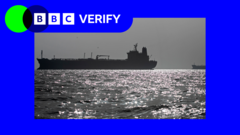
The headlines make it sound like a cinematic high-seas escape. This week, three massive oil tankers packed with five million barrels of Iranian crude glided right past a heavy U.S. naval blockade in the Strait of Hormuz. State media in Tehran immediately claimed a historic victory, shouting that American military muscle had failed to choke off their economy.
But don't buy into the theatrical chest-thumping from either side.
The reality on the water isn't a story of stealthy captains outmaneuvering American warships in the dead of night. It's a calculated, highly coordinated political theater. These ships—the Hero II, the Diona, and the Sonia I—didn't sneak past anyone. The U.S. military let them pass because a diplomatic reset is already written into the script.
What Really Happened in the Strait of Hormuz
To understand why this matters, you have to look at how brutal this blockade actually was before this week. Back in mid-April, after Pakistan-brokered peace talks completely collapsed, the Trump administration took a massive gamble. They deployed a physical naval blockade to stop every single ship leaving Iranian ports.
The U.S. military wasn't playing around. Central Command admits it redirected 142 commercial ships and physically disabled nine vessels that tried to defy the orders. They even used an AGM-114 missile to strike an Iranian-linked tanker named Lexie in the Indian Ocean.
The economic pain hit hard and fast. Look at the numbers from maritime tracking firms Kpler and Vortexa. By May, Iran's crude exports crashed to a six-year low of just 260,000 barrels per day. Compared to their 2025 average of 1.67 million barrels per day, Iran's main financial artery was basically flatlining.
Then everything shifted in a matter of hours.
On Sunday, President Trump posted a blunt message on Truth Social, declaring that a peace deal with the Islamic Republic was complete and telling the "Ships of the World" to start their engines and let the oil flow. Within 48 hours, the Hero II and the Diona—each holding two million barrels of oil—sailed straight through the Gulf of Oman heading toward Asia. The Sonia I followed closely behind, charting a course for Singapore.
This wasn't a failure of American military intelligence. It was a green light from Washington ahead of the formal ceremonial treaty signing in Switzerland.
The Bitcoin Toll and Hidden Market Stress
While the media focuses entirely on the geopolitical drama of warships and supertankers, the real mechanics of this conflict involved bizarre economic desperation.
When the U.S. first squeezed the strait in April, Iran tried a wild counter-strategy. Tehran floating a proposal to charge a $1-per-barrel transit toll for any ship passing through the Strait of Hormuz, demanding that the fee be paid exclusively in Bitcoin.
While energy analysts and crypto nerds debated whether a nation-state could actually run a maritime chokehold via digital currency, the ground reality was much less sophisticated. Iran's domestic oil storage facilities were maxing out. Experts estimated that Iran had filled roughly 60% of its 55-million-barrel storage capacity. If the blockade lasted another two weeks, they would have been forced to physically cap their own oil wells, causing permanent geological damage known as water coning.
Iran didn't negotiate because they wanted to; they negotiated because their entire energy infrastructure was about to break.
Why Global Markets Reacted Instantly
If you want to know who actually wins when these blockades dissolve, follow the money. Global markets don't care about political spin. They care about supply.
The moment maritime data confirmed those three tankers cleared the blockade, benchmark Brent crude futures took a nose dive, slipping below $80 a barrel. Just a few weeks ago, panic over the blockades had pushed oil prices up near a staggering $120 a barrel.
Crude Price Impact (Per Barrel)
Peak Blockade Panic:  $120
Post-Passage Drop:    $80
The drop in price instantly changes the game for major global buyers, especially China. As Iran's biggest customer, Beijing had grown tired of paying massive premiums for oil or relying on complex, illicit "dark fleet" transfers to dodge sanctions. With the U.S. preparing to lift restrictions on transportation, banking, and insurance under the new memorandum of understanding, the flow of discounted Iranian crude back into the market means cheaper energy for Asia, but massive headaches for rival oil producers who enjoyed the brief price spike.
The Complicated Reality Facing Shipping Fleets
Don't expect the global shipping crisis to vanish by tomorrow morning. A political handshake in Switzerland doesn't instantly erase the terror of sailing a $100 million vessel through a recent war zone.
Right now, roughly 118 oil tankers from other Gulf producers remain completely stuck inside the Persian Gulf, refusing to move until they see proof of safe passage. Shipbrokers in Athens and Singapore are telling their clients to hold tight. A piece of paper might reopen a strait legally, but maritime insurance companies still need to rewrite the risk profiles before captaining those routes.
If you are tracking the energy sector, stop looking at the political speeches. Watch the empty tankers. Tracking data shows an empty Iranian supertanker, the Stream, is currently sailing right back toward the Persian Gulf. Another partially full vessel, the Herby, is trailing just behind it.
This active repositioning of empty ships is the real metric to follow. It proves the oil industry knows the blockade is functionally dead, regardless of what military spokespersons say to save face before the weekend. The system reboot is happening in real time on the water.
To watch how these maritime tracking networks actually verify these ship movements using transponders and satellite imagery, take a look at this detailed breakdown of the Strait of Hormuz Tanker Tracking Analysis. It shows exactly how the physical location of the Hero II and Diona confirmed the blockade was lifting before the politicians made it official.