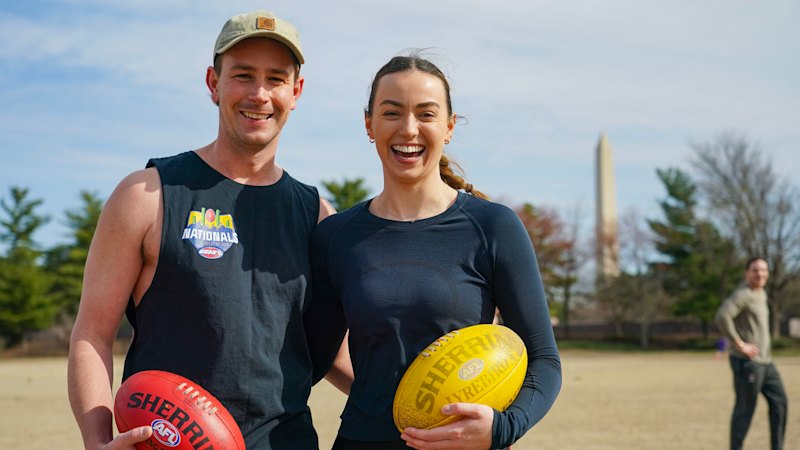
The morning air in Melbourne is a specific kind of sharp. It tastes of eucalyptus and impending rain, a crispness that settles into the bones of the MCG. But six thousand miles away, in a dusty park in the middle of London’s Clapham Common, the air is thick with diesel fumes and the damp smell of an English spring. Despite the distance, the sound is identical. It is a rhythmic, hollow thwack. It’s the sound of a Sherrin meeting a boot.
For the uninitiated, the Sherrin is not just a ball. It is an oval-shaped lung, a stitched leather vessel of national identity. To the rest of the world, Australian Rules Football (AFL) looks like a fever dream of basketball, rugby, and a bar fight. To those who play it, it is a religion that has finally decided to go on a global mission.
The Geography of Obsession
Consider a man named Hiroki. He lives in Tokyo, a city defined by its verticality and its crush of bodies. He doesn't grow up with a cricket bat or a rugby union jersey. One day, he sees a clip of a man jumping onto another man’s shoulders—not to hurt him, but to use him as a human ladder to pluck a ball from the clouds. This is the "specky," the high mark, the ultimate gravity-defying act of the AFL.
Hiroki is hooked. He joins the Tokyo Goannas. He spends his Saturday mornings learning how to kick "drop punts" on a field that is barely long enough to accommodate the sport's massive dimensions. AFL requires an oval between 135 and 185 meters long. In a world of standardized rectangles, it is an outlier. It demands space. It demands air.
But the game is no longer a prisoner of the Southern Hemisphere. It is leaking out of the edges of the Australian continent, carried by expats like a benign virus and caught by locals who are tired of the predictable rhythms of soccer. From the USAFL in the United States to the AFL Europe leagues, the red leather is crossing borders. It is a grassroots revolution built on the back of amateur enthusiasm. There are no billion-dollar TV deals in the parks of Berlin or the ovals of Toronto. There is only the grit of the game.
The Invisible Stakes of the Circle
In soccer, you have a net. In American football, you have a line. In AFL, you have four white posts and a chaotic, swirling vortex of thirty-six players. The complexity is the point. It is a game of 360-degree awareness. You are never safe. You can be tackled from any direction, at any time.
This creates a specific kind of human temperament. To play "footy" is to accept that you will be hit, and you will be hit hard, but you must keep your eyes on the ball. It is a metaphor for the modern world that is almost too on the nose. We are all being tackled from the blind side by rising rents, shifting careers, and global instability. The AFL player simply practices that reality every Saturday.
The stakes aren't just about points. In places like Nauru, where Australian Rules is the national sport, it is a social glue. In the remote communities of the Tiwi Islands, it is a form of artistic expression. When a Tiwi player moves the ball, it isn't just a tactical maneuver; it’s a dance. They play with a speed and a "no-look" intuition that defies the coaching manuals of the professional clubs in the big cities.
Now, imagine that same energy being translated into the suburbs of Los Angeles. The Orange County Giants aren't just playing for a trophy. They are building a community where none existed. They are teaching Americans how to handball—a punch of the ball that looks like a glitch in the matrix to those used to throwing or kicking.
The Architecture of the Punt
The physics of the sport are a nightmare for the uncoordinated. A "drop punt" requires you to hold the ball vertically, drop it with surgical precision, and strike it so it spins backward end-over-end. If you do it right, the ball cuts through the wind like a knife. It is predictable. It is beautiful.
If you do it wrong, the ball "shanks." It wobbles. It dies in the air.
For the international convert, mastering the drop punt is the first rite of passage. It is the moment you stop being a spectator and start being a practitioner. In the United States, there are now over 40 clubs. These aren't just social groups; they are competitive entities. They have their own rivalries, their own legends, and their own scarred knees.
The sport is growing because it offers something the "Big Four" American sports do not: continuous, unscripted flow. There are no commercial breaks every thirty seconds. There is no huddle. There is only the relentless movement of the ball and the desperate, lung-bursting sprint of the midfielders.
A Gendered Revolution
While the men’s game has been creeping across the globe for decades, the real explosion is feminine. The AFLW (the professional women’s league in Australia) has fundamentally changed the DNA of the sport. It has proven that the "toughness" of the game isn't a masculine trait, but a human one.
This has paved the way for women in the UK, Canada, and Scandinavia to pick up the Sherrin. They aren't burdened by a century of "this is how it’s always been done" tradition. They are inventing their own version of the game—cleaner, often more tactical, and fueled by a raw hunger to prove they belong on the oval.
In a small town in Denmark, a woman named Elena lines up for a goal. The wind is whipping off the North Sea. She has no professional contract. She has no sponsors. She has a bruise on her thigh the size of a dinner plate. She takes her steps, drops the ball, and watches it sail through the two tall posts.
She isn't just scoring a goal. She is participating in a global expansion of a culture that values the "hard ball get." In footy parlance, the "hard ball get" is when the ball is on the ground, two people are running at it from opposite directions, and one of them chooses to put their head down and go for it anyway.
It is the ultimate test of character.
The Loneliness of the Long-Distance Fan
Being an AFL fan outside of Australia is a test of devotion. It means waking up at 3:00 AM on a Tuesday in New York to watch a game happening in Perth. It means explaining to your coworkers for the hundredth time that no, it’s not rugby, and yes, the shorts are supposed to be that short.
But there is a secret payoff to this isolation. When you see someone else wearing a Richmond Tigers or a Collingwood Magpies scarf in a foreign airport, there is an instant, unspoken bond. You are both members of a tribe that understands the specific agony of a "behind" that should have been a "goal." You understand the poetry of a "smother."
The game is a language.
The facts tell us that the AFL is investing millions in international development. The statistics show a year-on-year increase in overseas participation. But the numbers don't capture the smell of the liniment in a cramped locker room in Paris. They don't capture the sound of thirty different accents shouting "Ball!" when a player is tackled.
The Red Leather Heartbeat
We live in a world that is increasingly digital, sanitized, and predictable. Sports have become "products" to be consumed, sliced into highlights, and optimized for gambling apps. But Australian Rules Football remains stubbornly, gloriously physical. It is a game of dirt, grass, and human contact. It is a game where you can run ten miles in a single match and still lose by a point because the ball bounced at a weird angle.
That unpredictability is why it is spreading. People are tired of the sanitized. They want the chaos of the oval.
Back on Clapham Common, the sun is beginning to set. The London Swans are packing up their gear. Their shins are bloodied, their lungs are burning, and they have to go back to their office jobs on Monday. But for eighty minutes, they weren't accountants or programmers. They were part of something older and more visceral.
They were part of the heartbeat.
As the last ball is zipped into a kit bag, a young boy walks past with his father. He looks at the strange, pointed ball and asks what it is. His father doesn't call it a sports implement. He doesn't mention the AFL's corporate strategy or the expansion metrics.
He just picks it up, spins it in his hands, and says, "That’s a Sherrin, mate. It’s the best thing you’ll ever kick."
The boy reaches out. His fingers touch the rough, pebbled leather. He feels the stitches. He feels the weight of a century of mud and glory. Somewhere, deep in his chest, the rhythm begins.
Thwack.
Would you like me to generate a training schedule for someone looking to master the basic skills of Australian Rules Football from scratch?