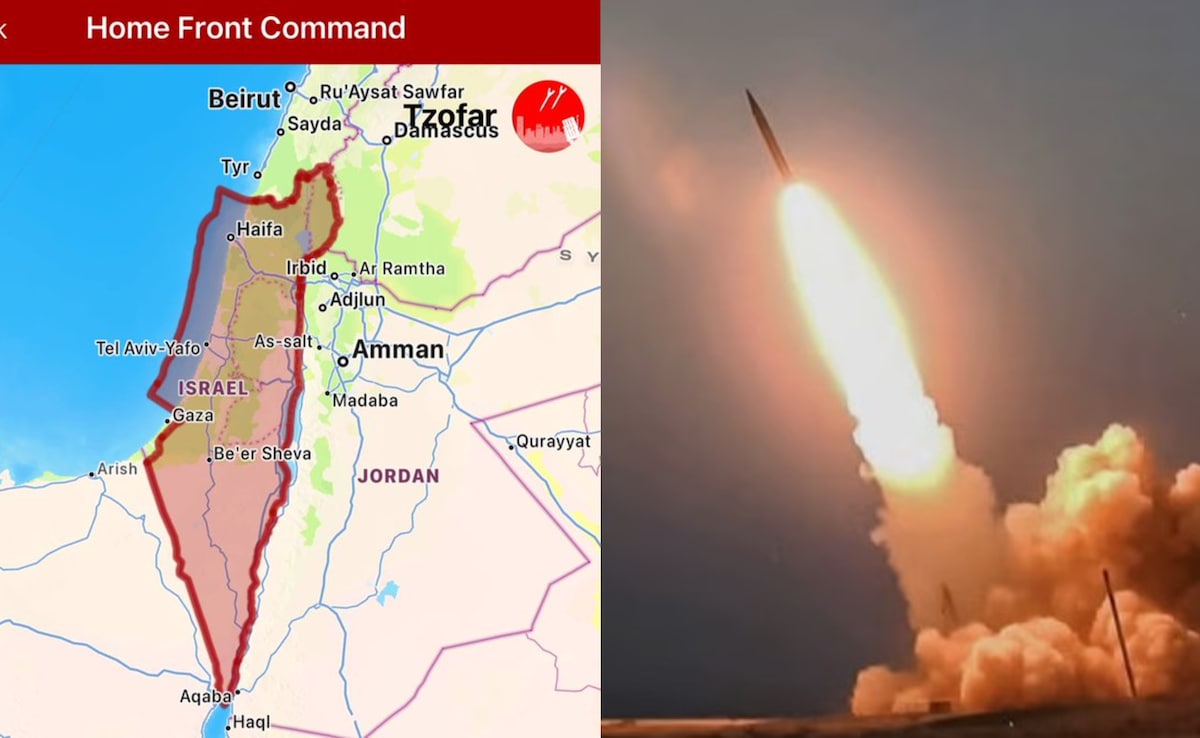
When the screens of millions of smartphones across Israel bleed a synchronized, diagnostic red, the world usually sees a country under siege. The "Red Alert" app, a cornerstone of Israeli civilian life, transforms the abstract threat of ballistic warfare into a tangible, vibrating panic in the palm of the hand. But during the massive Iranian missile barrages of October 2024 and the subsequent escalations of 2025, that red map told a story that was technically accurate yet strategically misleading.
The primary function of these alerts is to save lives by directing citizens to fortified "mamad" rooms within seconds. They succeed. However, the sheer scale of the "Red" state—covering entire regions from the Negev to the Galilee—exposed a deepening asymmetry in the Middle East. Iran has realized that it does not need to destroy a city to paralyze a nation; it only needs to trigger the algorithm that turns the map red.
The Geometry of a National Lockdown
Israel’s early warning system is a marvel of signal processing. It integrates data from the "Green Pine" radar arrays and US-operated SBIRS satellites to calculate trajectories in milliseconds. When a Fattah-1 or Kheibar Shekan missile clears the atmosphere, the Home Front Command doesn't just ring a bell. It carves the country into precise polygons.
If a missile is projected to hit a specific neighborhood in Tel Aviv, only that polygon should theoretically trigger. Yet, in major Iranian attacks, the map often glows red from top to bottom. This isn't always a sign of total saturation. Because ballistic missiles travel at hypersonic speeds—often exceeding Mach 5—the margin of error for debris fall and mid-air interceptions is vast. To ensure a zero-fatality policy, the IDF sets the caution threshold so high that a single mid-air explosion over the center of the country can effectively place three million people in a state of emergency.
This creates a paradox. The more "precise" the warning system becomes, the more it facilitates the economic and psychological shutdown of the state. When the app goes red, schools close, Ben Gurion Airport halts, and the "start-up nation" grinds to a halt. Iran has effectively outsourced its psychological operations to Israel’s own safety infrastructure.
The Arrow and the Invoice
Behind the digital alerts lies a brutal kinetic reality. During the October 2024 strikes, Iran launched nearly 200 missiles. While the IDF and the US-led coalition intercepted the vast majority, the victory was a fiscal nightmare.
Israel’s defense is a layered cake: Iron Dome for short-range rockets, David’s Sling for medium-range threats, and the Arrow-2 and Arrow-3 for the exo-atmospheric ballistic threats posed by Tehran. Each Arrow interceptor carries a price tag estimated between $2 million and $3.5 million.
Compare this to the Iranian cost of production. A liquid-fueled Ghadr or Emad missile is relatively cheap, built using decades-old North Korean and Soviet blueprints. Even the newer solid-fuel variants are produced at a fraction of the cost of an interceptor. In a single night of "winning" the defensive battle, Israel can burn through a billion dollars of ordnance.
The math is unsustainable. In the 2025 exchanges, we saw the first signs of "interception prioritization." Intelligence officials began leaking a grim truth: if the radar determines a missile is headed for an empty field or a non-critical civilian structure, the system may occasionally let it through. The cost of the cure has become more expensive than the disease.
Why the Shield is Fraying
The narrative of the "99% interception rate" is a powerful tool for national morale, but it masks a shift in Iranian tactics. In 2024, the goal was saturation—firing enough missiles to simply overwhelm the "brain" of the defense system. By 2025, the focus shifted to maneuverable re-entry vehicles (MaRVs).
Standard ballistic missiles follow a predictable parabolic arc. They are easy for a computer to track. Newer Iranian systems like the Fattah claim to utilize "hypersonic" capabilities, which in this context means the ability to change direction while re-entering the atmosphere. This turns a predictable physics problem into a guessing game.
Even a "successful" interception of a MaRV produces a massive field of supersonic shrapnel. In Jericho and Tel Aviv, the only fatalities in these massive exchanges often come from this falling debris. The "Red Alert" app remains red because even when the missile is destroyed, the sky is still falling.
The Silence After the Siren
The most dangerous part of the Red Alert phenomenon is not the noise, but the exhaustion. When a population lives by the vibrations of an app, "alert fatigue" becomes a genuine security threat. We saw this in the later stages of the 2025 conflict: people stopped running to shelters. They stayed on their balconies to film the "Iron Shield" in action, seeking social media engagement over physical safety.
This complacency is exactly what a long-term war of attrition seeks to cultivate. The Iranian strategy isn't a "blitzkrieg" to wipe Israel off the map in a day. It is a slow, methodical attempt to make life in the Levant feel impossible, expensive, and unpredictable.
The red map is a technical triumph of the Israeli Defense Forces. It is also a visual representation of a country trapped in a defensive loop. Until the cost of the interceptor matches the cost of the threat, or the "how" of the attack is met with a "why" that Tehran cannot ignore, the app will continue to bleed red.
True security isn't found in a faster alert system. It's found in a reality where the app isn't necessary. For now, that reality remains as elusive as a missile that hasn't been fired yet.
Monitor the regional satellite feeds for new launch site activity in western Iran.