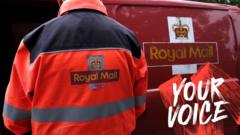
The floor of a sorting office at 5:00 AM is a place of rhythmic, mechanical chaos. It is the sound of plastic crates sliding over concrete, the thwack of rubber bands, and the frantic shuffling of paper. For decades, this was the heartbeat of British communication. But lately, the rhythm has skipped. The air in these depots has grown heavy with a secret that isn't much of a secret anymore.
Imagine a postman named David. He has walked the same six-mile loop for twenty years. He knows which gates stick, which dogs are bluffing, and which elderly residents wait by the window for a letter that might be their only conversation of the day. David’s bag used to be a cross-section of life: birthday cards, tax rebates, wedding invitations, and the occasional legal summons. In related news, take a look at: The Sabotage of the Sultans.
Now, his bag is a graveyard of glossy cardboard.
The parcels have taken over. Amazon boxes, clothing returns, and meal kits pile up like a rising tide. They are profitable. They are tracked. They are the shiny new future of a privatized Royal Mail. But in the corner of the depot, tucked under a staircase or hidden behind a mountain of empty York stone containers, sit the letters. Thousands of them. Some are marked with the red flicker of a first-class stamp. Others carry the NHS logo, containing appointment dates that have already passed. Al Jazeera has also covered this critical topic in extensive detail.
They are being hidden. Not because the postmen are lazy, but because the system is rigged against the very thing it was built to do.
The Magic Trick of Missing Mail
To understand why your birthday card is three weeks late, you have to understand the "clear floor" policy. On paper, Royal Mail is bound by a Universal Service Obligation. This is a fancy legal term that means they are supposed to deliver letters six days a week, regardless of whether you live in a London flat or a cottage in the Scottish Highlands. It is a social contract.
But contracts are expensive. Parcels, which compete with the likes of DPD and Evri, are where the money lives.
Whistleblowers from across the country have begun to describe a bizarre, clandestine ritual. When the regulators at Ofcom look at the spreadsheets, they want to see "targets met." They want to see that the mail has been processed. So, when the volume becomes too high and the staff too few, managers reportedly issue an order that sounds like something out of a heist movie: "Hide the mail."
They aren't throwing it away. That would be a crime. Instead, they are playing a shell game. Mail is moved into unmonitored areas, kept in the back of vans, or shoved into "dead" corners of the warehouse where the tracking sensors don't reach. If the mail isn't "checked in" to the delivery sequence, the clock never starts ticking. If the clock doesn't tick, the target isn't missed.
The floor looks clear. The spreadsheet glows green. The reality, however, is gathering dust in the dark.
The Human Cost of a Spreadsheet
When we talk about "service targets" and "operational efficiency," the words feel cold. They feel like something discussed in a glass-walled boardroom over lukewarm espresso. But for a woman named Sarah—let’s call her a hypothetical representation of the thousands currently waiting—the cost is a missed cancer screening.
Sarah waits for a letter from the hospital. She checks the mat every day at 11:00 AM. She hears the red van pull up, hears the heavy thump of a parcel hitting the porch, and sees the postman hurry back to his seat. No letter. She assumes the NHS is backlogged. She doesn't realize her appointment letter is currently sitting in a grey plastic crate, buried under a stack of "Special Delivery" clothes from a fast-fashion giant.
The postmen feel this weight. Many of them are breaking. They are being told to prioritize the parcels because parcels have barcodes that customers can track on their phones. If a parcel is late, the customer complains instantly. If a letter is late, who noticed? Who can prove exactly when a first-class letter was dropped into a pillar box three towns away?
The letters have become "the invisible mail."
There is a profound moral injury in being told to fail at your job so that the data looks like you’re succeeding. Long-serving postal workers describe a sense of grief. They were once the "fourth emergency service." Now, they feel like delivery drones for a logistics company that views the written word as an inconvenient byproduct of its past.
The Great Privatization Paradox
The rot didn't start yesterday. It is the result of a decade-long tension between public service and private profit. When Royal Mail was privatized, the promise was "efficiency." The logic suggested that the discipline of the market would trim the fat and modernize the service.
What the logic missed was that some things aren't meant to be "efficient" in a monetary sense. Delivering a single letter to a remote farm in Cornwall for the price of a stamp is a terrible business model. It’s a loss-leader. But it is a vital thread in the fabric of a functioning society.
As the company struggled to compete with nimble, parcel-only rivals, it began to cannibalize its own foundations. They cut the "sorting" staff. They increased the length of the "rounds." They introduced scanners that track a postman’s every movement, counting the seconds they spend standing still.
If David stops to help an old lady pick up her groceries, his scanner beeps. If he spends ten minutes trying to find a letter that fell behind a crate, he falls behind his "performance index." The system rewards the man who ignores the letters and flings the parcels.
The Illusion of Progress
We live in an era of "The Dashboard." Every CEO wants a screen that tells them everything is fine. But dashboards are only as honest as the people inputting the data.
When a manager tells a worker to leave the mail in the van so it doesn't count as "delayed" in the system, they are participating in a grand cultural lie. It is a form of gaslighting on a national scale. The public knows the mail is slow. The workers know the mail is slow. But the reports say the mail is on time.
The statistics become a wall. When journalists or regulators ask why delivery standards are slipping, the company points to the dashboard. They blame "high sick leave" or "industrial action." They rarely admit that the very architecture of the workplace has been redesigned to make the delivery of letters nearly impossible.
Consider the physical reality of the sorting office. In many locations, the "letter frames"—those iconic wooden pigeonholes where mail is sorted by hand—are being ripped out to make room for parcel sorting machines. It is a literal displacement. The physical space for your letters is shrinking, forced into the margins, much like the letters themselves.
The Silent Mailboxes
There is a specific kind of silence that happens when a neighborhood stops trusting its post. People stop sending cards. They stop relying on the mail for important documents. They move everything to digital.
For the tech-savvy, this is a minor inconvenience. But for the 2.5 million people in the UK who are not online, or the millions more who struggle with digital literacy, the death of the letter is a form of exile. If you cannot trust the red box on the corner, you lose your connection to the state, the health service, and your family.
The irony is that as Royal Mail tries to save itself by becoming another DPD, it is destroying the one thing that made it irreplaceable: the trust of the doorstep. A parcel is a transaction. A letter is a relationship.
One veteran worker recently described a "clear-out" day. They were finally told to process the "hidden" mail that had been sitting in a side room for nearly a month. He spoke of the shame he felt as he pushed letters through doors, knowing that the "get well soon" cards were being delivered to people who were already back at work, or that the "urgent" bills had already triggered late fees.
He didn't look the residents in the eye that day. He wore his high-vis jacket like a shroud.
The Paper Trail Ends
We are witnessing the slow-motion collapse of a 500-year-old institution. Not because the technology is obsolete—people still need physical documents, medicine, and tokens of affection—but because the people at the top have decided that the "Universal" part of the Universal Service is a liability.
They are managing a decline by hiding the evidence of it.
But you can only hide so much paper. Eventually, the crates overflow. Eventually, the vans are too full to lock. Eventually, the human beings tasked with carrying out the deception realize that their integrity is worth more than a manager's bonus or a clean spreadsheet.
The next time you see a red van speeding past, look at the driver. They aren't just fighting traffic. They are fighting a system that asks them to choose between their stopwatch and their soul. They are carrying the weight of a thousand hidden stories, all tucked away in the dark, waiting for someone to finally admit they are there.
The mail isn't gone. It’s just waiting for a world that cares enough to let it be delivered.
Would you like me to research the current Ofcom regulations regarding the Universal Service Obligation to see what legal recourse exists for these delivery failures?